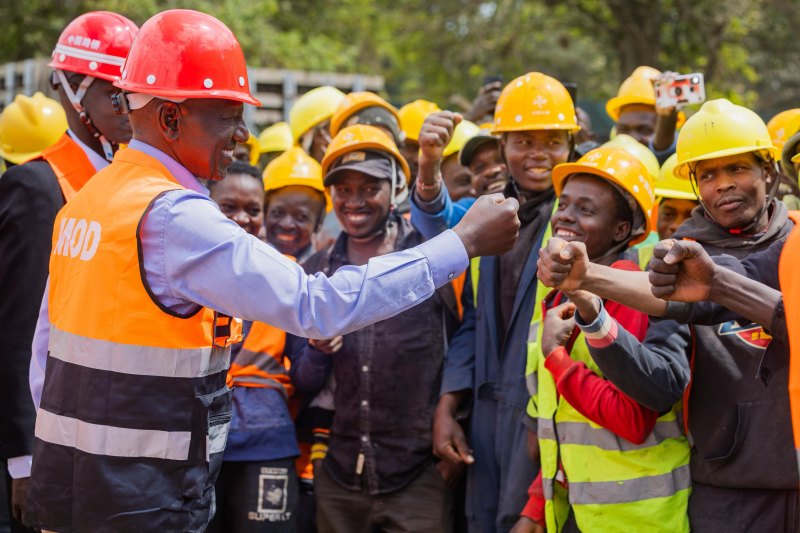
Olekina Ledama/handout
Having large herds of livestock among the Maasai community represents wealth, status and survival.
There has, however, been a raging debate on the need to reduce livestock numbers because of their impact on the planet.
Burping livestock is a major environmental problem.
When cows and other ruminants eat, their food ferments in their gut and produces methane, which contributes to global warming.
According to the United Nations Food and Agriculture Organisation, almost 600 million tonnes of methane are emitted into the atmosphere each year.
Of these, the FAO says about 60 per cent originates from human activities.
Agriculture contributes nearly half of global anthropogenic methane production, followed by fossil fuels and waste.
The livestock sector is one of the largest contributors to methane emissions, mainly produced through the natural digestive process of ruminants known as “enteric fermentation” and through manure management practices.
Methane is a highly potent greenhouse gas that increases global temperatures.
To limit global warming by 2030, countries should reduce methane emissions, particularly from livestock, by 30 per cent.
The FAO has been supporting countries to mitigate methane emissions from livestock as part of their climate action efforts while improving food security and livelihoods.
Discussions have been taking place on the need to introduce measures to reduce emissions, with some quarters proposing a reduction in livestock numbers.
To Olekina Ledama, the Narok Senator, this would expose his community, the Maasai, to abject poverty.
“For me, as a pastoralist, I care more about the implementation of the emissions policy rather than the policy itself. I represent a community that grazes cows,” he said.
The firebrand Senator spoke on Friday during a methane seminar convened under the theme, “African Parliaments for Climate Action: Reducing Methane, Promoting Development”, which officially opened on Friday at Ole Sereni.
The seminar drew Members of Parliament from across Africa, representatives of the Executive and international development partners.
Ledama said any policy aimed at reducing the number of cattle would affect his livelihood.
“And we will say no to that.”
Ledama said their way of life cannot be restricted.
He said he would welcome policies that help pastoralists generate more income.
“So it is imperative that, as we sit here today, we remember that the pastoral community, particularly the Maasai nation, depends on cows. So if anyone comes and tells me that now you are going to reduce your cows from 100 to two, you have to explain to me how I am going to support my family.”
Ledama said there is a need to formulate policies targeting the oil and gas industry, which he said is responsible for emissions.
“When it comes to our way of life, one of the biggest problems we are currently facing as a nation, and I mean as a Maasai nation, is the fact that our environmental laws are already limiting our access to grazing lands and our way of life,” he said.
“This whole business of carbon credits is now restricting our access to forests, where we graze cows during the drought season.”
“I want to encourage us as a nation, as Africa, not to be lured by developed nations, the EU and the United States, which have high levels of methane emissions, into adopting policies that will destroy our way of life.”
Speaking during the opening ceremony, Senate Speaker Amason Kingi said methane emissions have increasingly become a central issue in global climate discussions.
“Methane is a potent greenhouse gas released from sources such as livestock digestion, decomposing waste, manure management, rice cultivation, fossil fuel extraction and wetlands,” he said.
Kingi, in a speech read on his behalf by Mohamed Faki (Mombasa senator), said that although methane remains in the atmosphere for a shorter period than carbon dioxide, it is significantly more powerful in trapping heat.
Scientists estimate that methane is more than 80 times more potent than carbon dioxide over a 20-year period.
This makes methane reduction one of the fastest and most effective strategies for slowing global warming in the near term.
Kingi said methane emissions should be a matter of particular concern because many African economies heavily depend on agriculture and livestock production.
“It is now a governance, economic, health and development concern that demands legislative attention, political goodwill and collective continental action.”
Across the continent, millions of households rely on livestock for food, income, transport, trade and cultural identity.
The FAO estimates that approximately 55 to 65 per cent of methane emissions in Kenya come from livestock through enteric fermentation.
It also estimates that 15 to 25 per cent of methane emissions come from waste, 5 to 10 per cent from manure and less than 5 per cent from rice cultivation.
![[PHOTOS] The new Ngong –Naivasha Road viaduct](https://cdn.radioafrica.digital/image/2026/06/64d4f771-4432-4aee-ba3c-2f304c4436ec.jpg)






![[PHOTOS] 'Mr Speaker Sir' Gen Z protester in court](https://cdn.radioafrica.digital/image/2026/06/b3e62d8e-25c3-4780-90f9-4eb48b1ce8a7.jpg)