The Forest Conservation and Management (Amendment)
Bill, 2025 is proposing sweeping legal changes that could significantly
reshape how public forests, climate financing and infrastructure development
are managed.
The Bill,
which was passed by the
National Assembly and the Senate on Thursday, introduces new regulatory powers, tougher penalties, carbon market
frameworks and expanded authority for infrastructure access within public
forests.
One of the key
amendments will, if assented by
the President, allow the Kenya Forest Service to grant easements for
public roads and other public installations, as well as wayleaves for public
utilities in public forests.
The proposal
creates a formal legal pathway for projects such as highways, electricity
transmission lines, pipelines and telecommunications infrastructure to pass
through public forest land.
The amendment
specifies that the provision would apply only to public forests and not private
forests.
The Bill also
seeks to establish a new Directorate of Forest Regulation headed by a Secretary
of Forest Regulation with wide-ranging oversight powers.
The proposed
regulator would be responsible for licensing timber graders and certification
experts, conducting inspections, enforcing compliance standards, overseeing
forest carbon systems and coordinating forest-related regulation across the
country.
The changes
come as Kenya increasingly positions forests within climate financing and
carbon trading frameworks.
The Bill
introduces legal provisions on forest carbon management, Payment for Ecosystem
Services schemes and carbon-related incentives.
Under the
proposed law, the Kenya Forestry Research Institute would also be formally
established under the forestry legislation. It will enjoy expanded powers in
forest research, biodiversity monitoring, seed systems and climate-related
forestry programmes.
The amendments
further strengthen penalties for forest-related offences.
Illegal import
or export of prohibited forest products would attract fines of up to Sh5
million or imprisonment for up to three years.
Penalties
linked to illegal dumping, invasive species and forest degradation would also
increase substantially under the proposed law.
The Bill
additionally introduces provisions on dryland forestry management, agroforestry
systems, nursery certification, forest data systems and mandatory buffer zones
in public and community forests.
However, some
of the proposed legal changes have triggered sharp opposition from
environmental groups and conservation activists.
The Green Belt
Movement is among organisations that have strongly criticised the amendment
allowing easements and wayleaves inside public forests.
In a
statement, the organisation warned that the changes could create a “dangerous
legal pathway” for the gradual opening up of forests to roads, utilities and
commercial developments through administrative approvals.
“This
amendment is not innocent. It is a dangerous legal pathway being created to
open up our public forests to roads, infrastructure, utilities, commercial
interests and eventual destruction through administrative processes disguised
as development,” the movement said.
The group
argued that Kenya had already witnessed growing pressure on forests through
infrastructure and commercial projects.
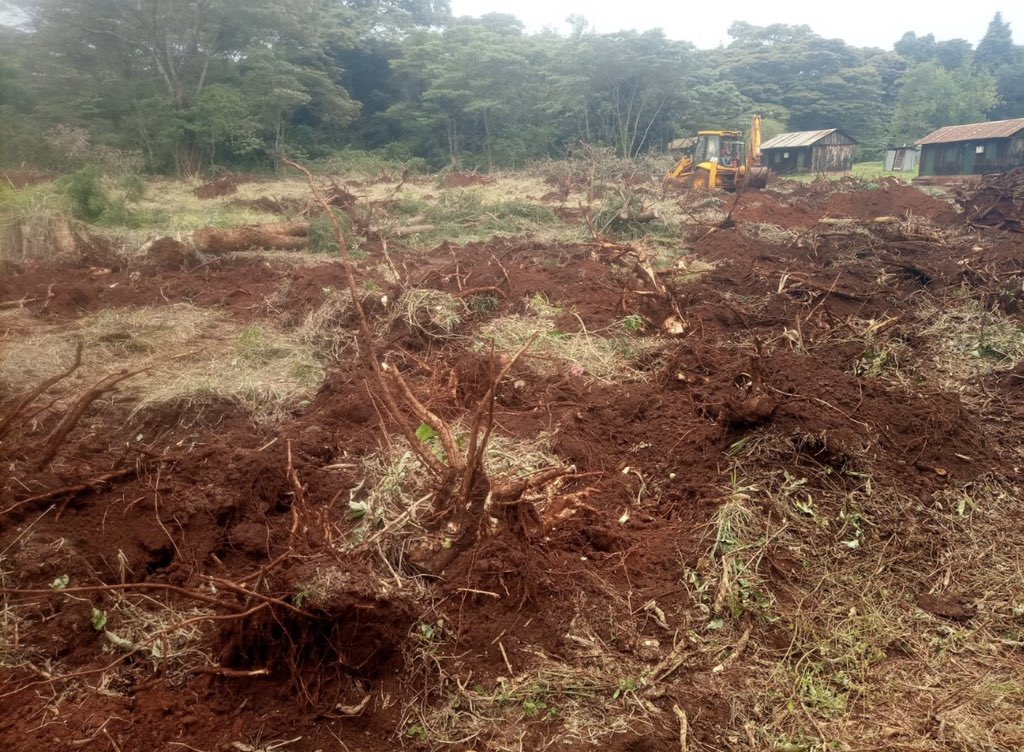
It pointed to
the 2024 controversy surrounding the proposed excision of 51.64 hectares of
Karura Forest for the expansion of Kiambu Road, saying the project was only
halted after court intervention and public opposition.
The movement
also cited concerns over a proposed road through the Aberdare Forest ecosystem
and ongoing developments around Ngong Road Forest.
“This is not a
coincidence; it is a pattern where first comes a road, then utilities, then
‘temporary access’ then commercial developments. Slowly, public forests
disappear piece by piece until nothing remains,” the organisation said.
The group
further warned that the amendment risks weakening constitutional protections on
public forests and increasing exposure to environmental degradation at a time
when Kenya is already facing climate-related pressures including drought,
flooding and water insecurity.





![[PHOTOS] The new Ngong –Naivasha Road viaduct](https://cdn.radioafrica.digital/image/2026/06/64d4f771-4432-4aee-ba3c-2f304c4436ec.jpg)








![[PHOTOS] 'Mr Speaker Sir' Gen Z protester in court](https://cdn.radioafrica.digital/image/2026/06/b3e62d8e-25c3-4780-90f9-4eb48b1ce8a7.jpg)