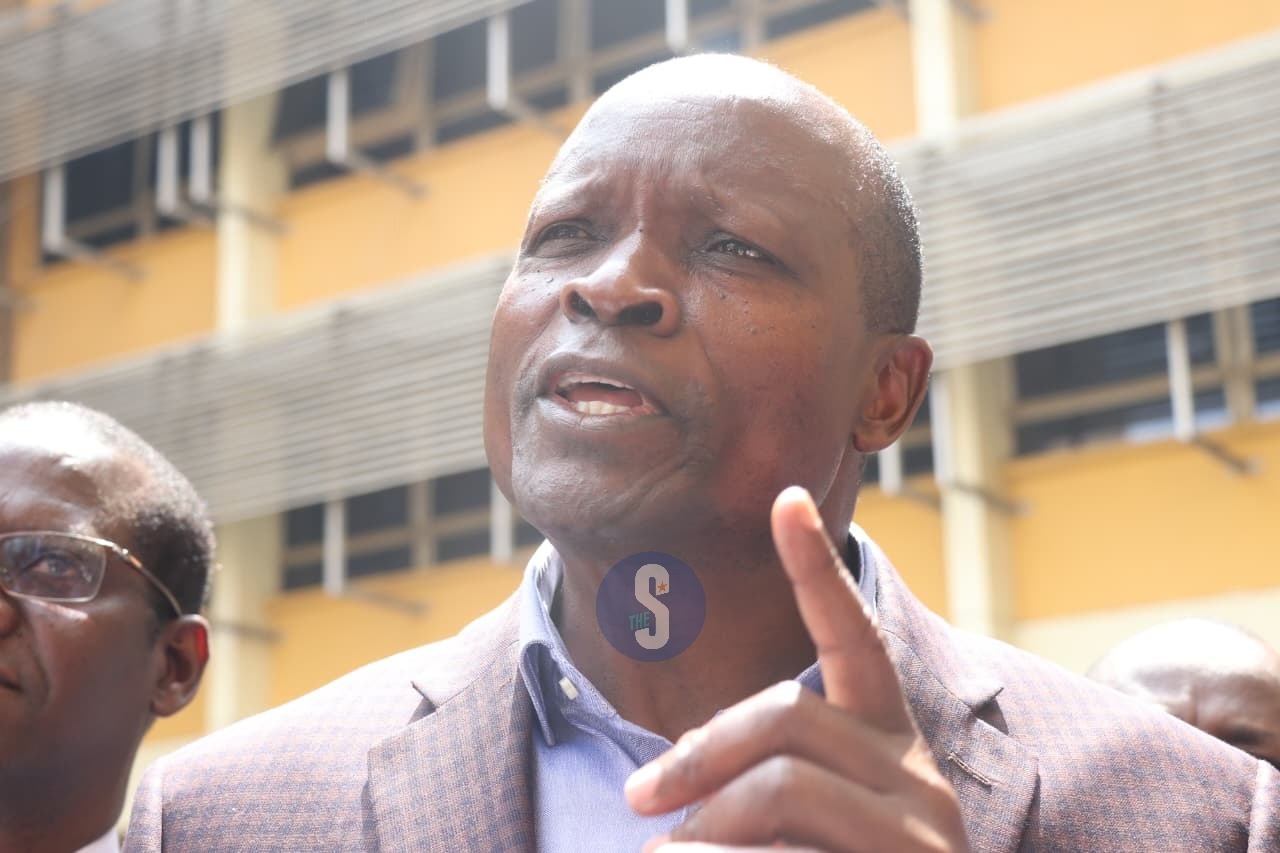
 Former Migori Governor Okoth Obado/LEAH MUKANGAI
Former Migori Governor Okoth Obado has had his Sh73.5 million graft case formally withdrawn after the court adopted a plea agreement as part of its final determination, bringing an end to years of proceedings in the anti-corruption case.
In a detailed ruling on Friday, the court held that the plea agreement met the legal threshold under the Criminal Procedure Code and the Constitution, noting that it had “surmounted the triple test” of public interest, the interests of the administration of justice, and the need to avoid abuse of legal process.
The court further observed that the agreement was grounded in lawful provisions, including Section 137A of the Criminal Procedure Code and Article 159(2)(c) of the Constitution, which encourages alternative dispute resolution mechanisms aimed at expediting justice.
A key point in the ruling was the court’s interpretation of plea bargaining options available under the law, including reduction of charges, withdrawal of charges, or staying of other charges.
In this case, Trial Magistrate Charles Ondieki found that withdrawal of charges was a legally permissible outcome under the agreement reached between the parties.
The Ethics and Anti-Corruption Commission (EACC) had challenged the arrangement, arguing that the plea agreement failed to meet statutory requirements and that proper plea bargaining should necessarily involve admission of criminal liability.
However, the court dismissed this position, stating that the law provides multiple lawful pathways and does not restrict plea agreements to conviction-based outcomes alone.
"This court found that the factual basis of this plea agreement was largely uncontroverted by EACC. What was fervently contested by EACC was the legal basis of the withdrawal," the magistrate held.
The court also noted that concerns raised by the EACC regarding alleged failure to meet legal standards were not sufficiently substantiated.
It found that the objection lacked specific evidence showing abuse of power or procedural irregularities in the negotiation process.
A significant aspect of the judgment was the court’s consideration of earlier civil proceedings involving the forfeiture of assets linked to the same facts.
The court observed that in separate High Court asset recovery cases, properties valued at approximately Sh235 million, along with two motor vehicles, had already been forfeited to the State.
It held that the civil settlement had a consequential effect on the criminal proceedings, noting that both cases arose from the same factual background.
The court reasoned that where civil forfeiture achieves the objective of depriving proceeds of corruption, similar goals may be considered in criminal plea negotiations.
The judgment further emphasised that public interest is inherently reflected in constitutional and legal processes.
Ultimately, the court concluded that the plea agreement was supported by a sound legal basis and satisfied the requirements of justice.
It ruled that there was no evidence of abuse of prosecutorial power and that the decision-making process complied with constitutional standards.
“The agreement has surmounted the triple condition test of public interest, administration of justice, and avoidance of abuse of the legal process,” Magistrate Okore stated.
Consequently, the court adopted the plea agreement as its judgment, leading to the withdrawal of all charges against Obado and his co-accused under the Criminal Procedure Code.

![[PHOTOS] The new Ngong –Naivasha Road viaduct](https://cdn.radioafrica.digital/image/2026/06/64d4f771-4432-4aee-ba3c-2f304c4436ec.jpg)





![[PHOTOS] 'Mr Speaker Sir' Gen Z protester in court](https://cdn.radioafrica.digital/image/2026/06/b3e62d8e-25c3-4780-90f9-4eb48b1ce8a7.jpg)