A recent wastewater analysis report released by the National Authority for the Campaign Against Alcohol and Drug Abuse (Nacada) has exposed the widespread use of cutting agents and adulterants in illicit drug supplies.
The findings highlight a significant trend in the marketplace where primary substances are frequently mixed with various pharmacological agents, potentially to increase volume or alter the drug’s effects.
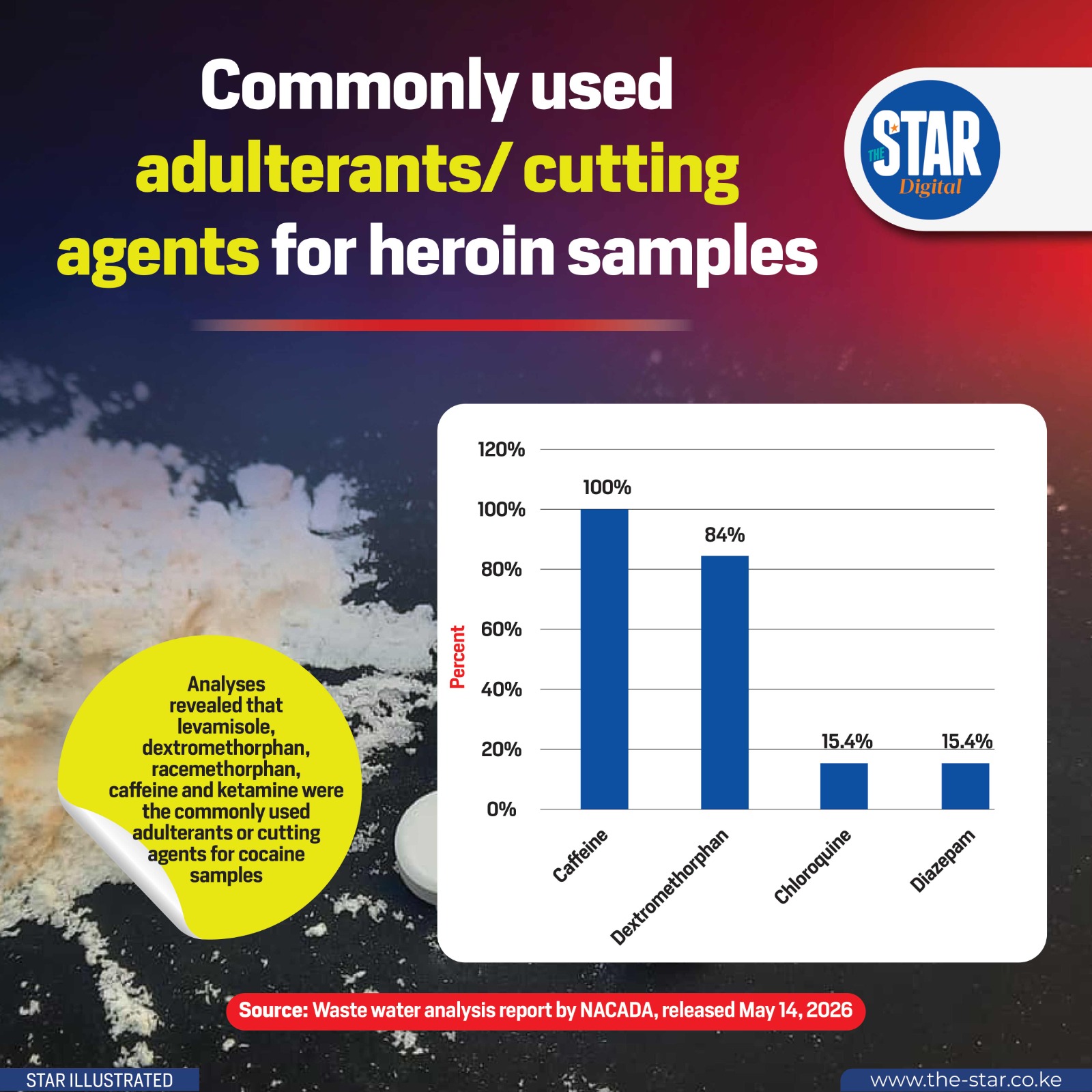
According to the data released on May 14, caffeine remains the most dominant adulterant found in heroin samples, appearing in 100 per cent of the tested instances.
This is closely followed by dextromethorphan, which was identified in 84 per cent of the heroin analyzed. Other substances appearing with less frequency but still present in the heroin supply include the anti-malarial drug chloroquine and the sedative diazepam, both of which were detected in 15.4 per cent of the samples.
The analysis further extended to cocaine samples, revealing a distinct chemical profile of contaminants.
Investigators identified levamisole, dextromethorphan, racemethorphan, caffeine and ketamine as the primary cutting agents used in cocaine.
These additives range from stimulants to dissociative anesthetics, indicating a complex landscape of drug purity.
These results underscore a public health environment where users are rarely consuming a single pure substance.
The prevalence of these specific adulterants provides critical insights for healthcare providers and policy makers regarding the composition of illicit substances currently circulating in the region.
The inclusion of pharmaceutical agents like diazepam and ketamine in these samples points toward a high level of chemical manipulation within the supply chain.



![[PHOTOS] The new Ngong –Naivasha Road viaduct](https://cdn.radioafrica.digital/image/2026/06/64d4f771-4432-4aee-ba3c-2f304c4436ec.jpg)











![[PHOTOS] 'Mr Speaker Sir' Gen Z protester in court](https://cdn.radioafrica.digital/image/2026/06/b3e62d8e-25c3-4780-90f9-4eb48b1ce8a7.jpg)