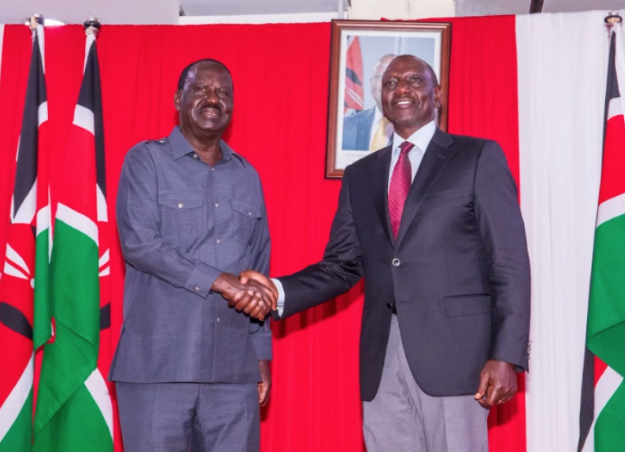
 Former Prime Minister Raila Odinga and President William Ruto shake hands after signing cooperation agreement at KICC on March 7 last year /FILE
Support for the broad-based government formed through cooperation between President William Ruto and the late former Prime Minister Raila Odinga has declined over the last six months, according to the latest survey findings by TIFA Research.
The survey shows that while support for the arrangement remains higher than it was a year ago, enthusiasm for the broad-based government has significantly cooled since November 2025.
According to the findings, support for the broad-based government stood at 44 per cent in November 2025 but has now dropped to 30 per cent in May 2026, representing a 14-point decline within six months.
The pollster said the decline effectively returns support levels close to where they stood in August 2025, when 29 per cent of respondents backed the arrangement.
At the same time, opposition to the broad-based government has increased. The survey found that 56 per cent of respondents now oppose the political cooperation between Ruto and Raila, up from 48 per cent recorded in November 2025.
The findings suggest that majority of Kenyans remain
unconvinced by the alliance despite the initial optimism that followed its
formation.
The proportion of respondents expressing no opinion also rose from eight per cent in November 2025 to 13 per cent in May 2026, an indication that uncertainty or political disengagement may be growing among sections of the public.
TIFA noted that support for the broad-based government had steadily risen over the course of 2025 before beginning to decline this year.
In May 2025, support stood at 22 per cent before increasing to 29 per cent in August and peaking at 44 per cent in November.
During the same period, opposition to the arrangement had dropped from 54 per cent in May 2025 to 48 per cent in November, suggesting that the cooperation between the Kenya Kwanza administration and opposition leaders had initially gained public acceptance.
However, the latest survey indicates that the momentum has reversed.
Political analysts say the decline in support could reflect growing public frustration over the high cost of living, unmet economic expectations and concerns about the effectiveness of the political arrangement in addressing pressing national issues.
The survey fieldwork was conducted between May 2 and May 11, 2026. The study used a nationally representative sample drawn from nine zones across the country, namely Central Rift, Coast, Lower Eastern, Mt Kenya, Nairobi, Northern, Nyanza, South Rift and Western regions.
Data collection was carried out through face-to-face household interviews. The interviews were conducted mainly in Swahili, with English also used where appropriate to ensure respondents clearly understood the questions.
A total of 2,013 respondents participated in the survey. The
study had a margin of error of plus or minus 2.18 per cent, although larger
margins of error applied to smaller sub-samples.



![[PHOTOS] The new Ngong –Naivasha Road viaduct](https://cdn.radioafrica.digital/image/2026/06/64d4f771-4432-4aee-ba3c-2f304c4436ec.jpg)








![[PHOTOS] 'Mr Speaker Sir' Gen Z protester in court](https://cdn.radioafrica.digital/image/2026/06/b3e62d8e-25c3-4780-90f9-4eb48b1ce8a7.jpg)