Tough questions have emerged over IEBC’s frequent overhaul of
multi-billion election technology that would see the poll budget hit a
historical Sh70 billion.
The electoral commission is pleading with MPs to allocate it
with Sh74.8 billion to run the 2027 General Election, a new budget jump of over
Sh10 billion.
With the National Treasury having allocated only Sh41.3 billion
so far, the polls agency faces a funding shortfall of Sh33.4 billion.
At the core of the budget crisis is a familiar and expensive
problem: election technology.
The IEBC wants Sh10.7 billion for new Kenya Integrated Election
Management System (KIEMS) kits, the handheld devices used for voter
identification and results transmission.
So far, Treasury has allocated only Sh1.5 billion for the
equipment, leaving a gap of Sh9.2 billion, excluding software maintenance
costs.
But for MPs, the real question is not just about money.
It is why the commission keeps buying expensive election
technology every cycle, only to declare it obsolete a few years later.
The current KIEMS infrastructure was first procured for the 2017
election at Sh6.2 billion.
Ahead of the 2022 election, the IEBC spent another Sh4.2 billion
on election technology, including 14,100 new kits supplied by election
technology firm Smartmatic.
At the time, the commission said about 41,000 older kits were
still functional.
Now, barely three years later, the IEBC says up to 45,352 kits
require replacement.
After acquisition of the system, IEBC also spent millions in
software upgrades.
The commission argues that many of the kits have failing
batteries, expired manufacturer support and outdated software, making them
unreliable for a high-stakes national election.
However, the ICT ministry is yet to complete an audit to
determine how many of the devices can still be used.
Despite the pending audit, the IEBC has urged MPs to approve
additional funding for a full replacement.
“From our perspective, the audit could say some kits are usable
on face value, but we cannot take the risk,” IEBC commissioner Francis Aduol
told the Justice and Legal Affairs Committee on Tuesday.
“Any single failure can cause problems,” he said, noting that
the number of polling stations is expected to increase in 2027.
Aduol disclosed that about 14,000 kits procured in 2022
experienced integration challenges with the older system, further complicating
the commission’s technology plans.
“We are not sure we are going to use Smartmatic. We are going to
open this for tender, and we foresee a challenge of integrating the new and old
systems,” he said.
“If we find we cannot use them with the new vendor, we can use
them for voter registration. The challenge is how we integrate the two. Hence,
we want a full new set.”
But MPs were not convinced.
In 2012, IEBC acquired BVR kits, used in voter registration at a
cost of Sh9.6 billion.
By 2017, the BVR technology was abandoned.
Aden Daud accused the commission of presenting a “moving target”
after the projected election budget jumped from Sh61 billion to Sh74.8 billion
within weeks.
He also questioned the projected cost of the KIEMS kits.
Daud noted that initial estimates had placed the cost at about
Sh140,000 per kit, but the revised budget reflected approximately Sh240,000 per
unit.
The sharp increase, he suggested, raised concerns about possible
inflation of costs.
Rarieda MP Otiende Amollo demanded evidence to support the IEBC’s claim
that the devices were obsolete.
“How do we conclude they are obsolete before we see the report?”
Amollo asked.
The IEBC had promised Parliament an independent audit of the
existing KIEMS kits to determine which devices could still function and which
were beyond repair.
MPs said the report had not been submitted, clouding the
commission’s justification for seeking billions to replace the entire
inventory.
Lawmakers warned that approving the request without proper
scrutiny would make Kenya’s elections even more expensive than they already
are.
Across Africa, election management bodies are grappling with
rising operational costs, but Nairobi’s per-voter expenditure remains among the
highest on the continent.
In 2017, Kenya spent an estimated Sh3,341 per voter. By 2022,
the figure dropped to approximately Sh1,922 per voter, though it remained
significantly higher than in several African democracies.
Nigeria’s 2023 elections cost an estimated Sh867 per voter,
while South Africa’s 2024 elections cost about Sh916 per voter despite
operating a complex three-ballot system.
Rwanda, which has invested heavily in biometric election
systems, has managed to keep its election technology costs comparatively low.
Treasury Cabinet Secretary John Mbadi recently lamented the
rising cost of elections in Kenya, warning that the IEBC must embrace
cost-cutting measures and avoid replacing reusable equipment every cycle.
“There are items like ballot boxes and surveillance equipment
that are reusable. You don’t have to buy everything afresh every five years,”
Mbadi said.
Since 2017, Kenya has spent more than Sh10 billion on election
technology, yet the IEBC continues to return to Parliament seeking billions for
new devices every election cycle.
Beyond technology, the commission’s funding gaps span nearly
every area of election operations.
The IEBC said temporary poll officials require Sh12.3 billion,
but only Sh7 billion has been allocated, leaving a shortfall of Sh5.1 billion.
Voter registration and biometric verification require Sh7.6
billion, against an allocation of Sh4.9 billion.
Ballot papers and voter registers require Sh6.8 billion, but
only Sh4.1 billion has been set aside.
Transport and field mobility require Sh3.5 billion, against an
allocation of Sh2 billion.
Litigation costs require Sh2.3 billion, but only Sh801 million
has been allocated.
The commission also wants to expand diaspora voter registration
centres from 18 to 55.
MPs further raised concerns that billions of shillings spent on
election technology have at times failed to deliver credible outcomes.
During the 2017 election, KIEMS kits reportedly failed in some
opposition strongholds, fuelling allegations of sabotage.
In 2022, the commission again experienced integration challenges
between older KIEMS kits and newer Smartmatic devices.
Then there is the question of accountability for lost and
damaged equipment.
A 2024 report by Auditor General Nancy Gathungu revealed that
3,433 KIEMS kits were faulty.
About 200 kits were never returned after the 2017 and 2022
elections, while two kits were reported lost.
Thirty kits were burnt during unrest in Wajir county.
In Karachuonyo constituency, 31 BVR laptops and 45 chargers went missing. In
Kisii county, 26 kits could not be accounted for.
The audit further revealed that 79 kits had no hard disks, while
another 215 devices were completely empty.
“There was inadequate accounting of the store records and no
reconciliation had been done,” Gathungu stated in the report.
Critics argue that the frequent technology overhauls have
created a lucrative cycle for foreign suppliers while draining public funds.
Elections Observation Group national coordinator Mule Musau said
transparency remains the biggest concern.
“My issue is always with the cost and transparency of the
process,” Musau said.
“We can get good, long-lasting and scalable equipment when there
is openness. Where opacity is the order of the day, there will always be
interests.”
For its part, the IEBC insists that using ageing technology in
Kenya’s highly contested elections would be too risky.
Justice and Legal Affairs Committee chairman Gitonga Murugara said Parliament would subject the commission’s budget request to
rigorous scrutiny.
“We can’t take public money and just approve without checks,”
Murugara said.
The committee has directed the IEBC to provide an expert assessment
on whether the existing KIEMS kits can still be used ahead of the 2027 polls.
INSTANT ANALYSIS
The IEBC’s latest budget request exposes a deeper structural problem in Kenya’s electoral management: costly technology procurement without a sustainable long-term strategy. Every election cycle, billions are spent replacing systems that were previously presented as secure and reliable, yet little public accountability exists on maintenance, depreciation, reuse or failed integration. The commission’s caution about system failure is understandable given Kenya’s tense elections, but Parliament is right to demand an independent audit before approving another massive expenditure. The risk is that election technology has become a perpetual procurement cycle benefiting vendors more than voters, while pushing Kenya’s already expensive elections to unsustainable levels.

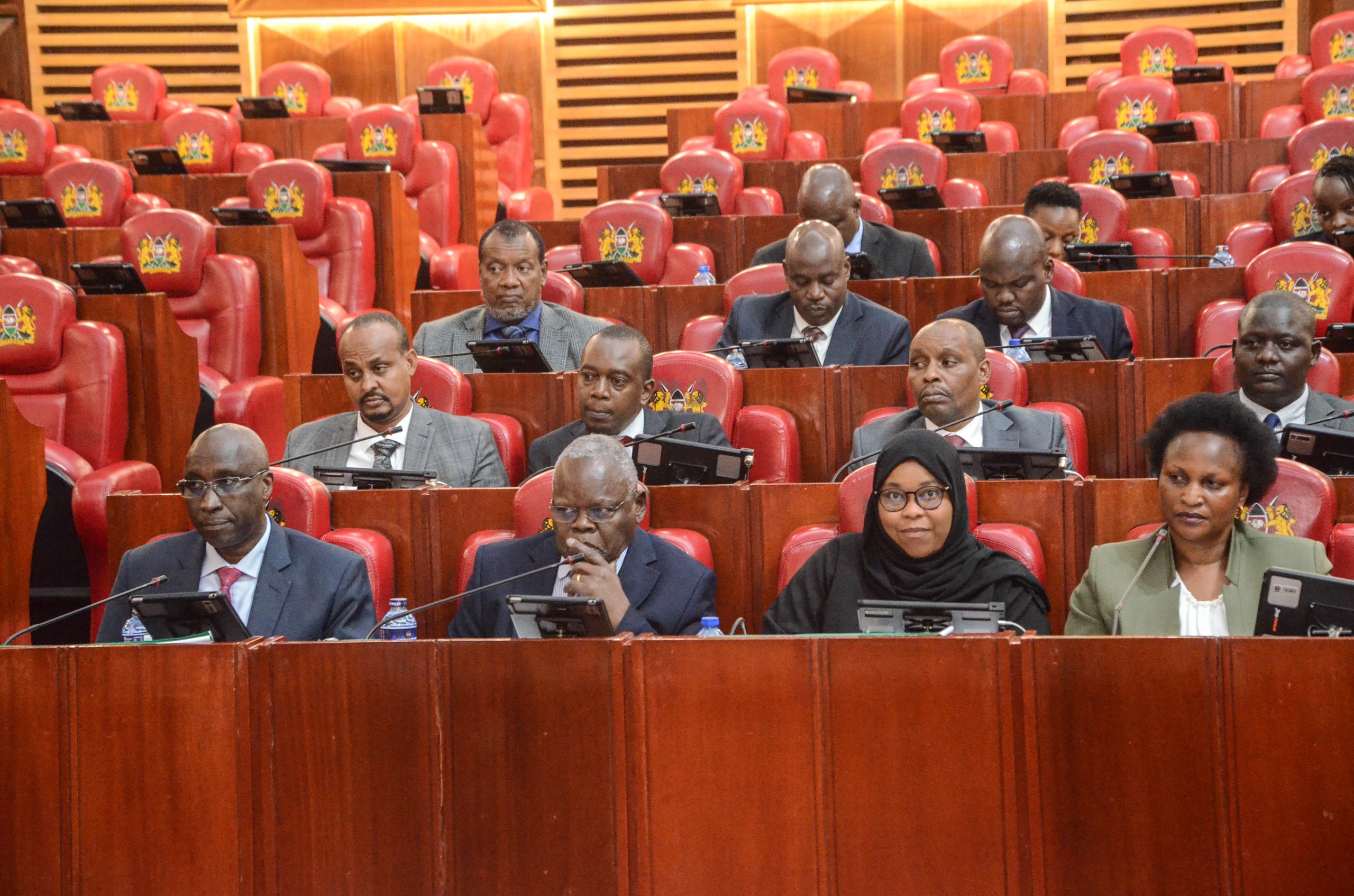 IEBC official Obadiah Keitany, Commissioners Francis Aduol, Fahima Abdallah and Ann Njeri Nderitu, when they appeared before the National Assembly Committee on Justice and Legal Affairs at Bunge Towers on May 12, 2026./HANDOUT



![[PHOTOS] The new Ngong –Naivasha Road viaduct](https://cdn.radioafrica.digital/image/2026/06/64d4f771-4432-4aee-ba3c-2f304c4436ec.jpg)







![[PHOTOS] 'Mr Speaker Sir' Gen Z protester in court](https://cdn.radioafrica.digital/image/2026/06/b3e62d8e-25c3-4780-90f9-4eb48b1ce8a7.jpg)