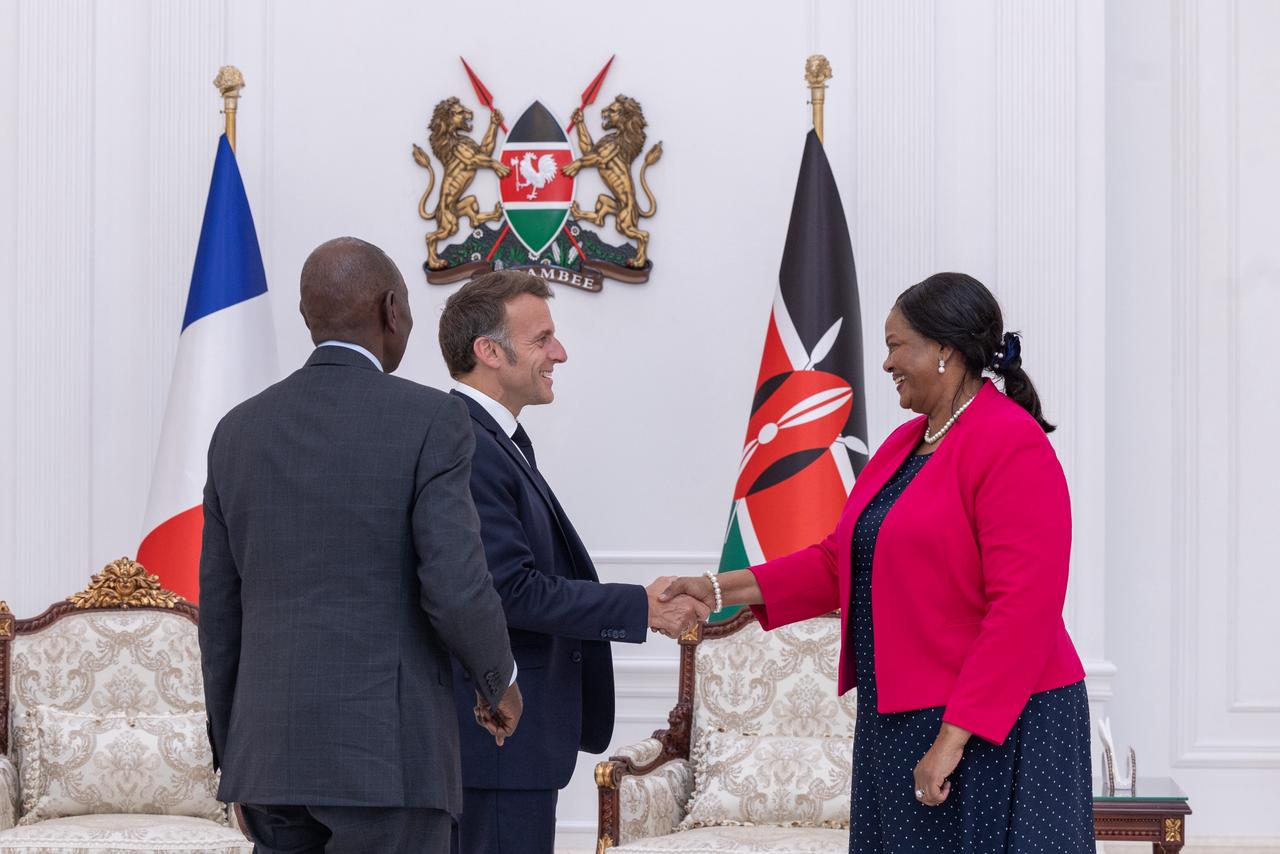
 President William Ruto introduces Supreme Court Judge Njoki Ndugu to his French counterpart Emmanuel Macron./PCS
President William Ruto intensified his campaign for Justice Njoki Ndungu in her quest for election as a judge of the International Criminal Court.
The President introduced and campaigned for Justice Njoki to several heads of State on the sidelines of the Africa Forward Summit.
They included leaders from France, Sierra Leone, Mauritius, Madagascar, Eswatini, Egypt, Chad, Comoros, Botswana, Congo-Brazzaville, Côte d’Ivoire and Liberia, as well as the Chairperson of the African Union Commission and officials from the IFC.
According to officials familiar with the engagements, Kenya’s message to world leaders has been consistent: Justice Njoki is not only qualified for the role but is also among the continent’s most accomplished legal minds.
Justice Njoki was among the founding judges of Kenya’s Supreme Court following the promulgation of the 2010 Constitution and served for more than a decade at the apex court, helping shape constitutional and criminal jurisprudence in the country.
She is also widely recognised as the architect of Kenya’s Sexual Offences Act, legislation credited with strengthening legal protections for survivors of gender-based violence.
Beyond Kenya, she played a key role in the development of the African Union’s Maputo Protocol, a landmark treaty on women’s rights adopted across Africa.
Her supporters argue that her judicial record and advocacy for vulnerable groups make her well suited for the ICC, which handles some of the world’s gravest crimes, including genocide, crimes against humanity and war crimes.
France and Sierra Leone are among the 125 state parties to the Rome Statute that currently have judges serving at the ICC, making Nairobi’s outreach to their leaders strategically significant.
For Kenya, the campaign represents both a diplomatic and symbolic push to place one of its most prominent jurists on the global judicial stage.
Her nomination is one of the most transparent, structured and merit-based international judicial nomination processes undertaken by the Republic.
Kenya has previously contributed distinguished judicial service to the ICC through Lady Justice Joyce Aluoch, who was elected as an ICC judge on January 20, 2009, and served from March 11, 2009, to March 10, 2018.
Her service remains a proud marker of Kenya’s contribution to international criminal justice and to the development of global jurisprudence.
The current nomination process was informed by prior experience.
In 2022, Lady Justice Wanjiru Karanja, a judge of the Court of Appeal, had been nominated as Kenya’s candidate.
However, following the commencement of the campaign, the Ministry of Foreign Affairs advised, through a letter dated September 20, 2023, that Kenya withdraw the candidature in light of strategic considerations that could adversely affect its chances of success.
That decision was taken in good faith to preserve Kenya’s diplomatic goodwill and enhance its competitiveness in a future election cycle.
Following that withdrawal, the Government of Kenya, in consultation with the Judiciary and the Executive Office of the President, resolved to defer Kenya’s candidature to the 2026 election cycle.
This was not a retreat, but a strategic recalibration. It allowed sufficient time for reflection, diplomatic alignment and preparation of a stronger, more coordinated national candidature.
For the 2026 election cycle, the process was formally initiated by the Attorney General, Dorcas Oduor, through a letter dated January 26, 2026, following notification from the Secretariat of the Assembly of States Parties.
The Judiciary then instituted a transparent, competitive and merit-based process, inviting expressions of interest from eligible judges of the superior courts.
Applications received were subjected to rigorous evaluation and transmitted to the Judicial Service Commission for consideration, in accordance with Article 36(4)(a) of the Rome Statute and Kenya’s constitutional and statutory framework governing judicial appointments.
Upon conclusion of this process, three candidates were recommended and forwarded for further consideration. Thereafter, through a letter dated February 25, 2026, the Chief of Staff and Head of the Public Service, Felix Koskei, informed the Chief Justice and President of the Supreme Court, Martha Koome, that President William Ruto had nominated Lady Justice Njoki Ndungu as Kenya’s candidate for election as a judge of the ICC.
The nomination was therefore the culmination of a structured national process, conducted in compliance with Article 36 of the Rome Statute and the requirements of the Advisory Committee on Nominations of Judges.
This degree of transparency is significant. Among Kenya’s international judicial nominations, the ICC process stands out as the clearest and most accountable.
The criteria, the initiating correspondence, the institutional consultations, the invitation for expressions of interest, the evaluation process, the role of the JSC, and the final communication of nomination are all traceable.
By comparison, other international judicial nomination processes, including Kenya’s procedure for nomination to the International Court of Justice, have not been presented to the Kenyan public with the same level of procedural detail.
“Media commentary should therefore distinguish between legitimate public scrutiny and inaccurate suggestions that the ICC nomination was opaque or informal,” an official said.
“The record demonstrates the opposite. Kenya’s ICC candidature was prepared through a transparent, consultative, merit-based and legally grounded process, reflecting the seriousness with which Kenya approaches international judicial service.”
The nomination of Lady Justice Njoki Ndungu should therefore be understood not merely as an individual candidature but as a national candidature, the official added.
It represents Kenya’s commitment to international criminal justice, the rule of law, gender-responsive justice, victim-centred jurisprudence and Africa’s continued contribution to the shaping of international legal norms.


![[PHOTOS] The new Ngong –Naivasha Road viaduct](https://cdn.radioafrica.digital/image/2026/06/64d4f771-4432-4aee-ba3c-2f304c4436ec.jpg)



![[PHOTOS] 'Mr Speaker Sir' Gen Z protester in court](https://cdn.radioafrica.digital/image/2026/06/b3e62d8e-25c3-4780-90f9-4eb48b1ce8a7.jpg)