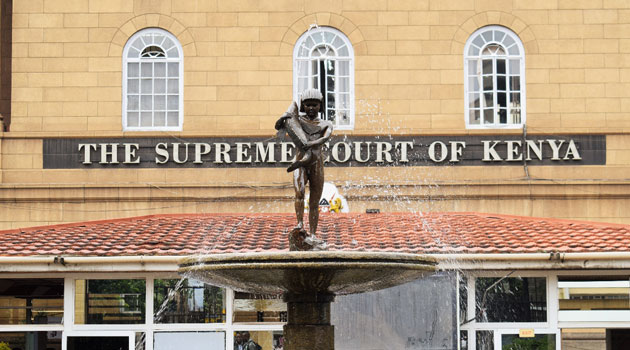
 Supreme Court/FILE
The Law Society of Kenya (LSK) has moved to the Supreme Court, challenging what it argues are key surveillance provisions of the Computer Misuse and Cybercrimes Act, 2018.
In the petition filed, LSK, alongside the Bloggers Association of Kenya (BAKE), Article 19 East Africa, and the Kenya Union of Journalists, is asking the apex court to declare Sections 27, 28, 37, and 48 through 53 of the Act unconstitutional.
"In the alternative to the declarations concerning sections 48, 50, 51,52 and 53, the court does, under article 23 of the constitution, read in sufficient judicial safeguards into those sections to bring them under review," their documents state.
At the heart of the challenge are Sections 48 to 53, which regulate interception of communications, access to subscriber data, and surveillance warrants.
The petition argues that the provisions allow the State to intercept emails, voice calls, and digital communications for periods of up to nine months.
This includes provisions that, in their view, compel service providers to hand over user data and permit the search of persons present during the execution of data-related warrants.
According to the petitioners, these powers are not sufficiently constrained by clear procedural safeguards.
They further argue that the absence of mandatory notification to affected individuals after surveillance has ended creates a system where individuals may never know that their communications were intercepted or their data collected.
“In the context of real-time surveillance, vast quantities of information are collected, allowing indiscriminate scrutiny of private communications, including those unrelated to investigations,” the petitioners argue.
They add that secrecy provisions insulating surveillance orders from disclosure prevent meaningful judicial accountability.
They contend that while Sections 52(6) and 53(6) require service providers to maintain confidentiality over surveillance orders, the law fails to require post-surveillance notification.
This, they argue, leaves affected persons permanently unaware of potential violations of their constitutional rights, effectively blocking avenues for redress.
The petition further faults the adequacy of judicial oversight under the Act, arguing that courts cannot effectively supervise compliance where the statutory framework lacks clear standards for proportionality, necessity, and reporting obligations.
This, they say, renders the limitation of the right to privacy disproportionate under Article 24 of the Constitution.
The case comes months after a partial victory for digital rights advocates.
In March 2026, the Court of Appeal struck down Sections 22 and 23 of the same Act, which had criminalised the publication of false or misleading information online.
The court described those provisions as overly broad and constitutionally impermissible, likening them to “unguided missiles” capable of ensnaring innocent users.
However, while that ruling was hailed as a win for journalists, bloggers, and online users, the Court of Appeal upheld other sections, which are now being contested.

![[PHOTOS] The new Ngong –Naivasha Road viaduct](https://cdn.radioafrica.digital/image/2026/06/64d4f771-4432-4aee-ba3c-2f304c4436ec.jpg)











![[PHOTOS] 'Mr Speaker Sir' Gen Z protester in court](https://cdn.radioafrica.digital/image/2026/06/b3e62d8e-25c3-4780-90f9-4eb48b1ce8a7.jpg)