Inside Gen Z’s shifting view of marriage: Between fear, freedom and commitment
Young Kenyans express mixed views on marriage, with some embracing it while others question its relevance
by PRECIOUS AGESA
Audio By Vocalize
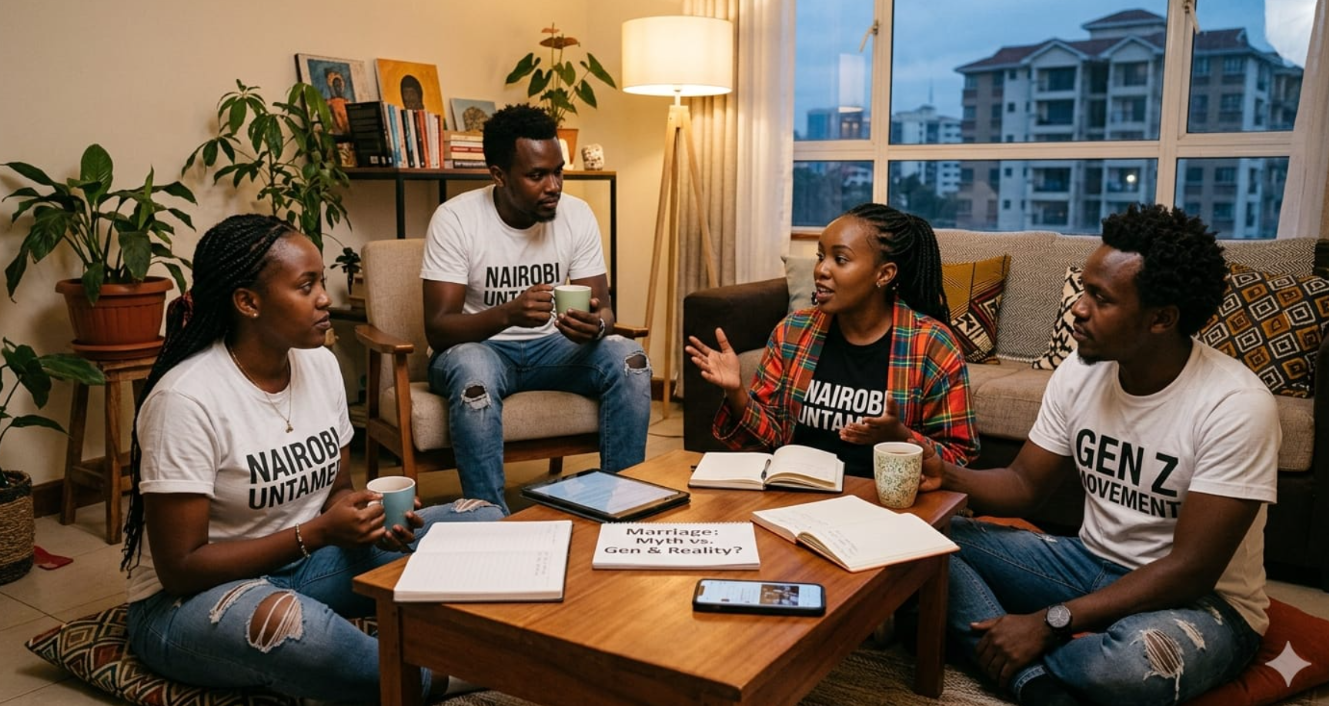
For many Kenyan Gen Zs, conversations about marriage are now shaped by fear, freedom and changing expectations. / AI-generated image via Gemini
It starts as a conversation about love, but quickly turns into something heavier—trust, fear and the meaning of forever. For some young people, marriage is no longer a milestone to rush into. It is a question mark, a maybe, or in some cases, a firm no.
“I can’t call it a relationship, it’s more like a partnership,” says Emmanuel Kegode, a young man who believes modern relationships have shifted from commitment to convenience.
His scepticism runs deep. “I don’t think successful relationships exist. In the past, you could find people staying together because loyalty was the key. Now things are totally different,” he adds.
For him, marriage is not something he sees in the near future.
“Maybe in my late 40s… just for companionship, not real marriage.”
Another young man, Gabriel, echoes a similar caution, though less absolute. He is in a relationship but hesitant about marriage.
“I fear marriage because of lack of loyalty,” he says.
Still, he believes in respect and trust as the foundation of any relationship.
“I am happy without marriage,” he admits, though he leaves a small window open for the future—children and community respect.
The 2026 Economic Survey reveals that in 2025, married people slightly increased to 974,154, making up 85.1 per cent of the population in that category.
The number of single individuals also rose to 168,158, accounting for 14.7 per cent. Divorce figures remained very low at 881 people, still representing 0.1 per cent.
While some voices lean toward hesitation, others reflect confidence in the idea of marriage, even if cautiously.
Marriage counsellor Presbyter Ndiragu sees these shifting attitudes not as random, but as part of a generational evolution.
“Comparing Gen Z to previous generations, I’ve observed they are not quick to commit,” he explains.
“Many just want to keep relationships open. There’s a notion of enjoying life without much commitment.”
He contrasts this with earlier generations, where marriage was more direct and decisive.
“In the older days, people were quicker to commit. Now, people are becoming less committed yet still want relationships.”
For him, the shift is tied to changing values around freedom, exposure and emotional independence.
Not all Gen Z voices are hesitant. For Doris Gakki, marriage is still meaningful and desirable.
“I have thought about marriage countless times,” she says.
To her, a successful relationship is built on “commitment from both parties and respect.” Despite her optimism, she is not blind to concerns.
“Yes, I fear domestic violence and cheating,” she admits.
But she also sees the emotional value of marriage. “It brings emotional support from a partner.” Her perspective, the counsellor notes, reflects something important: awareness without rejection.
“Young people today still want companionship,” Ndiragu explains. “The need for emotional connection has not changed. What has changed is trust and readiness for commitment.”
For others, however, fear becomes conviction.
Juliet is direct and unambiguous.
She is not married, not in a relationship, and does not see herself getting married.
“Never,” she says when asked about the future of marriage in her life.
Her idea of a successful relationship is fairness—50/50—, but even that is not enough to shift her view.
“I don’t see myself getting married. Never.”
This growing detachment, the counsellor suggests, is influenced by modern perceptions. “There’s a belief that life should always feel good,” he says.
“So if happiness reduces, people walk away. Earlier generations worked through challenges. Today, many move on.”
He adds that social media and films amplify this mindset. “People are driven by emotional love, but emotional love alone does not sustain marriage.”
Not everyone is overwhelmed by doubt. Philip Oboi offers a more grounded perspective. “I see marriage as part of my future life plans,” he says.
For him, success in relationships lies in “trust, communication, and consistency.” He acknowledges challenges but does not see them as deterrents.
“Marriage brings companionship, emotional support, and stability. You just have to be ready mentally and financially.”
His view, the counsellor says, represents the middle ground Gen Z is capable of reaching.
“There are still young people who understand that marriage requires preparation,” Ndiragu notes. “And that is encouraging.”
Despite the differing opinions, Ndiragu insists the issue is not that Gen Z rejects marriage entirely—it is that they misunderstand it.
“Many enter relationships thinking love is enough,” he says.
“But love is emotional. Marriage is structural. It requires knowledge, preparation, and commitment.”
He also believes early education is key.
“Young people should be taught what marriage truly means before they get there. Many mistakes come from lack of information.”
And while he acknowledges the rise of fear and hesitation, he remains hopeful.
“The needs for companionship, family, and continuity still exist. Marriage is still relevant. The understanding of it just needs to evolve.”
Between fear and hope, commitment and caution, Gen Z stands at a crossroads redefining what forever means in a world that rarely feels permanent.
And perhaps, as the counsellor suggests, the question is not whether they will marry, but whether they are being given the right understanding of what marriage truly is.
This is premium content
Subscribe to Continue Reading
Help us continue bringing you unbiased news, in-depth investigations, and diverse perspectives. Your subscription keeps our mission alive and empowers us to provide high-quality, trustworthy journalism. Join us today to make a difference!




![[PHOTOS] The new Ngong –Naivasha Road viaduct](https://cdn.radioafrica.digital/image/2026/06/64d4f771-4432-4aee-ba3c-2f304c4436ec.jpg)









![[PHOTOS] 'Mr Speaker Sir' Gen Z protester in court](https://cdn.radioafrica.digital/image/2026/06/b3e62d8e-25c3-4780-90f9-4eb48b1ce8a7.jpg)