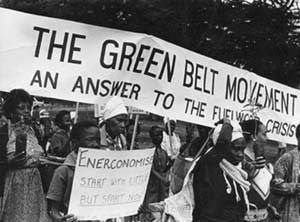
The Green Belt Movement has strongly opposed proposed amendments to the Forest Conservation and Management Act, 2016, warning that the changes could open Kenya’s public forests to unchecked infrastructure projects, commercial encroachment, and eventual destruction.
In a statement released amid growing environmental concerns, the movement claimed the government was attempting to create what it termed a “dangerous legal pathway” that would allow roads, utilities, and public installations to be introduced inside protected forests under the guise of development.
The proposed amendment to Section 56(2) of the Forest Conservation and Management Act seeks to give the Kenya Forest Service (KFS) authority to grant easements for public roads, utilities, and other installations within public forests.
But the Green Belt Movement said the language being used to justify the changes should not deceive Kenyans.
“Kenyans must not be deceived by the language of ‘public utility’ and ‘public installations.’ This amendment is not innocent,” the organisation said in the statement.
“It is a dangerous legal pathway being created to open up our public forests to roads, infrastructure, utilities, commercial interests and eventual destruction through administrative processes disguised as development.”
The movement argued that forests are not idle public land available for allocation but critical ecosystems that sustain the country’s water security, biodiversity, climate resilience, and livelihoods.
“Our forests are not empty land waiting to be allocated. They are our water towers, our climate shield, our biodiversity, our heritage and the lifeline of future generations,” the statement said.
The organisation pointed to recent battles over forest land as evidence of what it described as a growing pattern of gradual encroachment through administrative approvals and infrastructure projects
Among the cases cited was the controversial attempt in 2024 to excise 51.64 hectares of Karura Forest for the expansion of Kiambu Road.
The proposal triggered public outrage, court action, and sustained opposition from environmental groups before the courts halted the planned allocation.
“It took public outrage, legal action and the intervention of the courts to stop the destruction,” the Green Belt Movement said.
The organisation further claimed that Karura Forest continues to face pressure from attempts to introduce security installations and barracks within the protected area.
The statement also highlighted ongoing opposition to a proposed 25-kilometre road through the Aberdare Forest ecosystem, which environmentalists argue threatens one of Kenya’s most critical water catchment areas.
“The Aberdare Forest is not just a forest. It is the source of rivers, livelihoods, agriculture and water security for millions of Kenyans. Yet infrastructure interests continue to threaten its survival,” the movement said.
The group also raised alarm over what it described as increasing commercial encroachment at Ngong Road Forest, citing the construction of a luxury hotel and plans to allocate 10 hectares of forest land for a road linking the Bomas of Kenya to Talanta Stadium.
According to the movement, such developments follow a predictable pattern that gradually erodes protected forests.
“This is not a coincidence; it is a pattern where first comes a road, then utilities, then ‘temporary access’ then commercial developments. Slowly, public forests disappear piece by piece until nothing remains,” the statement said.
The organisation warned that the proposed amendment risks weakening constitutional protections governing public forests and could create room for abuse, corruption, and environmentally harmful projects.
“The Constitution of Kenya is clear. Public forests are public land held in trust for the people of Kenya. They cannot become corridors for unchecked infrastructure expansion under vague claims of public interest,” the statement added.
It has now called on Kenyans, civil society organisations, faith groups, students, professionals, and environmental activists to mobilise against the proposed legal changes.
“This is not just about trees,” the statement said.
“If we remain silent today, tomorrow there may be no Karura, no Aberdares, no Ngong Road Forest and no public forests left to defend.”

![[PHOTOS] The new Ngong –Naivasha Road viaduct](https://cdn.radioafrica.digital/image/2026/06/64d4f771-4432-4aee-ba3c-2f304c4436ec.jpg)









![[PHOTOS] 'Mr Speaker Sir' Gen Z protester in court](https://cdn.radioafrica.digital/image/2026/06/b3e62d8e-25c3-4780-90f9-4eb48b1ce8a7.jpg)