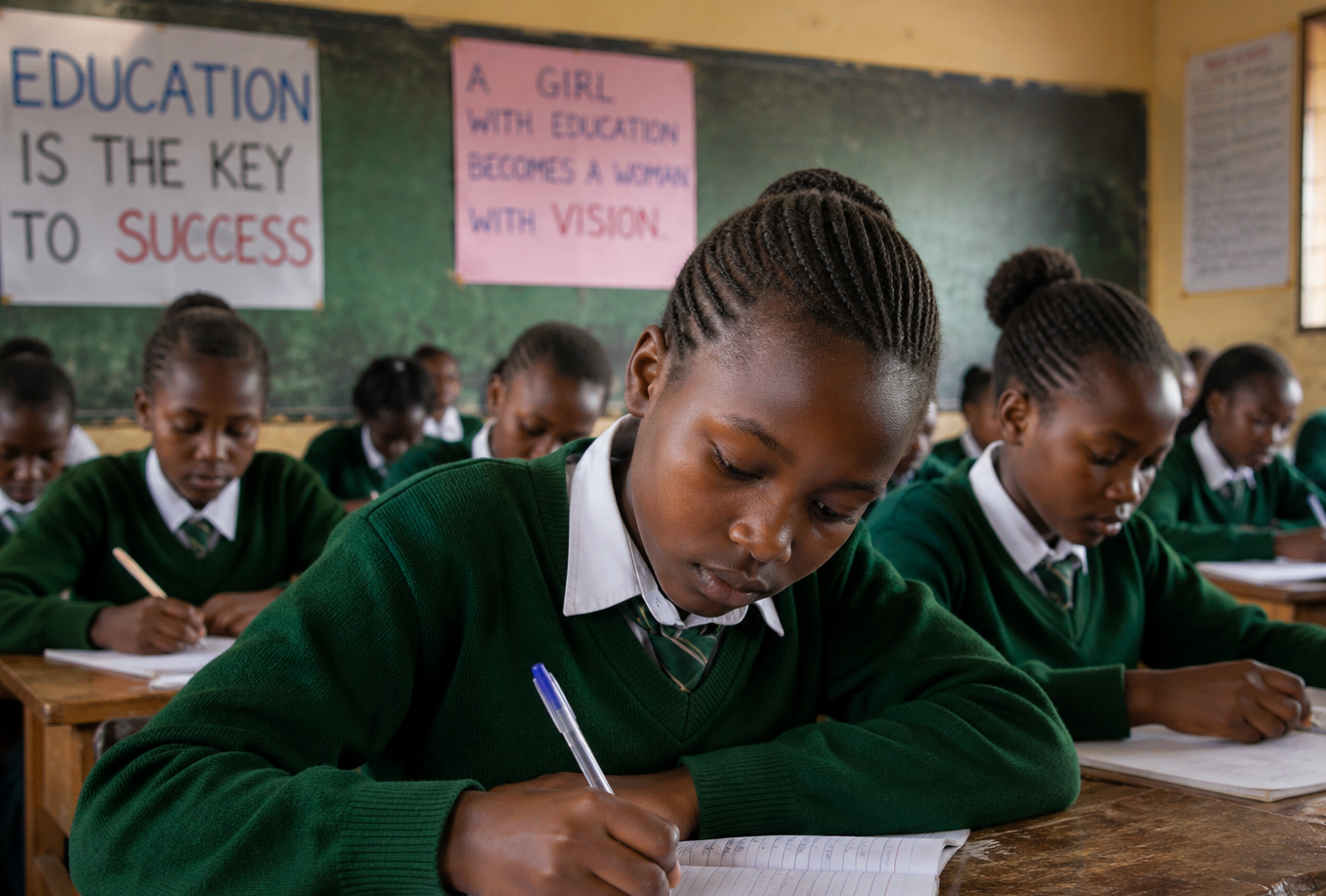
Girls in Kenya continue to face disproportionate disadvantages caused by systemic inequalities in the education sector despite outperforming boys in foundational literacy and numeracy and recording higher enrolment in primary schools, a new survey has found.
The second gender equality report by Usawa Agenda reveals deep gender disparities in school infrastructure, leadership representation, access to learning resources and participation in science and technology pathways.
The survey, conducted in June and July 2025 across all 47 counties, collected data from households, primary schools, junior schools and cluster one to four senior schools.
Researchers interviewed 41,156 households and assessed 49,835 children aged between 10 and 15 years, including both in-school and out-of-school children, as well as learners in Grades 3 to 9 aged up to 17 years.
The study also assessed 1,527 public and private primary and comprehensive schools, assessing facilities, staffing, leadership and enrolment levels.
The schools had a combined learner population of over one million, comprising 530,704 learners in primary schools, 340,691 in junior schools and 146,515 in Early Childhood Development Education (ECDE).
Additionally, the report analysed gender-disaggregated data from a stratified random sample of 1,194 senior schools, including boys’, girls’ and mixed schools, with principals serving as the primary respondents.
The survey found that although more boys than girls are out of school nationally, teenage pregnancy remains one of the biggest barriers to girls’ education, with half of girls who become pregnant failing to return to school after childbirth.
Children with disabilities were also found to face severe exclusion from education. The report shows that 36 out of every 100 children with mental disabilities are out of school, while boys with disabilities are marginally more likely to be excluded than girls.
However, girls with specific conditions faced significantly higher exclusion rates. The survey found that 46 out of 100 girls with mental disabilities were out of school compared to 31 out of 100 boys.
Among children with autism, 45 out of 100 girls were out of school compared to 30 out of 100 boys, against an overall average of 34 out of 100 children with autism being out of school.
The study further established major disparities in learning resources between boys’ and girls’ senior schools.
Although girls’ senior schools account for 14 per cent of senior schools compared to 9 per cent for boys’ schools, the report found that boys’ schools are generally older and better established.
Seven out of 10 boys’ schools have existed for more than 30 years compared to only three out of 10 girls’ schools.
The report says the historical advantage has enabled boys’ schools to build stronger infrastructure, including classrooms, laboratories and sanitation facilities.
“Boy schools have benefitted from decades of established legacy, while girl schools are still catching up,” the report states.
Researchers found that boys’ senior schools are 13 per cent more likely to offer computer lessons than girls’ schools, giving boys stronger pathways into digital and STEM-related careers.
Boys’ schools were also found to offer a wider range of examinable subjects across most school categories, translating into broader academic and career opportunities for learners.
Nearly two-thirds of boys’ senior schools, representing 62.1 per cent, offer at least 12 examinable subjects compared to 58.5 per cent of girls’ schools and 19 per cent of mixed schools.
“Schools offering more subjects provide learners with a wider range of academic and career pathways, highlighting disparities in opportunities across school type and gender categories,” the report says.
Significant disparities were also recorded in ownership of science laboratories. Chemistry laboratories were available in 61.8 per cent of boys’ schools compared to 48.2 per cent of girls’ schools and 21.8 per cent of mixed schools.
Biology laboratories were present in 53.4 per cent of boys’ schools, 40.4 per cent of girls’ schools and 14.6 per cent of mixed schools, while physics laboratories were available in 58.7 per cent of boys’ schools compared to 40.4 per cent of girls’ schools and 15.4 per cent of mixed schools.
Girls’ schools performed better only in ownership of multipurpose laboratories, with 76 per cent having the facilities compared to 60.4 per cent of boys’ schools.
Overall, the report found that boys’ schools are 13.6 per cent more likely to own chemistry laboratories, 13 per cent more likely to own biology laboratories and 18.3 per cent more likely to own physics laboratories than girls’ schools.
The survey further showed that boys’ schools outperform girls’ schools in access to most essential learning facilities and services, including textbooks, dining halls, playgrounds, dormitory space, libraries and computer lessons.
ICT resources were also skewed in favour of boys’ schools. LCD projectors were present in 85.3 per cent of boys’ schools compared to 76.1 per cent of girls’ schools.
Although girls’ schools recorded a slightly higher proportion of teacher digital devices at 48.1 per cent compared to 41.5 per cent in boys’ schools, more boys’ schools had operational computer laboratories at 66 per cent compared to 58.6 per cent for girls’ schools.
The report also found that girls increasingly lose access to female role models as they progress through the education system because leadership and teaching positions become more male-dominated at higher levels.
In primary schools, women account for 58 per cent of teachers, but men occupy 67 per cent of principal positions while 86 per cent of Boards of Management are male-dominated.
At junior school level, female teachers account for 51 per cent of staff, while male dominance among principals remains unchanged and 82 per cent of Boards of Management remain male-dominated.
The gender gap widens further at senior school level where women account for only 43 per cent of teachers, while men occupy 69 per cent of principal positions and chair 87 per cent of Boards of Management.
Science and mathematics teaching was also found to be heavily male-dominated across boys’, girls’ and mixed senior schools.
The report notes that boys’ schools generally have higher average numbers of science teachers than girls’ and mixed schools, giving boys stronger support systems in STEM pathways.
“Women are under-represented in the leadership of senior schools, except for girl schools where women are 84 per cent of the school heads. Even for girl schools, only 31 in 100 of their Board of Management chairpersons are women,” the report states.
The findings suggest that girls remain disadvantaged by structural inequalities in school leadership, learning resources and STEM support despite gains in enrolment and learning outcomes.




![[PHOTOS] The new Ngong –Naivasha Road viaduct](https://cdn.radioafrica.digital/image/2026/06/64d4f771-4432-4aee-ba3c-2f304c4436ec.jpg)











![[PHOTOS] 'Mr Speaker Sir' Gen Z protester in court](https://cdn.radioafrica.digital/image/2026/06/b3e62d8e-25c3-4780-90f9-4eb48b1ce8a7.jpg)