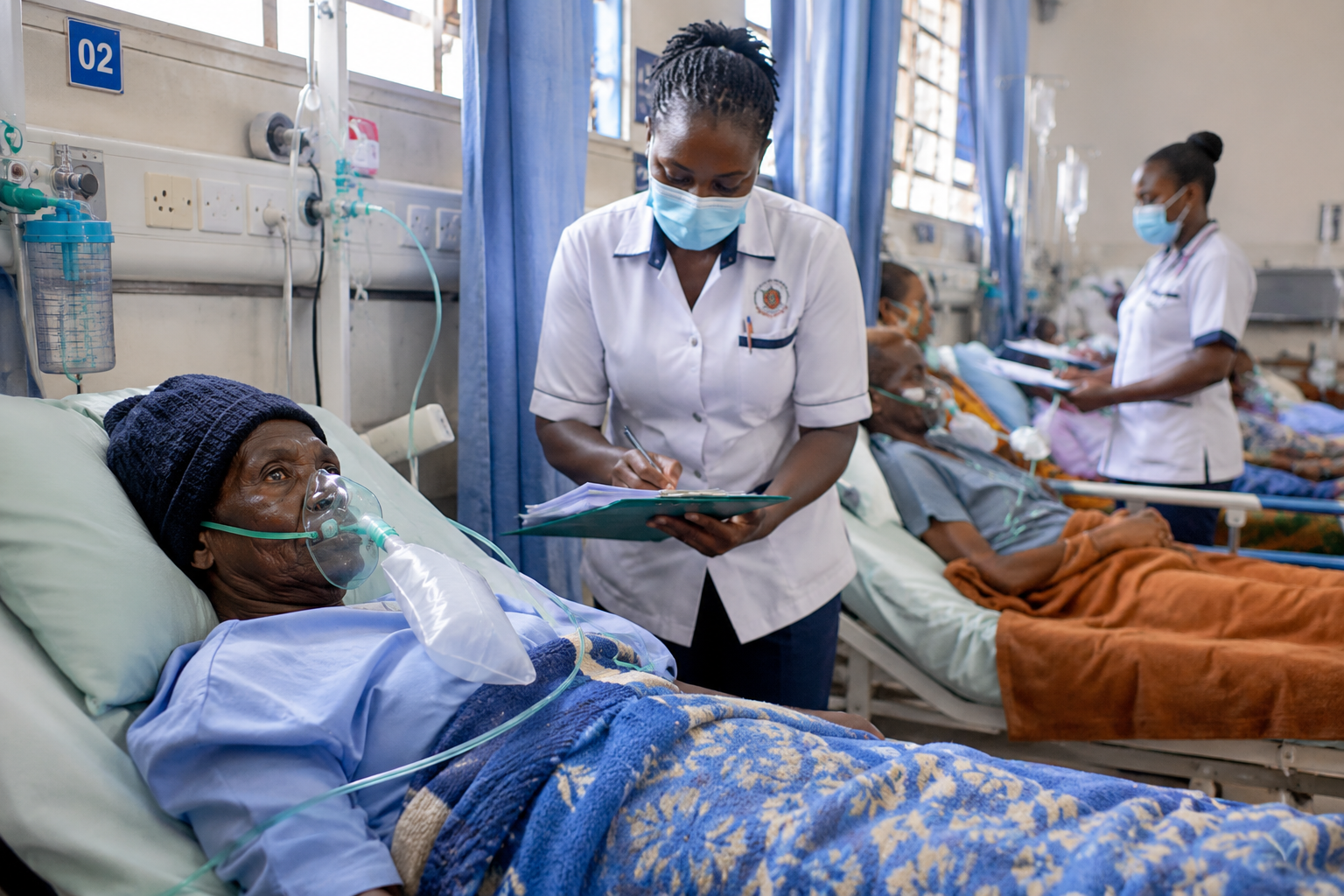
 Respiratory illnesses remained the biggest disease burden despite cases dropping by 22.8 per cent in 2025. /AI ILLUSTRATION
Kenya recorded a slight decline in its overall disease burden in 2025 as increased spending on healthcare by both the national and county governments boosted access to medical services and expanded health infrastructure across the country.
Data from the Kenya National Bureau of Statistics contained in the 2026 Economic Survey shows that although malaria cases surged from 3.8 million in 2024 to 14.3 million in 2025, the total number of reported disease cases marginally declined from 79.6 million to 79.5 million over the same period.
The reduction came amid a sharp rise in public expenditure on health services.
National government spending on healthcare increased by 22.8 per cent to Sh150.9 billion in the 2025/26 financial year, up from Sh122.9 billion in the previous year.
The allocation accounted for 3.5 per cent of the total Sh4.2 trillion national government expenditure, compared to 3 per cent in the preceding financial year.
County governments also increased spending on health services by 23.3 per cent to Sh133.4 billion, reflecting continued investment in healthcare infrastructure and service delivery.
Of the national allocation, Sh60 billion was channelled towards public health services, while Sh45 billion went to hospital services through both recurrent and development expenditure.
The increased funding coincided with continued expansion of healthcare facilities and personnel.
The number of operational health facilities rose by 4.6 per cent from 15,984 in 2024 to 16,713 in 2025, largely driven by growth in Level 3 facilities, which increased from 3,518 to 4,172.
Level 4 facilities increased from 1,119 to 1,188, while Level 5 facilities rose from 28 to 37.
Level 6 facilities increased from six to seven, although Level 2 facilities slightly declined from 11,313 to 11,309.
Hospital bed capacity grew by 3 per cent from 101,267 to 104,348, while the number of registered nurses increased by 12.7 per cent to 65,300 in 2025.
Despite recording a significant decline in cases, diseases of the respiratory system remained the leading cause of morbidity in Kenya in 2025.
Respiratory disease cases fell by 22.8 per cent from 19.98 million in 2024 to 15.43 million in 2025, representing a decline of 5.7 percentage points in their share of the overall disease burden.
Even so, respiratory illnesses still accounted for the largest share of reported diseases in the country.
Diseases of the respiratory system affect the air passages, including the nasal passages, bronchi and lungs, and include acute respiratory infections as well as chronic illnesses such as asthma, chronic obstructive pulmonary disease and lung cancer.
The burden of respiratory diseases stood at 20.6 million cases in 2021 before dropping to 17.1 million in 2022, then rising again to 19.6 million in 2023 and 20 million in 2024.
Diseases of the skin, including ulcers, accounted for the third-highest disease burden at 3.1 million cases, representing 3.9 per cent of all reported illnesses.
Urinary tract infections and eye infections followed, accounting for 3.3 per cent and 3.2 per cent of reported cases respectively, while hypertension accounted for 2 per cent.
The report further showed that Kenya registered 217,601 deaths in 2025, with male deaths exceeding female deaths across most age groups.
The highest number of deaths for both sexes was recorded among people aged 75 years and above, where registered deaths rose sharply from 49,583 in 2024 to 83,465 in 2025.
Male deaths in the 75-plus category increased from 23,273 to 42,031, while female deaths rose from 26,310 to 41,434.
The lowest number of registered deaths was recorded among children aged between five and 14 years, where deaths declined from 6,366 to 5,893, comprising 3,304 males and 2,589 females.
Deaths among infants and young children remained comparatively low, collectively accounting for 7,220 deaths in 2025.

![[PHOTOS] The new Ngong –Naivasha Road viaduct](https://cdn.radioafrica.digital/image/2026/06/64d4f771-4432-4aee-ba3c-2f304c4436ec.jpg)









![[PHOTOS] 'Mr Speaker Sir' Gen Z protester in court](https://cdn.radioafrica.digital/image/2026/06/b3e62d8e-25c3-4780-90f9-4eb48b1ce8a7.jpg)