
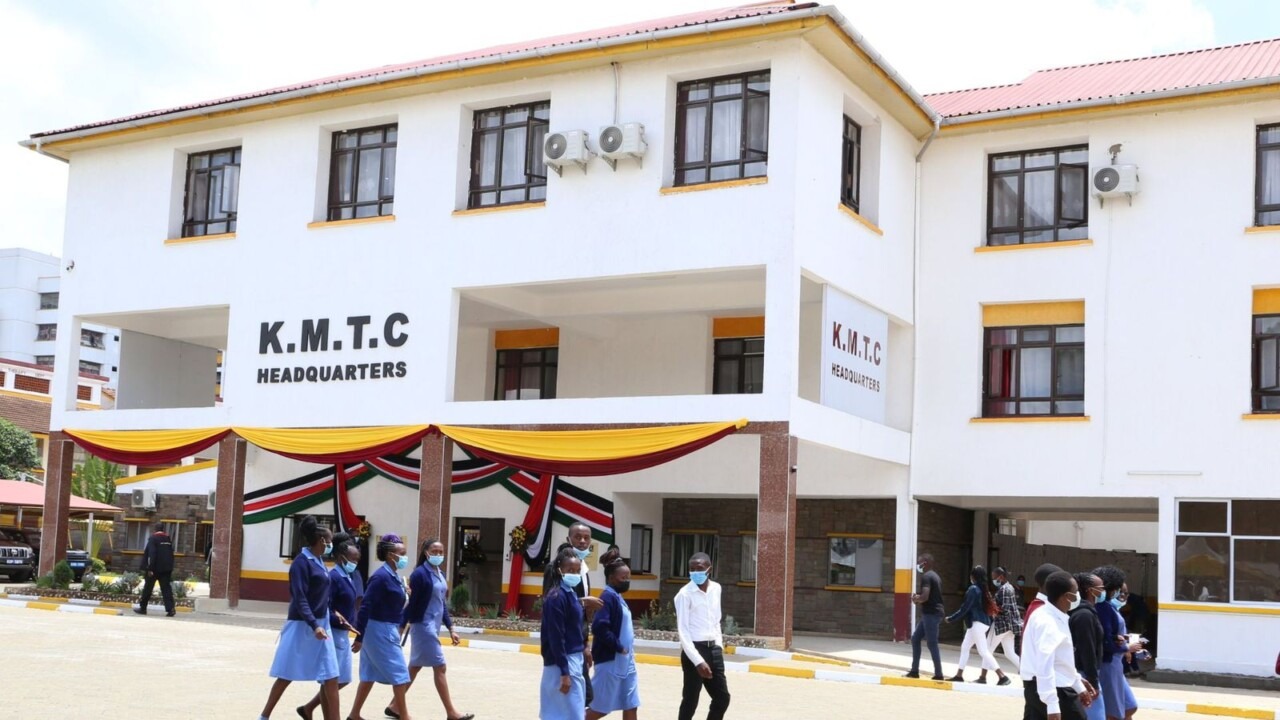
 Data from the 2026 Economic Survey shows that total enrolment at KMTC rose by 23.5 per cent to 36,330 in the 2024–25 academic year.
Demand for health training in Kenya is surging with enrolment at the Kenya Medical Training College more than doubling in five years, driven by overwhelming preference for frontline programmes such as community health nursing, emergency medical services and trauma care.
Certificate in Emergency Medical Technician, Diploma in Community Health Nursing and Diploma in Orthopaedic and Trauma Medicine have emerged among the most sought-after programmes at the premier institution, reflecting a sustained surge in demand for health training in the country.
Data from the 2026 Economic Survey by the Kenya National Bureau of Statistics shows that total enrolment of middle-level health trainees at KMTC rose by 23.5 per cent to 36,330 in the 2024–25 academic year.
The growth was largely driven by increased uptake of certificate and diploma courses, underscoring their central role in shaping Kenya’s healthcare workforce.
Diploma enrolment grew by 13.4 per cent to 22,092, up from 19,483 in 2023–24, while admissions to certificate programmes jumped sharply from 9,141 to 12,936 over the same period.
Higher diploma enrolment recorded the fastest growth, rising by 66.1 per cent to 1,302 from 784.
The data highlights strong demand across specific programmes. Admissions to certificate courses in Community Nursing rose from 1,409 to 2,232, while Emergency Medical Technician enrolment increased by 60.8 per cent from 1,539 to 2,475.
Orthopaedic Plaster Technology grew from 1,696 to 2,439, and Health Records and Information Technology rose from 1,623 to 2,543, pointing to expanding interest in both clinical and health information disciplines.
The upward trajectory is even more pronounced over a longer period. Between the 2020–21 and 2024–25 academic years, enrolment in certificate courses across KMTC’s 92 campuses and six satellite campuses more than doubled from 6,170 to 12,936.
Diploma enrolment also grew significantly, rising from 8,837 to 22,092 over the same period.
Community Health Nursing has consistently dominated as the most popular diploma course. It recorded over 4,000 trainees annually across the five-year period, increasing from 4,274 in 2020–21 to 4,388 in 2021–22, before a slight dip to 4,236 in 2022–23.
Enrolment then surged to 4,825 in 2023–24 and climbed further to 5,715 in 2024–25, marking its highest level.
Other high-demand diploma programmes in 2024–25 included Clinical Medicine and Surgery with 2,298 trainees, Community Health with 2,102, Orthopaedic and Trauma Medicine with 2,082, and Health Records and Information, which admitted 1,826 trainees, a sharp rise from 473 in 2020–21.
A similar growth pattern is evident in certificate-level Community Nursing, where enrolment rose progressively from 996 in 2020–21 to 1,102 in 2021–22, dipped to 921 in 2022–23, and then increased to 1,409 in 2023–24 before surging to 2,232 in 2024–25.
At the higher diploma level, Clinical Medicine and Surgery—covering specialties such as paediatrics, orthopaedics, anaesthesia, pulmonology, dermatology, ENT and audiology, mental health and psychiatry, reproductive health, ophthalmology, and advanced refraction—recorded the highest enrolment.
Admissions rose from 376 in 2020–21 to 554 in 2024–25, despite fluctuations in between, with figures standing at 413 in 2021–22 and dipping to 345 and 352 in the subsequent two academic years.
Nursing-related higher diploma specialisations, including mental health and psychiatry, community health nursing, palliative care, nephrology, anaesthesia, intensive care, ophthalmic and peri-operative nursing, also maintained steady demand. Admissions in these areas increased from 161 in 2023–24 to 239 in 2024–25.
Overall admissions to KMTC more than doubled over the five-year period, rising from 15,743 in 2020–21 to 36,330 in 2024–25.
This expansion has translated into a growing output of health professionals, with the institution producing 22,746 graduates in 2024–25, a 7.6 per cent increase from 21,147 in the previous year. The figure is more than double the 12,592 graduates recorded in 2020–21.
The trend mirrors developments at the university level, where health-related courses continue to dominate enrolment.
In the 2025–26 academic year, Nursing was the most popular undergraduate programme with 8,829 new admissions, followed closely by Medicine and Surgery with 8,365 students, highlighting strong demand for health training across both middle-level and degree institutions.
University graduate output also rose significantly. Total graduates increased by 28.3 per cent to 7,056, with undergraduate graduates growing by 30 per cent to 6,325, while postgraduate numbers rose by 15.3 per cent to 731.
Nursing accounted for 29 per cent of all graduates, maintaining its lead, followed by Medicine and Surgery with 934 graduates.
Other programmes also posted notable gains. Graduates in Medical Laboratory Sciences more than doubled from 312 to 768, while Community Health and Development rose from 108 to 384, reflecting diversification in health training pathways.
Gender trends show a higher number of female graduates in Nursing and Community Health programmes, reinforcing the longstanding gender skew in these fields.
The data collectively points to a sustained expansion of Kenya’s health training infrastructure, with KMTC at the centre of producing the mid-level workforce that aligns with the country’s evolving healthcare demands.

![[PHOTOS] The new Ngong –Naivasha Road viaduct](https://cdn.radioafrica.digital/image/2026/06/64d4f771-4432-4aee-ba3c-2f304c4436ec.jpg)










![[PHOTOS] 'Mr Speaker Sir' Gen Z protester in court](https://cdn.radioafrica.digital/image/2026/06/b3e62d8e-25c3-4780-90f9-4eb48b1ce8a7.jpg)