An alleged informal commitment by the government that it would settle a Sh640 million debt owed to a French
investor has triggered a major financial crisis in Meru county.
The controversy emerged after National Treasury Cabinet
Secretary John Mbadi moved to withhold disbursement of funds to the county,
citing failure to clear the debt owed to Leopard Rock Mico Limited, a
French-linked investor.
The decision has plunged the Meru county government into a severe cash
crunch, disrupting salary payments, halting operations, and deepening tensions
over responsibility for historical contractual obligations.
The dispute traces back to a lease agreement first entered
in 1997 between Leopard Rock Mico Limited and the then Nyambene county council,
the predecessor of the current Meru county government.
The lease was later revised in 2008, adjusting rent to
Sh60,000 monthly, with a 10 per cent increment every two years and additional
revenue-sharing arrangements tied to hotel bed occupancy.
However, in July 2018, the county government terminated the
lease, citing a lack of approval for building plans.
The investor disputed the termination and escalated the
matter to arbitration.
A tribunal later ruled in favour of the investor,
awarding Sh339.07 million in December 2019.
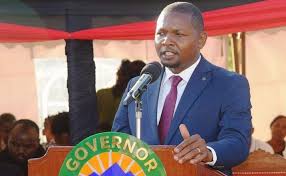
Meru Governor Isaac Mutuma said the amount has
since ballooned to more than Sh800 million due to accrued interest of 14 per
cent annually.
The situation escalated further after President William Ruto
reportedly made a public declaration in May 2025 at Meru National Park, stating
that the national government would assume responsibility for the debt.
The pledge, however, was never formalised in the national
budget or implemented through actual disbursement.
The county had paid Sh200 million when the President said
his administration would take up the debt.
Although the Ministry of Trade and Industry later took up
the matter, no payment has been made, leaving the obligation unresolved while
legal and financial pressures mount on the county government.
In a dramatic move, the National Treasury has now halted up
to 50 per cent of Meru’s equitable share, citing failure to settle the debt.
The freeze has severely disrupted county operations, with
officials warning of a looming shutdown of essential services.
Treasury has also accused the county of accumulating Sh1.3
billion in unpaid bills owed to suppliers and contractors, failing to remit
employee deductions for more than five months, and struggling to maintain
medical supply chains due to debts with the Kenya Medical Supplies Authority
(KEMSA).
Appearing before the Senate Finance and Budget Committee,
Governor Mutuma acknowledged the crisis but argued that the national government
had previously committed to taking over the liability.
He told senators that the public assurance in
May 2025 created an expectation that the debt would be absorbed by the national
government.
“The Ministry of Trade and Industry took up the matter but
the settlement has not been effected, despite the presidential announcement
being framed as a waiver or takeover,” Mutuma said.
He added that the directive was never backed by formal
budgetary allocation, leaving the county exposed to enforcement actions by the
creditor.
The governor has now urged the National Treasury to suspend
the fund stoppage, warning that continued withholding of funds will cripple
service delivery and derail development plans for the 2025/2026 financial year.
“We humbly request your office to suspend the proposed
stoppage as it will greatly affect the county government of Meru’s operations
and ability to offer essential service delivery,” Mutuma said.
He said the financial burden stems from
decisions made by previous county leadership between 2013 and 2017, when the
investor was evicted, and that the current administration is being punished for
past administrative actions.
Meanwhile, the investor’s legal representatives have
intensified pressure on the county, issuing notices under the Public Finance
Management Act demanding immediate settlement of the decretal amount, now
estimated at more than Sh470 million in recoverable sums after adjustments.
Law firm Manyonge Wanyama & Associates LLP warned that
continued non-payment constitutes a serious breach warranting enforcement
measures, including attachment of county funds.
The Controller of Budget has also weighed in, cautioning
that suspension of funds poses a major risk to service delivery, particularly
in health, agriculture extension, education support, and public works.
Deputy Controller of Budget Stephen Masha urged both levels
of government to ensure that remaining funds are protected and directed
strictly towards essential services during the freeze period.
“The stoppage of funds transfers carries inherent risks to
service delivery. Measures must be taken to safeguard critical services for
residents,” he said.
Treasury CS John Mbadi has defended the decision, invoking
Article 225 of the Constitution, arguing that the county’s failure to honour
its financial obligations constitutes a “persistent material breach” justifying
intervention.



![[PHOTOS] The new Ngong –Naivasha Road viaduct](https://cdn.radioafrica.digital/image/2026/06/64d4f771-4432-4aee-ba3c-2f304c4436ec.jpg)




![[PHOTOS] 'Mr Speaker Sir' Gen Z protester in court](https://cdn.radioafrica.digital/image/2026/06/b3e62d8e-25c3-4780-90f9-4eb48b1ce8a7.jpg)