The decision will automatically trigger protracted
negotiations with the National Assembly over the Division of Revenue Bill,
2026.
The Senate has instead proposed an enhanced allocation of
Sh454.7 billion for the 2026–27 financial year.
The development has ignited yet another battle between the
two Houses over how to share revenue between the national and county
governments.
The disagreement mirrors past disputes that have often
delayed the passage of crucial revenue-sharing laws, threatening timely
disbursement of funds to devolved units.
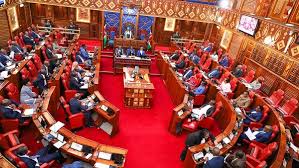
With the two chambers now sharply divided, the Speaker of
the bicameral Parliament is expected to constitute a mediation committee to
negotiate and agree on a compromise figure.
Senators argue that the Sh420 billion approved by the
National Assembly is too low and fails to reflect the financial realities
facing counties.
Vihiga Senator Godfrey Osotsi said the figure falls below
recommendations made by the Commission on Revenue Allocation.
“The Sh420 billion being proposed is far much lower than
what the Commission on Revenue Allocation had recommended. CRA proposed Sh458
billion, while the Senate Finance Committee has proposed Sh454 billion,” Osotsi
said.
Majority leader Aaron Cheruiyot signalled that senators are
prepared for a drawn-out battle to push for a higher allocation.
“My interest in this Bill is that we must be ready to engage
in a battle with the National Assembly to secure, at the very minimum, Sh450
billion for counties. That process takes timeand we must begin it,” he said.
The Senate’s position is backed by its Finance and Budget
Committee, chaired by Mandera Senator Ali Roba, which tabled a report
justifying the higher allocation.
The committee cited rising inflation, economic growth
pressures and the need to hire community health workers as key reasons for
increasing county funding.
The proposal is significantly higher than the National
Treasury’s Sh420 billion recommendation, which is likely to be supported by the
National Assembly, as has been the trend since the advent of devolution.
Governors, however, are pushing for an even higher
allocation of Sh534.4 billion through the Council of Governors, widening the
gap between stakeholders.
They argue their proposal reflects the real financial
pressures facing counties, including salary obligations, health sector reforms
and the transfer of additional devolved functions from the national government.
According to the governors, their demand includes Sh35
billion to account for revenue growth, Sh8.94 billion for the absorption of Universal
Health Coverage workers.
Others are Sh10.06 billion for salary reviews by the Salaries
and Remuneration Commission and Sh65.97 billion tied to functions earmarked for
transfer to counties.
“The national government has already implemented all SRC
salary cycles, leaving counties behind. This is discriminatory and has
triggered industrial action that will escalate if not addressed,” the governors
said in a statement.
They further argue that billions of shillings currently held
by ministries, departments and agencies should be transferred alongside the
devolved functions.
The Commission on Revenue Allocation has recommended Sh458.7
billion for counties—higher than the Treasury’s proposal but still below the
governors’ demand.
CRA projects that shareable revenue will rise from Sh2.6
trillion to Sh2.98 trillion in the next financial year, an increase of Sh342.6
billion. Of this, Sh2.5 trillion would go to the national government, with
counties receiving Sh458.7 billion.
Senators maintain that a higher allocation is necessary to
stabilise county finances, clear pending bills and prevent service disruptions.
Beyond the allocation dispute, the Senate has also pushed
for greater accountability and transparency in the use of public funds.
Lawmakers have directed the Treasury to submit, by June 30,
2026, a comprehensive impact assessment of all conditional allocations made to
counties since the inception of devolution.
The report is expected to detail actual transfers, pending
disbursements and the status of projects in each county.
The Senate has also instructed the Intergovernmental
Relations Technical Committee to finalise, within six months, the costing of
devolved functions in collaboration with the Treasury and the Council of
Governors.
To improve financial planning, senators are advocating for
the fast-tracking of a revenue forecasting model to help counties better estimate
their own-source revenue.
At the same time, they have taken a firm stance on fiscal
discipline, warning that counties that fail to implement pending bills action
plans within the first quarter of the financial year risk having their funds
suspended under Article 225(3) of the constitution.
The Treasury has also been directed to provide a timeline
for integrating the Human Resource Information System with the Integrated
Financial Management Information System, as well as an action plan to address
unremitted pension deductions.




![[PHOTOS] The new Ngong –Naivasha Road viaduct](https://cdn.radioafrica.digital/image/2026/06/64d4f771-4432-4aee-ba3c-2f304c4436ec.jpg)





![[PHOTOS] 'Mr Speaker Sir' Gen Z protester in court](https://cdn.radioafrica.digital/image/2026/06/b3e62d8e-25c3-4780-90f9-4eb48b1ce8a7.jpg)