A proposal to
issue national IDs to secondary
school students has sparked legal and policy concerns, raising questions over
data protection, feasibility and potential disruption to learning.
The proposal has drawn criticism from the Law Society of Kenya and Immigration
and Citizen Services, both of which argue it is legally problematic in its
current form.
At the centre
of the concerns is the handling of minors’ data.
Gilbert Kitiyo, secretary of the National Registration Bureau (NRB), warned that collecting biometric and personal
data from underage students may not align with existing legal frameworks.
The current system relies on live capture units that
process and transmit data in real time, making it difficult to accommodate
minors under the law.
“Since the
department is now using live capture units which process and transmit data to
the production centre in real time, it is not viable to collect information of
underage persons,” Kitiyo said.
The concerns
are rooted in the Data Protection Act, which imposes strict conditions on
the collection and processing of personal data, particularly for vulnerable
groups such as minors.
Stakeholders
warn that proceeding without clear safeguards could expose the government to
legal challenges and potentially render the process unlawful.
Beyond legal
risks, the proposal also raises operational questions.
The NRB has cautioned that
implementing a nationwide registration exercise within schools would require
adjustments to the academic calendar, diverting time and resources away from
learning.
Currently, the
school calendar does not provide for such an exercise. Kitiyo said that any legislative change would need to be matched by
amendments to education laws to formally allocate time for registration.
“The legal
amendment should cause a consequential amendment to the education act to
provide specific timelines within the school calendar to allow for the
registration exercise.”
In his
presentation to the National Assembly’s Committee on Administration and
Internal Security, Kitiyo defended the current system, where registration of
eligible students is conducted through arrangements with school administrations
rather than as a fixed national programme.
The LSK echoed
these concerns, warning that obtaining personal data from minors would require
explicit parental or guardian consent—an obligation that may be difficult to
fulfil consistently within a school-based framework.
“The [Registration of Persons (Amendment) Bill, 2025] is silent on data protection and we proposed an
insertion of a clause to secure mining of minors’ data,” Ruth Nyaberi,
representing the LSK, said.
Despite the
pushback, Suba South MP Caroli Omondi, the Bill’s sponsor, maintains that early registration would streamline identification
processes and ease access to services as students transition into adulthood.
“IDs are not
only identification documents, but key documents in job recruitment and
accessing various government services, and that is why we should have them
issued to all eligible youths in schools,” he said.
He argues that
the proposal would also advance constitutional principles of fairness and
equity by ensuring all eligible youths are registered without discrimination.
According to
the legislator, about three million
school-going youths become eligible for IDs each year.
Caroli further points to international examples, citing
countries such as South Africa, India and Rwanda, where similar systems are in
place.
However, the
proposal illustrates a broader policy tension: the drive to expand access to
identification services versus the need to uphold legal safeguards and protect
minors.
While early
registration could improve efficiency and inclusion, gaps in the current Bill—particularly around data protection and
implementation—raise questions about readiness.
Committee
vice-chairperson Rasso Dido, who chaired the session, said lawmakers will review stakeholder submissions
before making a determination.
“The committee is going to retreat to consider your
submissions. We are going to assess whether the proposed law is necessary,” he
said.
The proposed law seeks to amend Section 6 of the Registration of
Persons Act to formalise the annual registration of eligible secondary school
students, with the principal registrar mandated to conduct the exercise by the
end of August each year.
It further
proposes that data collection be completed between September and December,
after which IDs would be
issued free of charge and delivered to schools or designated collection points.
While the
proposal aims to streamline identification and expand access, its fate will
likely depend on whether lawmakers can reconcile efficiency with
legality—ensuring that any system introduced is both practical and compliant
with Kenya’s data protection regime.

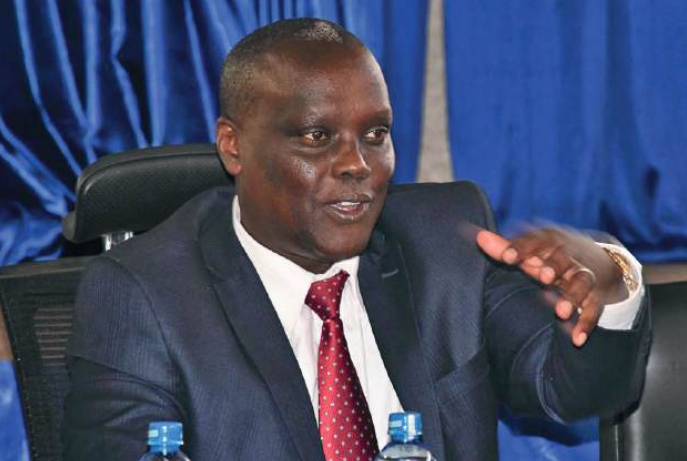 Gilbert Kitiyo,
secretary
of the National
Registration
Bureau. He
has warned
that collecting
biometric and
personal data
from underage
students may
violate the law
/FILE
Gilbert Kitiyo,
secretary
of the National
Registration
Bureau. He
has warned
that collecting
biometric and
personal data
from underage
students may
violate the law
/FILE





![[PHOTOS] The new Ngong –Naivasha Road viaduct](https://cdn.radioafrica.digital/image/2026/06/64d4f771-4432-4aee-ba3c-2f304c4436ec.jpg)











![[PHOTOS] 'Mr Speaker Sir' Gen Z protester in court](https://cdn.radioafrica.digital/image/2026/06/b3e62d8e-25c3-4780-90f9-4eb48b1ce8a7.jpg)