When Dedie Mwenda was asked how he would respond to the
escalating threats facing the planet, his answer was simple: plant a tree
seedling every day.
That commitment, first made while he was a student at Maseno
School, has grown into a consistent personal mission shaped by family influence
and early exposure to environmental stewardship.
Mwenda said his father’s work in a tree nursery played a key
role in shaping his outlook.
“My dad has been nurturing tree seedlings in his nursery,
and he is the source of inspiration,” he said.
Now 18, Mwenda traces his environmental consciousness back
to childhood. He says his connection to nature developed early and was
reinforced throughout his schooling.
While at Maseno School, he served as environmental captain,
a role he used to helped coordinate tree-planting and waste management
initiatives within and beyond the school.
He has already planted hundreds of trees, describing the act
as both routine and responsibility rather than symbolism.
Mwenda scored an A in the KCSE exam and now intends to
pursue Artificial Intelligence and Robotics, with a stated interest in applying
technology to environmental challenges.
“I would want to use modern technologies to address some of
the challenges facing the planet,” he said.
His work has since attracted the attention of environmental
experts, including through enrolment in the United Nations Environment
Programme (UNEP) youth mentorship programme, which supports young people
engaged in climate action and sustainability initiatives.
UNEP’s youth-focused programmes, including its Youth and
Education Alliance, aim to strengthen environmental awareness and integrate
young people into decision-making processes on global ecological challenges.
The organisation has increasingly positioned youth
participation as central to addressing climate change, biodiversity loss and
pollution.
Mwenda’s initiative was highlighted during a recent
sensitisation conference in Gigiri on the obligations of states in relation to
climate change.
Philip Osano, chief operating officer at the Centre for
International Forestry Research and World Agroforestry (CIFOR-ICRAF), described
Mwenda’s efforts as exemplary.
He said he was struck by the student’s commitment during a
school engagement.
Osano, an alumnus of Maseno School, said Mwenda’s idea of
planting a seedling daily stood out as both practical and scalable.
“He said he would take a seedling to school and plant it
each day,” Osano said.
He has since taken on a mentorship role for Mwenda, framing
it as part of a broader cycle of guidance and intergenerational support.
Osano also urged young people to align their ideas with
national and continental climate goals, including Kenya’s target of growing 15
billion trees by 2032.
The initiative forms part of the African Landscape
Restoration drive aimed at reducing greenhouse gas emissions, halting
deforestation and restoring degraded land.
The Gigiri conference brought together government officials,
regional bodies, international legal experts and civil society actors to
discuss African-led responses to climate change.
The discussions were influenced by a recent advisory opinion
from the International Court of Justice, which reaffirmed that states carry
binding obligations to protect the climate system and may be held accountable
for climate-related harm.
Within that wider policy and legal context, Mwenda’s story
stands as a reminder that climate action is increasingly being shaped not only
in courtrooms and conference halls, but also in classrooms and through
consistent individual actions.

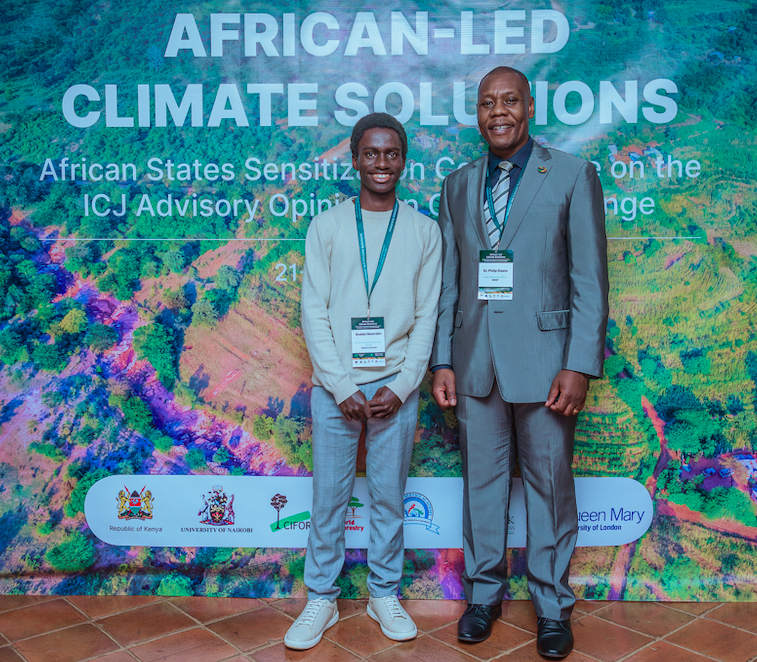 Centre for International Forestry Research and World Agroforestry (CIFOR-ICRAF) Chief Operating Officer Dr Philip Osano poses for a photo with Dedie Mwenda.



![[PHOTOS] The new Ngong –Naivasha Road viaduct](https://cdn.radioafrica.digital/image/2026/06/64d4f771-4432-4aee-ba3c-2f304c4436ec.jpg)








![[PHOTOS] 'Mr Speaker Sir' Gen Z protester in court](https://cdn.radioafrica.digital/image/2026/06/b3e62d8e-25c3-4780-90f9-4eb48b1ce8a7.jpg)