Ruto moves to mend ODM-UDA rift with joint public functions
Parties agree to hold joint public engagements, including rallies, to project unity
by LUKE AWICH
Audio By Vocalize
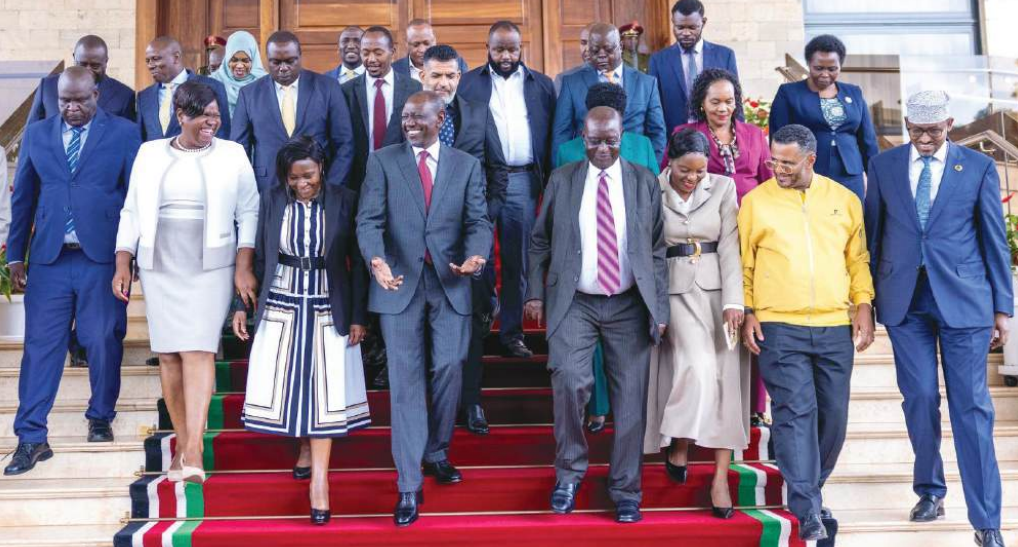
President William Ruto and ODM boss Oburu Oginga, flanked by top party officials, after they co-chaired the ODM Central Management Committee and UDA Steering Committee meeting at State House, Nairobi, on Thursday /PCS
President William Ruto on Thursday moved to contain growing
tensions within his fragile political arrangement with ODM.
He convened a high-stakes meeting at State House that
exposed both the necessity and the strain of the Broad-Based Government.
The President brought together top decision-making organs
from the ruling UDA and its political partner ODM in what insiders described as
a decisive attempt to steady a relationship that has, in recent weeks, been
rocked by public spats, mistrust and open political brinkmanship.
The closed-door meeting, held in the morning, brought
together members of the UDA steering committee and the ODM Central Committee
led by party leader Oburu Oginga, signalling the seriousness with which both
sides now view the emerging cracks.
At the centre of the discussions was a growing recognition
that, without deliberate political management, the alliance risks unravelling
under the weight of competing interests, especially at the grassroots where
rivalry between the two outfits has been intensifying.
The meeting resolved to establish a joint committee to
address emerging issues threatening unity under the Broad-Based government.
This effectively
creates a structured mechanism for managing disputes that have increasingly
played out in public.
According to sources who attended, the leaders agreed on a
raft of measures aimed at cooling tempers and restoring cohesion.
These include joint public engagements where leaders from both
sides will appear together at rallies and official functions to project unity.
“The future is bright. We agreed to be talking to each other
and not at each other. We have created two layers to guide our relationship and
you will see more of our respective party organs holding joint meetings,” a
source privy to the deliberations said.
The parties also agreed to institutionalise regular
consultations through joint meetings of their top organs, with the next session
already scheduled for next week.
These forums are expected to serve as an early warning and
response system for disputes, as well as a platform to align policy positions
and coordinate political strategy.
Beyond internal coordination, the two parties are also
planning joint political activities targeting key constituencies, particularly
the youth and women, in what appears to be a calculated effort to build a
shared political base and reduce competition at the grassroots.
These engagements will be spearheaded by ODM chairperson
Gladys Wanga and her UDA counterpart Cecily Mbarire, further signalling a shift
towards structured cooperation at both leadership and operational levels.
Ruto’s personal intervention comes against the backdrop of
escalating friction that has laid bare the uneasy nature of the ODM-UDA
arrangement.
In recent days, ODM has openly accused its partner of
disrespect and political hostility, even threatening to freeze cooperation and
scale back support for the President’s re-election campaign.
The tensions boiled over last week.
The Orange party, in a strongly worded statement read by
acting secretary general Catherine Omanyo following a Central Committee
meeting, accused senior UDA officials of making “unwarranted public utterances”
that were fuelling anxiety within its ranks.
“As a party that believes in its principles, ideology and
the foundation on which it was founded, we demand respect from the UDA party,”
the statement read, signalling a rare moment of open defiance within the
alliance.
Although Oburu later sought to downplay the situation,
insisting there were no formal talks to stall, the public messaging from ODM
pointed to deeper frustrations over how the partnership is being managed.
At the heart of the dispute lies the contentious issue of
zoning—an arrangement where coalition partners agree not to field competing
candidates in certain regions.
ODM has been pushing for zoning in its perceived
strongholds, arguing that it is a minimum condition for any meaningful
political cooperation.
UDA, however, has rejected the proposal.
Speaking in Kilifi earlier this month, UDA secretary general
Hassan Omar dismissed the idea, insisting every party has the democratic right
to field candidates across the country.
“ODM are saying the Coast is their stronghold and it should
be left to them. I want to tell them that the Coast region belongs to its
residents. They should allow us to compete fairly,” Omar said.
“If you believe this is your stronghold, then why are you
worried? Come, campaign, and win,” he added, capturing UDA’s broader position
on open political competition.
ODM leaders have, however, doubled down on zoning as a
non-negotiable demand.
Speaking in Kisumu, Wanga made it clear that zoning would
form part of the preconditions for any structured engagement with the ruling
party.
“If we are going for negotiations, we are going as equal
partners, not as a weaker party,” Wanga said, reflecting a growing insistence
within ODM on political parity.
Other leaders, including Alego Usonga MP Samuel Atandi, have
gone further, warning that ODM will resist any attempt by UDA to field
candidates in its traditional bases.
“There is no negotiation when it comes to zoning. We are not
going to allow UDA to plant candidates in our strongholds,” Atandi said.
It is this widening gulf between cooperation at the top and
competition at the grassroots that appears to have triggered Ruto’s
intervention. The President is keen to prevent the alliance from sliding into
open conflict.
During the State House meeting, sources said Ruto urged both
sides to tone down their positions on zoning, suggesting that the issue would
ease over time as the partnership matures.
“The President said the two sides should gel first and the
issues like zoning will just fizzle out,” a source who attended the meeting
said.
In a joint statement co-signed by Ruto and Oburu, the two
leaders announced the formation of a Broad-Based Management Committee
comprising party leaders, selected Cabinet Secretaries, and the Majority and Minority
leaders in Parliament.
The committee will be tasked with coordinating and
synchronising the legislative and executive agenda of government to ensure
coherence, efficiency and effective service delivery.
“Both parties reaffirmed their commitment to constructive
dialogue, unity of purpose and a shared vision for national development and
inclusive governance,” the statement read in part.
Yet even as the leadership projects unity, analysts say the
underlying tensions are unlikely to disappear in the short term.
The ODM-UDA arrangement, while politically expedient, brings
together parties with distinct identities, support bases and long-term
ambitions, making friction almost inevitable.
The dispute over zoning, in particular, reflects a deeper
struggle over political territory ahead of the 2027 elections, where both
parties are keen to protect and expand their influence without conceding
ground.
Ruto’s intervention, therefore, is as much about political
survival as it is about governance.
The stability of his administration depends significantly on
keeping the broad-based arrangement intact, even as internal contradictions
persist.
The creation of joint structures and regular consultation
mechanisms may help manage tensions in the short term. However, the durability
of the alliance will ultimately depend on how far each side is willing to
compromise without appearing politically diminished.
For now, the State House truce offers a temporary reset. But
beneath the surface, the contest for political space continues to simmer,
raising fresh questions about whether unity at the top can hold against rivalry
on the ground.
This is premium content
Subscribe to Continue Reading
Help us continue bringing you unbiased news, in-depth investigations, and diverse perspectives. Your subscription keeps our mission alive and empowers us to provide high-quality, trustworthy journalism. Join us today to make a difference!



![[PHOTOS] The new Ngong –Naivasha Road viaduct](https://cdn.radioafrica.digital/image/2026/06/64d4f771-4432-4aee-ba3c-2f304c4436ec.jpg)


![[PHOTOS] 'Mr Speaker Sir' Gen Z protester in court](https://cdn.radioafrica.digital/image/2026/06/b3e62d8e-25c3-4780-90f9-4eb48b1ce8a7.jpg)