The government has had to revert to subsidies and a cut in
VAT to try to cushion consumers from historic fuel prices, as the impact of
the Middle East war finally hits home.
Even so, pump prices for diesel and petrol have gone up to
what was last witnessed in 2023 when they first crossed the 200 mark.
In the latest monthly review, the government has been forced
to subsidise petrol by Sh4.92, but a litre has still gone up by Sh28.69, pushing
it up to Sh206.97 in Nairobi.
This means a litre would have hit a record Sh211.89 up from
Sh178.28.
Diesel, widely used in the industrial sector, energy
generation, manufacturing, transport and agriculture sectors, has been subsidised
by Sh20.30, but a litre has increased by Sh40.30, to retail at Sh206.84, and
would have gone up to Sh227.14 from Sh166.54.
Pump prices for kerosene, which is used for lighting and
cooking in poor households, remain unchanged at Sh152.78 per litre, meaning
100 per cent subsidy.
Mandera will have the highest fuel prices, where a litre of
petrol will go for Sh229.15, up from Sh200.46, diesel Sh229.02, up from Sh188.
72 while kerosene will retail at Sh174.96.
The government has also reduced the Value Added Tax rate on
super petrol, diesel and kerosene from 16 per cent to 13 per cent, Energy and
Petroleum Regulatory Authority (EPRA) acting director general Joseph Oketch
said yesterday.
This, he said, was “in order to cushion consumers from the
high landed cost of petroleum products as a result of the escalated prices in
the international market.”
“The government will further cushion the consumers through
the Petroleum Development Levy (PDL) Fund by utilising approximately Sh6.2
billion to stabilise the pump prices,” Oketch said.
The landed cost for petrol went up to Sh107.24 per litre,
Sh133.89 for diesel and Sh170.86 for kerosene, up from Sh75.42, Sh82.30 and
Sh82 respectively.
“We wish to reiterate that as per the earlier directive from the government, the super petrol delivered by One Petroleum ex MT Paloma has not
been included in the computation of the applicable prices,” Oketch said.
All three major Middle Eastern state-owned oil giants in
the G2G deal with Kenya, that is, Saudi Aramco (Saudi Arabia), Abu Dhabi
National Oil Company (ADNOC) (UAE) and Emirates National Oil Company (ENOC)
(UAE), have been affected by the war, as crude prices crossed the $100 per
barrel mark.
A rise in fuel prices now translates to high commodity
prices as manufacturers are expected to pass on extra production and logistics
costs to consumers.
Large-scale farming activities are also set for higher costs
as a result of diesel. Fares are also expected to go up as the matatu industry
and public transport sector at large pass extra costs.
“It is obvious that when fuel prices go up, operating costs
go up, spare parts cost more from a manufacturing aspect and delivery costs. We will, however, be speaking to our members to make reasonable
adjustments,” Matatu Owners Association president Albert Karakacha, told the
Star.
Power bills in homes are also expected to go up as
Independent Power Producers in thermal generation move to recover higher diesel
costs.
“High oil costs will fuel inflation,” Kenya Association of
Manufacturers CEO Tobias Alando said.
The country’s inflation is expected to go up from the 4.4
per cent recorded in March, which was a slight increase from 4.3 per cent in
February.
These are the highest fuel prices since September 2023, when
they crossed the historic Sh200 mark for the first time, with petrol in Nairobi
rising to over Sh211 per litre.
These record highs were driven by the removal of subsidies
and increased VAT.
Among key drivers was the increase in Value Added Tax (VAT)
on petroleum products from eight per cent to 16 per cent and high landed costs.
Global inflation is expected to increase in 2026 because of
higher energy prices and fertiliser costs attributed to the supply disruptions
from the conflict.
During his post-Monetary Policy Committee briefing last
week, Central Bank of Kenya governor Kamau Thugge noted that the Middle East
war would have an impact on the economy.
“The growth of the economy is projected at 5.3 per cent in
2026 compared to the previous projection of 5.5 per cent, reflecting the
emerging risks of the conflict in the Middle East on the performance of some
key sectors of the economy,” Thugge said.
President William Ruto, on March 30, said the ongoing
conflict in the Middle East is having a significant impact on the global
economy, with Kenya not immune to these effects.
He, however, promised measures to moderate “any adverse
effects” on the global oil price increases and ensure that Kenya maintains
adequate supplies.
“Rising international oil prices are already affecting
consumers globally. However, the Government-to-Government fuel procurement
arrangement has cushioned Kenyans from immediate shocks,” Ruto had said
earlier.
This strategic intervention, he noted, has mitigated price
increases, ensured security of supply, and proven to be both prudent and
forward-looking.


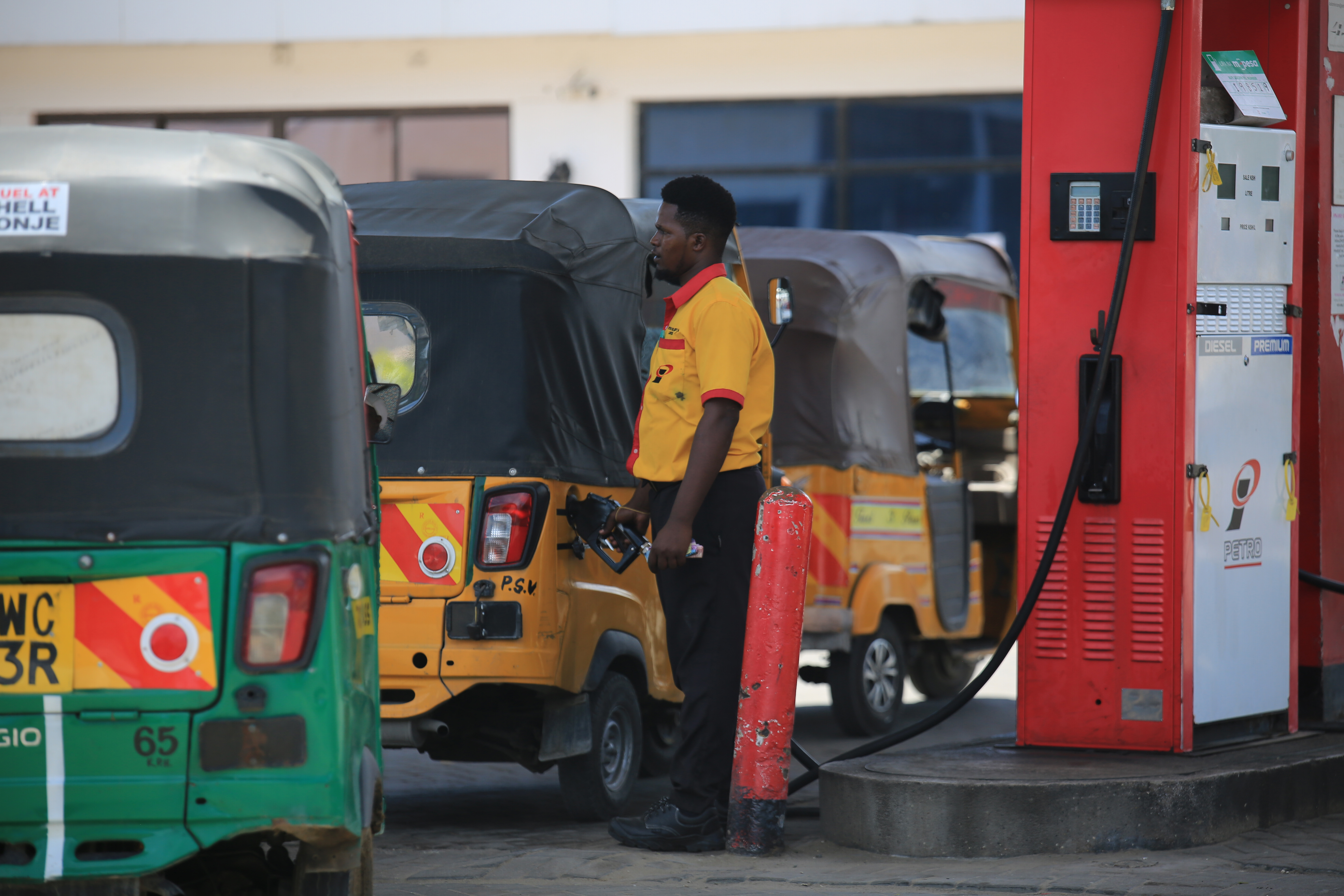 An
attendant fuels
a tuk-tuk in
Mombasa
/JOHN CHESOLI
An
attendant fuels
a tuk-tuk in
Mombasa
/JOHN CHESOLI


![[PHOTOS] The new Ngong –Naivasha Road viaduct](https://cdn.radioafrica.digital/image/2026/06/64d4f771-4432-4aee-ba3c-2f304c4436ec.jpg)











![[PHOTOS] 'Mr Speaker Sir' Gen Z protester in court](https://cdn.radioafrica.digital/image/2026/06/b3e62d8e-25c3-4780-90f9-4eb48b1ce8a7.jpg)