
This means rival candidates from Kenya, Uganda and Tanzania
will split the East African vote, which risks weakening chances for Justice Ndung’u.
The candidates are Rosette Muzigo-Morrison (Uganda), who worked
at the office of the Prosecutor at the ICC in The Hague and court of Appeal
Judge Deo John Nangela (Tanzania).
Other candidates are Evelyn Ankumah (Ghana), Guénaël
Mettraux (Switzerland), Diana Bacares (Colombia) and Yoshimitsu Yamauchi
(Japan).
The presence of Ugandan and Tanzanian candidates complicates
the equation for Kenya because in multilateral elections, regional blocs, such
as the African Group and EAC, often play a decisive role. A divided East
African vote could hand an advantage to candidates from other regions or
better-coordinated African campaigns.
This also comes at a time Kenya’s aggressive pursuit of top
international positions is under scrutiny, as Nairobi backs Justice Ndung’u for
the ICC post.
The endorsement comes amid concerns that Nairobi is
scrambling for whatever opportunity becomes available.
The Law Society of Kenya has warned that Justice Ndung’u’s
bid risks not only a loss but could also undermine Kenya’s parallel campaign at
the International Court of Justice for Prof Phoebe Okowa.
The ICC elections are scheduled for the 25th session of the
Assembly of States Parties in New York from December 7 to 17.
Around the same time, Okowa will in November be seeking a
full nine-year term at the ICJ for the 2027–36 period. She was elected to the
ICJ bench in November 2025 to fill a casual vacancy on the court.
Observers argue that Kenya’s increasingly crowded and poorly
sequenced approach to global lobbying and fielding multiple high-profile
candidates simultaneously risks branding Kenya as greedy.
The race will come just months after the appointment of
former National Security Adviser Monica Juma as Director-General of the UN
Office at Vienna and Executive Director of the UN Office on Drugs and Crime.
However, Kenya’s track record at the global stage in recent
years has been marked by losses.
Former Prime Minister Raila Odinga failed in his bid for the
AU Commission chairmanship in February last year, while Amb Nancy Karigithu
lost her campaign for International Maritime Organisation director general
post.
Former Foreign Affairs CS Amina Mohamed lost her bids for
both the AUC and the World Trade Organisation. Former Foreign Affairs CS
Raychelle Omamo was unsuccessful in her bid for International Fund for
Agricultural Development.
Even Juma herself failed to have her bid for Commonwealth
Secretariat take off, despite endorsement by then President Uhuru
Kenyatta.
Dr Ogwell Ouma also lost his bid to head the Africa Centres
for Disease Control and Prevention, with the AU instead selecting DRC’s Jean
Kaseya to succeed John Nkengasong in 2023.
Taken together, these losses point to a pattern where Kenya
is highly active in international contests but struggles to convert that
visibility into wins.
Diplomatic observers argue that the problem is not a lack of
qualified candidates, but rather a question of strategy and the perception.
Prof Macharia Munene, who teaches at USIU, told the Star
that the joint bid is good for Kenya but dynamics at the international level
might be different.
He said with Prof Okowa’s bid coming earlier, and already
being an incumbent, might help her.
“But questions will be asked. Why now? And did Justice
Ndung’u express interest herself or someone else is offering an incentive to
create space for someone else? Judges retire at 70 and there might be thinking
that it is a bit too far for her,” the don said.
This, he noted, risks creating a perception about the bid,
with the thinking that a domestic issue is being exported to the global stage.
“If people who make decisions question the circumstances, it
may not auger very well,” he said.
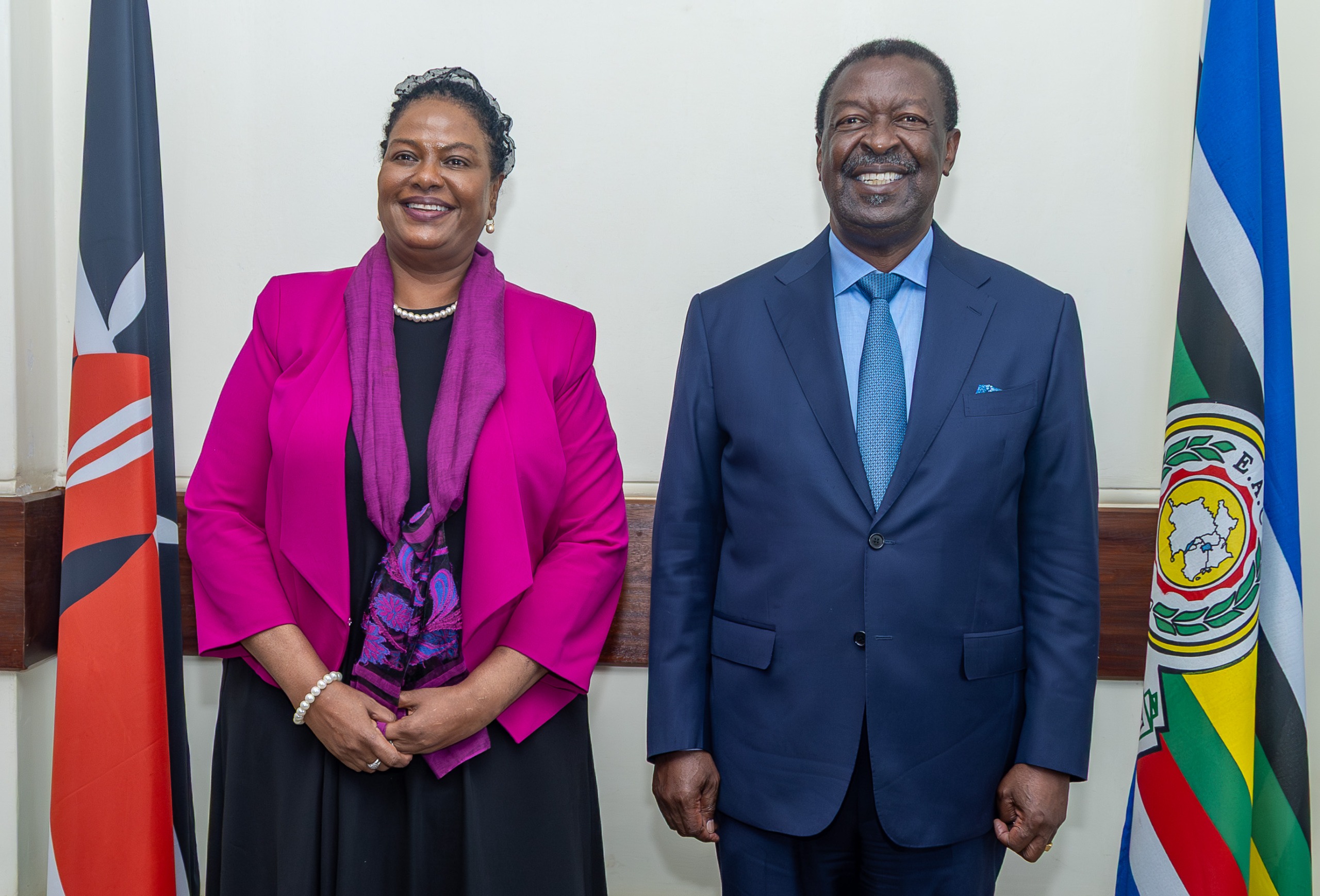
“How it is being presented might also be an issue. Mudavadi
said he would do his best to help her secure the seat. But this is a judicial
matter being projected politically.”
International relations scholar Dr Adhere Cavince says
states are free to exploit opportunities available at the international level,
and probably that’s how Nairobi is looking at the ICC and the ICJ slots.
However, Dr Cavince argues that the same should be
accompanied by the capacity to overcome the bottlenecks that may emerge in the
campaign.
“Negotiations are about give and take. So, our foreign
affairs must be convincing enough to convince other states why it deserves the
positions,” he said.
An official at a multilateral body said there is a tendency
for Kenya to pursue multiple high-level positions simultaneously without
clearly prioritising where it has the strongest chance.
“That dilutes lobbying efforts and creates unnecessary
competition,” the official said.
The Ndung’u bid appears to fit this pattern.
In a February 25 letter to Attorney General Dorcas Oduor,
then LSK president Faith Odhiambo warned that sponsoring multiple candidates
within the same election cycle could undermine Kenya’s chances.
She particularly said Kenya’s campaign to secure the
re-election of Prof Okowa risks being compromised by an additional ICC bid.
“It would be imprudent for Kenya to nominate candidates for
elections to two international courts in the same year,” Odhiambo cautioned.
She further noted that Kenya had already made concessions
and secured commitments from other states during the campaign for Okowa,
agreements that could now be strained if Nairobi doubles its ambitions.
By pushing Ndung’u’s candidacy while also backing Okowa for
the ICJ, Nairobi could end up splitting its diplomatic focus.

![[PHOTOS] The new Ngong –Naivasha Road viaduct](https://cdn.radioafrica.digital/image/2026/06/64d4f771-4432-4aee-ba3c-2f304c4436ec.jpg)







![[PHOTOS] 'Mr Speaker Sir' Gen Z protester in court](https://cdn.radioafrica.digital/image/2026/06/b3e62d8e-25c3-4780-90f9-4eb48b1ce8a7.jpg)