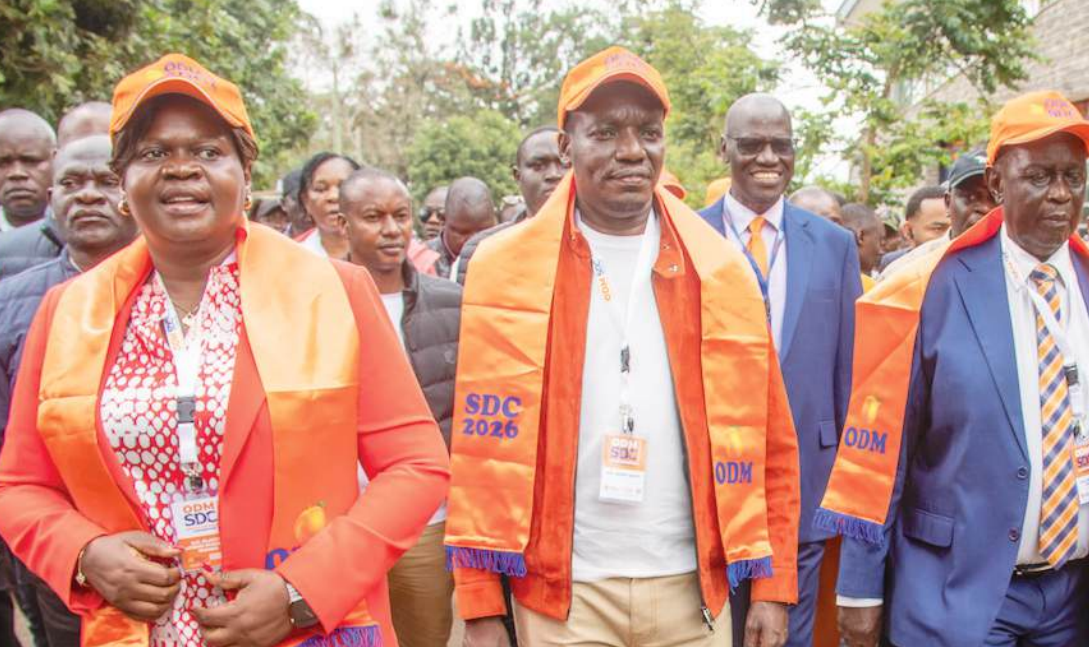
A fresh political storm is brewing within the ODM faction aligned to Oburu Oginga, as internal disagreements over zoning and leadership style threaten to widen existing cracks among key figures.
Sources within the camp indicate that a section of leaders has grown increasingly uneasy with what they describe as a top-down approach to decision-making, the latest point of contention being the divisive issue of zoning.
There are also growing jitters that some party officials may be seeking to consolidate power for personal or factional advantage.
ODM is still recovering from an acrimonious split with the Linda Mwananchi group, spearheaded by, among others, Secretary General Edwin Sifuna.
Some analysts argue that the fallout has already weakened ODM and reduced its negotiating leverage with President William Ruto.
Fresh divisions, they warn, could further erode the party’s standing as it heads into the 2027 polls—its first without its founding leader, Raila Odinga, widely regarded as the most consequential politician in Kenya since independence.
The zoning policy, which seeks to ringfence ODM strongholds from competition by coalition partners, is being championed by key party leaders, among them national chairperson Gladys Wanga.
Critics have openly challenged the Homa Bay
governor on the matter and called on the party to reconsider the position
which they warn may stifle grassroots democracy.
Several members have voiced concerns that once
zoning is finalised, power will be concentrated in the hands of a few
influential figures who will ultimately determine who secures the party ticket.
The lawmakers led by National Assembly’s Minority
Whip Millie Odhiambo urged the top leadership to abandon the plan in favour of
free and credible nominations.
“ODM has always managed to successfully front
candidates without any formal form of zoning, perhaps there may be silent
agreements in urban areas like Nairobi, but there has never been a need for
zoning for ODM,” Millie said.
“We need to listen to the public and the public
is keen that we show what we have done for them. When we start pushing an
agenda strongly of zoning it means that we are actually putting our personal
interests ahead of that of our constituents.”
The leaders have also taken issue with the
broader governance style within the camp, accusing the leadership of ignoring consultation and sidelining inclusivity.
Millie lifted the lid
to the simmering row over leadership lapse in the outfit accusing some unnamed top
officials within ODM of overstepping their mandate and acting as though they
are late party leader Raila Odinga.
In a sharp rebuke, the outspoken four-term lawmaker claimed
that some individuals in the party’s leadership ranks were making unilateral
decisions and sidelining established structures, a move she said was fuelling
internal discontent.
“What I can tell the ODM party is that we are
moving in a direction I don’t like, which is disunity. We are all elected in
our respective constituencies. Let us respect each other,” Millie fired at the top leadership.
“Let us also be
honest none of us is Raila and because none of us is Raila we need to listen to
the public.”
Muhoroni MP Onyango Koyoo has also publicly castigated
some top party officials of being ‘bully’ in the party demanding that only the
Secretary General and Party Leader Oburu Oginga should speak on behalf of the
party.
“Serious issues
involving the party position should either be articulated by the party leader
or the secretary general,” Koyoo
said even as he criticised zoning as was being advanced by Gladys Wanga.
The third-term MP even demanded that some top officials
be excluded from the yet to begin negotiations, signalling the magnitude of the
internal rift.
“President to talk
to party leader and a group that we will give him very soon but not these
youngsters who are running around they don't have experience they don't know
how far people have come”
In apparent reference to the ODM chairperson,
Koyoo raised fears that the Homa Bay governor is keen on using her influence in
the party to ‘impose’ candidates.
The lawmaker was referring to a recent case where
the ODM chairperson held a meeting in his constituency which was attended by
his rival and the governor’s brother.
“In my constituency, they came to endorse a
candidate who is her brother. I have vast experience in this field and it is
good I now know the owner of the dog,” Koyoo stated.
Wanga did not respond to our inquiries.
The discontent, insiders say, has fuelled quiet
but growing resistance, with some leaders calling for more consultation on serious
party matters.
However, proponents of zoning within the faction
maintain that the strategy is necessary to prevent chaotic primaries and reduce
internal disputes that could weaken the party ahead of future elections.
They argue that consensus-building through zoning
has historically helped maintain political stability in competitive regions.
ODM Vice chairperson and Rarieda MP Otiende
Amollo called for restraint among leaders engaged in the ongoing zoning debate,
terming the public exchanges as unnecessary and counterproductive.
The legislator said discussions on zoning within
the party and its coalition partners should be handled through structured
channels rather than media spats.
Otiende noted that such sensitive negotiations
are best suited for formal platforms, urging the party leadership to urgently
constitute negotiating committee to steer the process
“There is no need to engage in
public spat in funerals when there is provision to have that debate in closed
doors as part of negotiations,” Otiende told the Star.
“What we should be doing as a party
is to move on from where we left in
joint Parliamentary Group with UDA, by now the technical committee should have laid ground for appointment of the negotiating committees.”
“Let the negotiating team focus on
these details.”
The Rarieda MP however defended
zoning as a normal tool that has been used to consolidate votes for a
presidential candidate in coalition arrangements.
“The public spat is unnecessary and misguided, zoning is
normal and this is something that is common in a presidential system where you
want to consolidate votes for a presidential candidate,” he argued.



![[PHOTOS] The new Ngong –Naivasha Road viaduct](https://cdn.radioafrica.digital/image/2026/06/64d4f771-4432-4aee-ba3c-2f304c4436ec.jpg)


![[PHOTOS] 'Mr Speaker Sir' Gen Z protester in court](https://cdn.radioafrica.digital/image/2026/06/b3e62d8e-25c3-4780-90f9-4eb48b1ce8a7.jpg)