School feeding plan in Asal suffers Sh6.6bn budgetary shortfall
This follows a Sh6.6 billion funding shortfall that threatens the government’s feeding programme
by LUKE AWICH
Audio By Vocalize
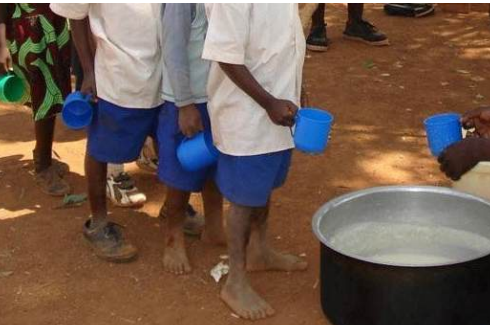
Children line-up for porridge in school /FILE
Vulnerable school-going children from arid and semi-arid
areas now face the risk of dropping out of school.
This follows a Sh6.6 billion funding shortfall that
threatens the government’s feeding programme.
MPs on Thursday heard that the National Council for Nomadic
Education in Kenya (NACONEK) requires Sh8.3 billion annually to sustain its
feeding programme but has only been allocated Sh1.7 billion in the current
budget.
NACONEK was appearing before the National Assembly’s Public
Investments Committee on Governance and Education to respond to audit queries.
The agency’s chief executive officer Harun Yussuf told the
committee chaired by Bumula MP Wanami Wamboka, that the funding gap had
significantly affected service delivery.
“We have a serious gap in the school feeding programme. The
cost of feeding a child is Sh22 per day for about 51 days, requiring
approximately Sh8.3 billion, but we have only been allocated Sh1.7 billion,”
Yussuf said.
He told MPs the council is working with the National
Treasury to streamline capitation. He added that the programme will, for now,
focus on providing porridge to learners as a stop-gap measure.
The council, which supports education for children from
nomadic and marginalised communities, also faces challenges in infrastructure
development, particularly the construction of modern school kitchens.
Yussuf said while parents in many parts of the country
support school feeding initiatives, communities served by NACONEK often lack
the capacity to build proper kitchens.
“It is the responsibility of government to establish
kitchens at school level, but we do not have the budget for that,” he said.
“We have only piloted clean energy cooking in six schools
and are expanding to 14 more, but funding remains inadequate.”
Committee members acknowledged the unique challenges facing
the council and called for increased funding and policy support.
Narok Woman Representative Rebecca Tonkei emphasised the
vulnerability of the communities served by NACONEK, urging the government to
adopt a progressive approach in addressing their needs.
“These are very poor communities. If you ask parents in such
areas to build modern kitchens, children will drop out of school,” she said.
“We must support them to ensure learners can eat in a clean
and safe environment.”
Sotik MP Julius Sigei echoed her sentiments, noting that
marginalised communities require affirmative action.
“These are people who have been neglected for a long time.
We must enhance resources to uplift them while ensuring safety standards are
not compromised,” he said.
Lunga Lunga MP Chiforomodo Mangale Munga cautioned against
lowering standards, insisting that all children deserve access to quality facilities.
“We should not compromise quality. These are Kenyan children
and must have access to clean, modern kitchens. The council should seek more
resources to meet these standards,” he said.
The committee also questioned the irregular disbursement of
funds flagged by the Auditor General, which reportedly led to delays in the
delivery of food supplies in some regions.
MPs noted that in some instances, schools went for months
without receiving food, undermining the programme’s effectiveness.
Kasipul MP Boyd Were, who chaired the session, assured the
council that the committee would make recommendations to address the funding
and operational gaps.
“This matter is before the committee, and we will make
recommendations to ensure you receive adequate funding to resolve these
challenges,” he said.
Kilome MP Thaddeus Nzambia sought clarification on the
council’s funding model and sustainability.
“I think the issue of resources is critical. As a committee,
we can recommend increased funding and even involve the Education CS and
Principal Secretary to ensure these concerns are addressed,” added Bomachoge
Chache MP Alpha Miruka.
Lawmakers further called for a holistic government approach,
warning that budget cuts at various levels continue to undermine efforts to
support vulnerable learners.
The revelations came as the committee also examined
NACONEK’s financial statements for the year ended June 30, 2025.
The MPs are pushing for reforms to ensure consistent
funding, improved infrastructure and better oversight of the programme.
If unaddressed, MPs warned, the funding gap could reverse
gains made in improving access to education among children in marginalised and
nomadic communities, where school feeding programmes remain a critical
incentive for enrolment and retention.
This is premium content
Subscribe to Continue Reading
Help us continue bringing you unbiased news, in-depth investigations, and diverse perspectives. Your subscription keeps our mission alive and empowers us to provide high-quality, trustworthy journalism. Join us today to make a difference!


![[PHOTOS] The new Ngong –Naivasha Road viaduct](https://cdn.radioafrica.digital/image/2026/06/64d4f771-4432-4aee-ba3c-2f304c4436ec.jpg)










![[PHOTOS] 'Mr Speaker Sir' Gen Z protester in court](https://cdn.radioafrica.digital/image/2026/06/b3e62d8e-25c3-4780-90f9-4eb48b1ce8a7.jpg)
