
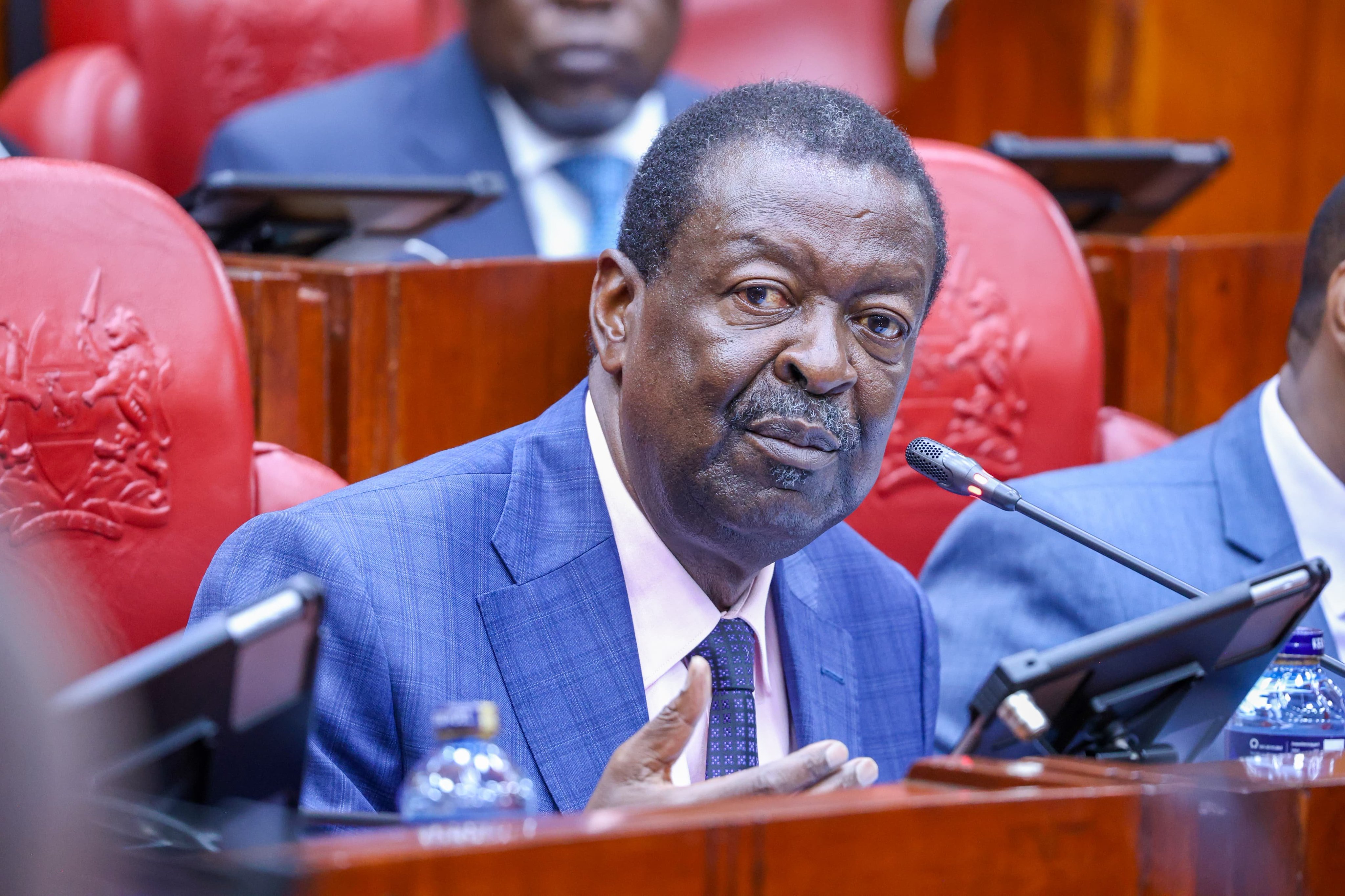
 Prime Cabinet Secretary Musalia Mudavadi / HANDOUT
Kenya is intensifying efforts to dismantle recruitment networks exploiting citizens, targeting traffickers, rogue agencies, and cross-border syndicates linked to foreign conflicts.
Kenya has stepped up a sweeping crackdown on fraudulent recruitment networks, targeting illegal recruiters and cross-border syndicates accused of exploiting vulnerable citizens through deceptive job offers and illegal enlistment schemes abroad.
Appearing before a parliamentary committee, Prime Cabinet Secretary and Foreign Affairs Cabinet Secretary Musalia Mudavadi outlined a multi-layered strategy aimed at identifying, disrupting, and dismantling both local and international recruitment syndicates.
"It has been established that the recruitment is being conducted by unregistered agencies, and individuals operating either in Kenya, Russia or third countries like Qatar and the United Arab Emirates," Mudavadi said.
"They use tourist visas, and use transit routes through neighbouring countries to evade scrutiny at our points of exit, JKIA or Mombasa airports, where surveillance is high," he added.
Investigations have already led to arrests, and the suspects have been charged with trafficking-related offences.
Central to the operation are specialised units within the Office of the Director of Public Prosecutions (ODPP), which are focusing on human trafficking cases to strengthen investigations and secure convictions against rogue actors.
Mudavadi said the enforcement drive has widened to include agencies linked to exploitative destinations, including operations tied to scam centres in the Golden Triangle and recruitment pipelines feeding into the Russia-Ukraine conflict.
He said security agencies have intensified surveillance at key exit points, with stricter scrutiny at airports and border crossings designed to disrupt trafficking routes and expose facilitators, including any complicit officials.
Mudavadi said the approach goes beyond arrests, combining enforcement with sustained public awareness campaigns aimed at cutting off the supply of victims.
Through media platforms, public barazas, town hall meetings and social media outreach, the government is warning Kenyans against engaging unregistered recruitment agencies, while educating them on safe migration pathways and how to detect fraudulent schemes and avoid job scams abroad.
At the diplomatic level, Kenya has also moved to tighten labour migration controls, including initiating a Bilateral Labour Agreement with the Russian Federation to regulate and safeguard employment opportunities abroad.
"There is diplomatic engagement with the Russian Federation, including ongoing discussions on curbing illegal recruitment, reviewing visa policies, and pursuing Bilateral Labour Agreements to create a safe and regular pathway for Kenyans seeking legitimate work in Russian," he said.
Mudavadi revealed that recent high-level engagements with Russian authorities had yielded a critical commitment to halt the enlistment of Kenyans into Russian military forces.
“As part of our engagements, we agreed on clear measures, including placing Kenya on a stop list, effectively ending the recruitment of Kenyans into the Special Military Forces of Russia,” he said.
The operation is unfolding against a backdrop of increased coordination among government agencies tasked with addressing the crisis.
Mudavadi said the Ministry of Foreign and Diaspora Affairs is working closely with the Interior Ministry, bringing together the National Intelligence Service, the Directorate of Criminal Investigations, Immigration Services, and the National Employment Authority in a joint response framework.
He said diplomatic efforts have also intensified, with Kenya engaging both Russia and Ukraine on the safety and status of affected citizens.
During a recent visit to Moscow, Mudavadi held talks with Russian Foreign Minister Sergey Lavrov, where both sides agreed to enhance cooperation on curbing illegal recruitment, facilitate consular access to affected Kenyans, and fast-track compensation processes for families.
The discussions also opened pathways for the voluntary disengagement of Kenyans involved in foreign military operations, alongside plans to establish structured labour mobility agreements.
At the same time, the government has engaged Ukrainian authorities in efforts to trace, protect and repatriate Kenyans caught up in the conflict, including those reported as prisoners of war.
Officials confirmed that a small number of cases are currently being handled, with consular access being pursued and verification ongoing.
As enforcement tightens, the government says the focus remains firmly on dismantling the networks driving the schemes, rather than only addressing the consequences.
Mudavadi maintained that sustained coordination, stronger prosecutions, and international cooperation will be key in shutting down the recruitment pipelines and protecting Kenyans from exploitation.
With investigations expanding and diplomatic pressure mounting, authorities now face the critical test of whether the intensified crackdown can fully dismantle the networks at the centre of the crisis.

![[PHOTOS] The new Ngong –Naivasha Road viaduct](https://cdn.radioafrica.digital/image/2026/06/64d4f771-4432-4aee-ba3c-2f304c4436ec.jpg)








![[PHOTOS] 'Mr Speaker Sir' Gen Z protester in court](https://cdn.radioafrica.digital/image/2026/06/b3e62d8e-25c3-4780-90f9-4eb48b1ce8a7.jpg)