Mubure Wachira, a farmer from Gaturi in
Kiharu constituency, Murang’a county, harvested five bags of maize last season.
This may seem modest but it is a significant improvement for him and his
family.
For years, Wachira rarely harvested more
than one bag from his nearly two-acre plot. “Last year, only the long rains
season did well but the short rains were very inconsistent towards the end of
the year. However, I managed to harvest enough maize in that one season, and I
no longer buy maize flour,” he said.
The key difference for Wachira is the
government’s subsidised fertiliser programme. He could not afford the high
costs of commercial fertiliser, and the market was flooded with substandard
inputs. Wachira registered with the government and has consistently received 10
bags of subsidised fertiliser.
He travels to the National Cereals and
Produce Board stores in Maragua to collect the commodity. “Fertiliser was too
expensive before this programme. Many of us preferred not to buy because it was
as costly as maize flour, and the quality was poor. But with this initiative,
we can farm confidently, knowing the harvests are assured as long as there is
rain,” he said.
Joseph Kamau from Gatanga buys 10 bags
for his 8,000 tea bushes and has seen notable improvements in production. “You
can tell even without quantifying it when your tea bushes are yielding more.
It’s quite visible,” he said.
Kamau said the Kenya Kwanza government
has revitalised farming by providing affordable inputs, rescuing millions of
smallholder farmers who previously struggled to afford fertiliser.
In Kigumo, farmer Peter Kaihura
explained he has only accessed government fertiliser once, citing the long
distance to the NCPB stores in Maragua. A small store set up by the board in
Marumi rarely stocks fertiliser, forcing farmers to rely on their coffee
cooperatives, which source supplies from private factories. “It’s a good
programme, if only the government could make it easier to access the
fertiliser,” he said.
President William Ruto launched the
subsidised fertiliser scheme under the Bottom-up Economic Transformation Agenda
soon after taking office in September 2022. He explained that “the only way to
increase agricultural productivity is through the use of high-quality inputs,
particularly fertiliser, which significantly boosts crop yields on the same
land.”
The figures highlight the progress made
under the scheme in ensuring food security and boosting farmers’ incomes across
Kenya. The Government Delivery Unit record shows a total of 23.1 million tonnes
of subsidised fertiliser have been distributed nationwide.
The cost of a 50kg bag of fertiliser has
been reduced from a high of Sh7,000 in 2022 to Sh2,500, making it far more
affordable for farmers. The uptake has surged from 1.4 million bags in 2022 to
an estimated 10.1 million in 2025.
President Ruto stated that the target
was to produce 61 million bags of maize annually by 2027. However, the
programme has exceeded expectations, with maize production rising from 44
million bags in 2022 to 67 million in 2024, and an estimated 75 million bags in
2025.
The largest quantities of fertiliser
have been distributed in counties such as Uasin Gishu (3.19 million tonnes),
Nakuru (2.04 million), Trans Nzoia (1.35 million), Narok (1.32 million), and
Nandi (1.18 million).
The NCPB acts as the government’s
distribution agent, managing procurement, storage, and distribution of
subsidised fertiliser. It handles logistics and maintains accountability
throughout the process. Farmers’ data, generated through joint registration by
the Ministry of Agriculture and county governments, guides distribution. Over
7.1 million farmers have registered on the government’s digital platform,
helping to reduce fraud and facilitate direct input support.
“Farmers access fertiliser via NCPB
depots and last-mile centres managed by counties,” acting managing director
Samuel Ndung’u said. “Once registered, farmers’ data is entered into the Kenya
Integrated Agricultural Management Information System. They then receive
e-voucher messages based on land size and crop type.”
At distribution centres, farmers present
their ID and mobile phone number to redeem their voucher and pay for the fertiliser.
“Currently, the board is distributing the 2026 long rains fertiliser,” Ndung’u said.
“Since distribution began on December 18, 2025, some 4.5 million bags have been
redeemed—2.8 million for planting and 1.6 million for top dressing.”
In Machakos county, farmers say the
subsidised fertiliser has improved both the quality and quantity of their
yields.
Job Mogaka, a farmer in Mlolongo, told
the Star the subsidised fertiliser has boosted his earnings. “We were visited
by government officers who explained the programme, and I registered. I’ve
received two 50kg bags of NPK,” he said. Mogaka cultivates vegetables in
Mlolongo and has a tea farm in Nyamira county.
He explained that fertiliser previously
cost Sh7,000 a bag, which he could not afford for his two acres. “Now, I buy
all types—DAP, CAN, NPK—at Sh2,500 from the NCPB stores in Nairobi’s Industrial
Area.”
He added that the lower costs have
increased his profits and improved his standard of living. “I can now pay
school fees, rent, and care for my family without difficulty. I also save from
my produce,” Mogaka added.
Joseph Mutinda from Masii expressed his
gratitude for the programme, stating, “I’ve struggled with poor yields because
of expensive fertiliser. The subsidised inputs are a blessing. I hope for
bumper harvests this season.”
Bernadette Mwende also said she no longer
relies solely on manure, and her yields have improved. “I no longer struggle to
pay school fees or buy fertiliser thanks to the subsidies. I am very grateful
to the government.”
Farmers across the North Rift also
attest to how the subsidised fertiliser initiative has helped increase both
acreage and production over recent years.
David Kiberenge, a representative of
small-scale farmers in the region, explained that before the programme, many
farmers could not afford fertiliser and had to reduce their land under cereal
cultivation, especially maize. “Production was declining rapidly because
fertiliser is the main input for maize and wheat,” he said.
High fertiliser costs and the
circulation of fake inputs had adversely affected both yields and soil health.
“From my 11-acre farm, I used to get about 17 bags of maize per acre and was
almost ready to give up. But since the subsidy programme started, my yields
have increased to over 24 bags per acre,” he said.
Jane Yatich, a smallholder farmer in Uasin
Gishu, said easy access to subsidised fertiliser has contributed to increased
production. “We now have NCPB depots and distribution centres everywhere,
making it easier and cheaper to obtain fertiliser,” she said.
Yatich manages three acres in Moiben,
where her yields have risen to over 75 bags of maize, compared to fewer than 40
previously.
Thomas Korogoren, a leading farmer in
the region, said early distribution enables better planning. “Now I can
organise my farm activities well in advance, unlike before, when we had to
scramble or miss out altogether, incurring extra costs.”
The scheme has allowed farmers to save
money. Additionally, soil testing is now part of the programme, ensuring
fertiliser is tailored to local soil and crop requirements.
However, critics argue that there are
persistent delays in the delivery of fertiliser. Kipkorir Menjo, a director of
the Kenya Farmers Association, said this year’s delays have been particularly
severe. “Farmers are still queuing at NCPB depots, trying to get the subsidised
fertiliser as the planting season approaches,” he said.
He also noted the high costs of other
inputs, such as seeds, continue to undermine gains made by the programme. “The
costs of other farm inputs are rising each season, eroding the benefits. There
is also a need to subsidise maize seed prices, which remain unaffordable for many
farmers.”
Menjo called on the government to
allocate at least 10 per cent of the national budget to agriculture, as stipulated
in the 2003 Maputo Declaration. “This would provide more resources to support
farmers through subsidies, credit, and other initiatives.”
Governor George Natembeya of Trans Nzoia
echoed concerns about farmers’ limited capacity to buy subsidised fertiliser
due to financial constraints. “Many small-scale farmers, with just one or two
acres, still cannot afford inputs, including subsidised fertiliser,” he said.
To support the subsidy programme,
Natembeya is implementing a free seed scheme benefiting over 300,000 farmers in
Trans Nzoia.

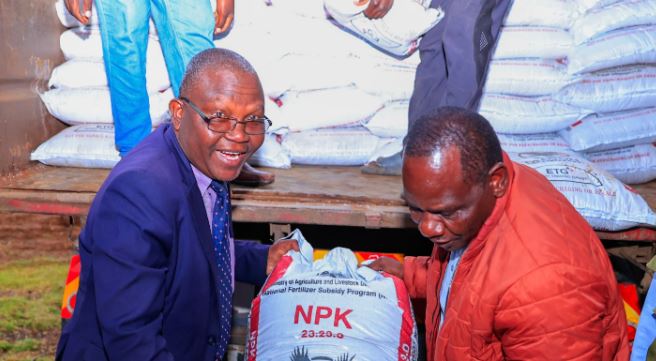


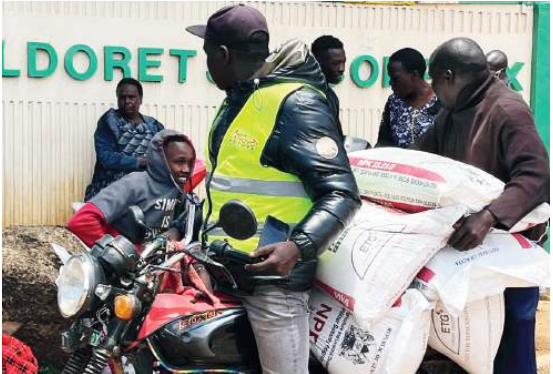 Small-scale farmers collect subsidised fertiliser at the NCPB depot in
Eldoret /MATHEWS NDANYI
Small-scale farmers collect subsidised fertiliser at the NCPB depot in
Eldoret /MATHEWS NDANYI


![[PHOTOS] The new Ngong –Naivasha Road viaduct](https://cdn.radioafrica.digital/image/2026/06/64d4f771-4432-4aee-ba3c-2f304c4436ec.jpg)








![[PHOTOS] 'Mr Speaker Sir' Gen Z protester in court](https://cdn.radioafrica.digital/image/2026/06/b3e62d8e-25c3-4780-90f9-4eb48b1ce8a7.jpg)