How the Senate has cornered governors in accountability fight
Decision to involve police appears to have shifted balance of power.
by JULIUS OTIENO
Audio By Vocalize
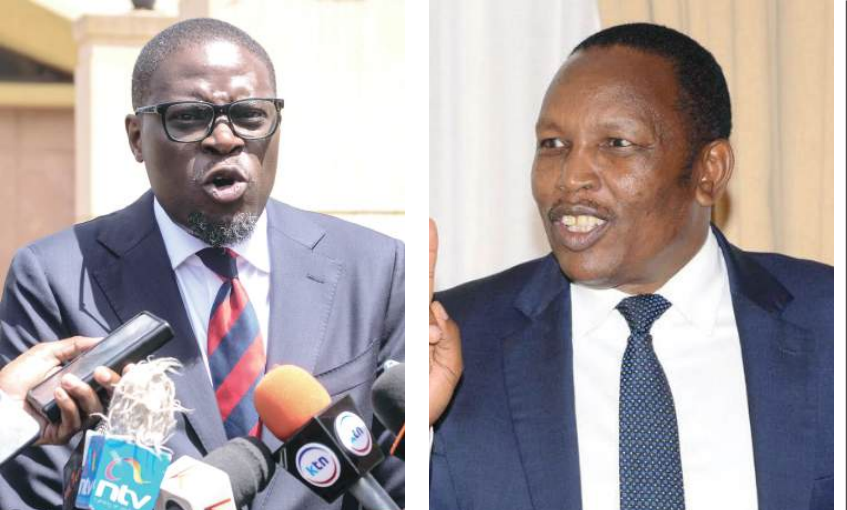
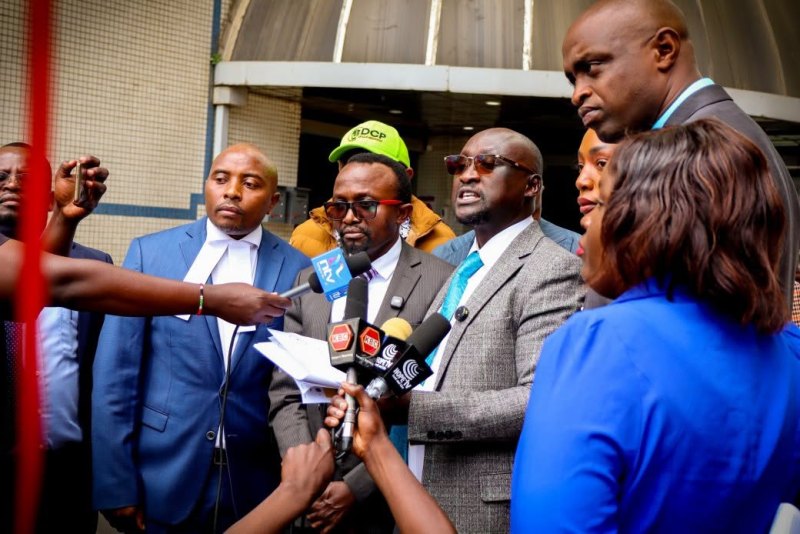
Nairobi Governor Johnson Sakaja outside the Senate
building (left) and Samburu Governor Lati Lelelit/FILE
Senators have seemingly cornered governors in their vicious
war over accountability for the billions of shillings sent to county
governments.
The development came after Inspector General of Police Douglas Kanja bowed to
Senate pressure and moved to enforce arrest warrants against governors who have
failed to appear before the Senate County Public Accounts Committee (CPAC).
On Monday, police officers, led by the Nairobi regional
commander, were dispatched to arrest Nairobi Governor Johnson Sakaja, who had
skipped a scheduled appearance before the powerful oversight committee.
At the same time, Samburu Governor Lati Lelelit was also
being pursued for failing to respond to audit queries relating to the 2024-25
financial year.
The unprecedented move triggered an uproar among governors,
who accused the Senate of weaponising oversight and using coercion to settle
political scores.
Council of Governors (CoG)
chairman Ahmed Abdullahi criticised the police's involvement in what he termed a disproportionate show of force.
“The Council of Governors notes with utmost concern the
actions by the Office of the Inspector General of Police in what appears to be
an unwarranted and disproportionate exercise of force,” he said.
Abdullahiinsisted the dispute was not about individual governors
but a collective position taken by the council, adding that isolating a few
county bosses for arrest undermined ongoing efforts to resolve the impasse.
“It is regrettable to single out a few governors for
coercive action in a grave matter that remains unresolved between the committee
and the council,” he added.
The decision to involve the police now appears to have
significantly shifted the balance of power in favour of the Senate.
Beyond the immediate humiliation associated with arrests,
the move risks denting the public image of governors by reinforcing perceptions
of corruption and lack of transparency.
Political analysts say the arrests place governors in a
difficult position, leaving them with little choice but to comply with Senate
summons or face legal consequences.
The standoff between senators and governors has simmered for
over a month, with county chiefs boycotting CPAC sessions.
The governors accuse the committee of intimidation,
blackmail and conducting what they describe as political witch hunts, claims
that senators have repeatedly dismissed.
Efforts to broker a truce through engagements with Senate
leadership have failed to yield a breakthrough, deepening mistrust
between the two levels of government.
“The decision to pursue arrest of governors while
allegations against committee members remain unaddressed defeats the intent of
oversight, deepens mistrust and undermines the rule of law,” the CoG said,
demanding the immediate withdrawal of arrest warrants and suspension of
coercive measures.
However, senators have remained defiant, insisting that
governors must submit to parliamentary oversight as required by law. They
accuse the county chiefs of deliberately evading scrutiny over the use of
public funds.
Over the past weeks, the Senate has steadily escalated
pressure on governors, including threats to freeze county funds, proposals to
require Senate clearance before counties access money from the Controller of
Budget, and referrals of suspected financial impropriety cases to investigative
agencies such as the Ethics and Anti-Corruption Commission and the
Directorate of Criminal Investigations.
More than 140 cases linked to counties are reportedly under
investigation, underscoring the scale of accountability concerns within
devolved units.
On Tuesday, CPAC signalled that more drastic measures could
follow, warning that up to 26 additional governors could face arrest warrants
for failing to honour summons.
“At this rate, we will issue one warrant of arrest per week
until all governors account for the resources sent to them,” CPAC chairman
Moses Kajwang’ said.
Nandi Senator Samson Cherargei, a member of the committee,
urged the police to prepare for a sustained enforcement operation.
“We are likely to issue more warrants of arrest to the tune
of 26. We appeal to the Inspector General of Police to prepare adequate
manpower,” he said.
Cherargeiwent further to describe non-compliant governors as
“fugitives of justice” and proposed travel restrictions to prevent them from
leaving the country before clearing with the Senate.
“The two governors must be produced before the committee. We
shall first deal with contempt proceedings before moving to substantive audit
issues,” he said.
Governor Sakaja, who narrowly evaded arrest, sought to
defend himself after holding a closed-door meeting with Senate leadership that
lasted more than two hours.
Speaking to the media afterwards, Sakaja denied attempting
to dodge accountability, noting he had appeared before Senate committees
multiple times.
“I have appeared before these committees many times—six
times this year alone and about 10 times last year. I have even responded to
audit queries dating back to 2015, including those from my predecessors,” he
said.
The governor explained that his failure to attend the latest CPAC
session was in line with a directive from the Council of Governors, which had
raised concerns about the conduct of the committee.
“When the CoG raised issues regarding that specific
committee, we were guided that those concerns be resolved first. Accountability
is important, but it must be undertaken in the right way,” Sakaja said.
He said he had reached out to both Senate and CoG
leadership in a bid to de-escalate tensions and find a lasting solution.
“We need to resolve these issues so that we can be held
accountable as required by the Senate,” Sakaja said.
A host of governors now find themselves on the Senate’s
radar, including Muthomi Njuki (Tharaka Nithi), Simba Arati (Kisii), Ahmed
Abdullahi (Wajir), Fernandes Barasa (Kakamega), Gladys Wanga (Homa Bay), Eric
Mutai (Kericho) and Joseph Lenku (Kajiado).
Others are Issa Timamy (Lamu), Abdulswamad Nassir (Mombasa),
Anyang’ Nyong’o (Kisumu), Stephen Sang (Nandi), Abdi Guyo (Isiolo), Irungu
Kang’ata (Murang’a), Susan Kihika (Nakuru), Mohamud Ali (Marsabit), Ochillo
Ayacko (Migori) and Andrew Mwadime (Taita Taveta).
Also listed are Gideon Mung’aro (Kilifi), Anne Waiguru
(Kirinyaga), Paul Otuoma (Busia), Jonathan Bii (Uasin Gishu), Amos Nyaribo
(Nyamira), Kimani Wamatangi (Kiambu), Benjamin Cheboi (Baringo) and Nadhif Jama
(Garissa).
The Senate is anchoring its actions on Article 125 of the
Constitution, which grants Parliament powers to summon any person to appear
before it and enforce attendance.
Audit reports tabled before CPAC paint a troubling picture
of financial mismanagement in several counties.
In Nairobi, auditors flagged unaccounted-for bursaries and scholarships amounting to Sh270.43 million, as well as Sh125.52 million spent on
garbage collection without adequate documentation.
In Mombasa, concerns were raised over stalled projects worth
more than Sh400 million, irregular use of direct procurement methods and
unsupported legal fees totalling Sh158.16 million.
INSTANT ANALYSIS
The unfolding confrontation underscores the growing tension
between oversight and autonomy in Kenya’s devolved system of governance.While
the Senate insists it is merely executing its constitutional mandate to
safeguard public resources, governors argue that the process must be fair,
impartial and free from political interference. As both sides dig in, the
standoff risks paralysing critical county operations and eroding public
confidence in devolved governance.
This is premium content
Subscribe to Continue Reading
Help us continue bringing you unbiased news, in-depth investigations, and diverse perspectives. Your subscription keeps our mission alive and empowers us to provide high-quality, trustworthy journalism. Join us today to make a difference!

 Nairobi Governor Johnson Sakaja outside the Senate
building (left) and Samburu Governor Lati Lelelit/FILE
Nairobi Governor Johnson Sakaja outside the Senate
building (left) and Samburu Governor Lati Lelelit/FILE


![[PHOTOS] The new Ngong –Naivasha Road viaduct](https://cdn.radioafrica.digital/image/2026/06/64d4f771-4432-4aee-ba3c-2f304c4436ec.jpg)




![[PHOTOS] 'Mr Speaker Sir' Gen Z protester in court](https://cdn.radioafrica.digital/image/2026/06/b3e62d8e-25c3-4780-90f9-4eb48b1ce8a7.jpg)