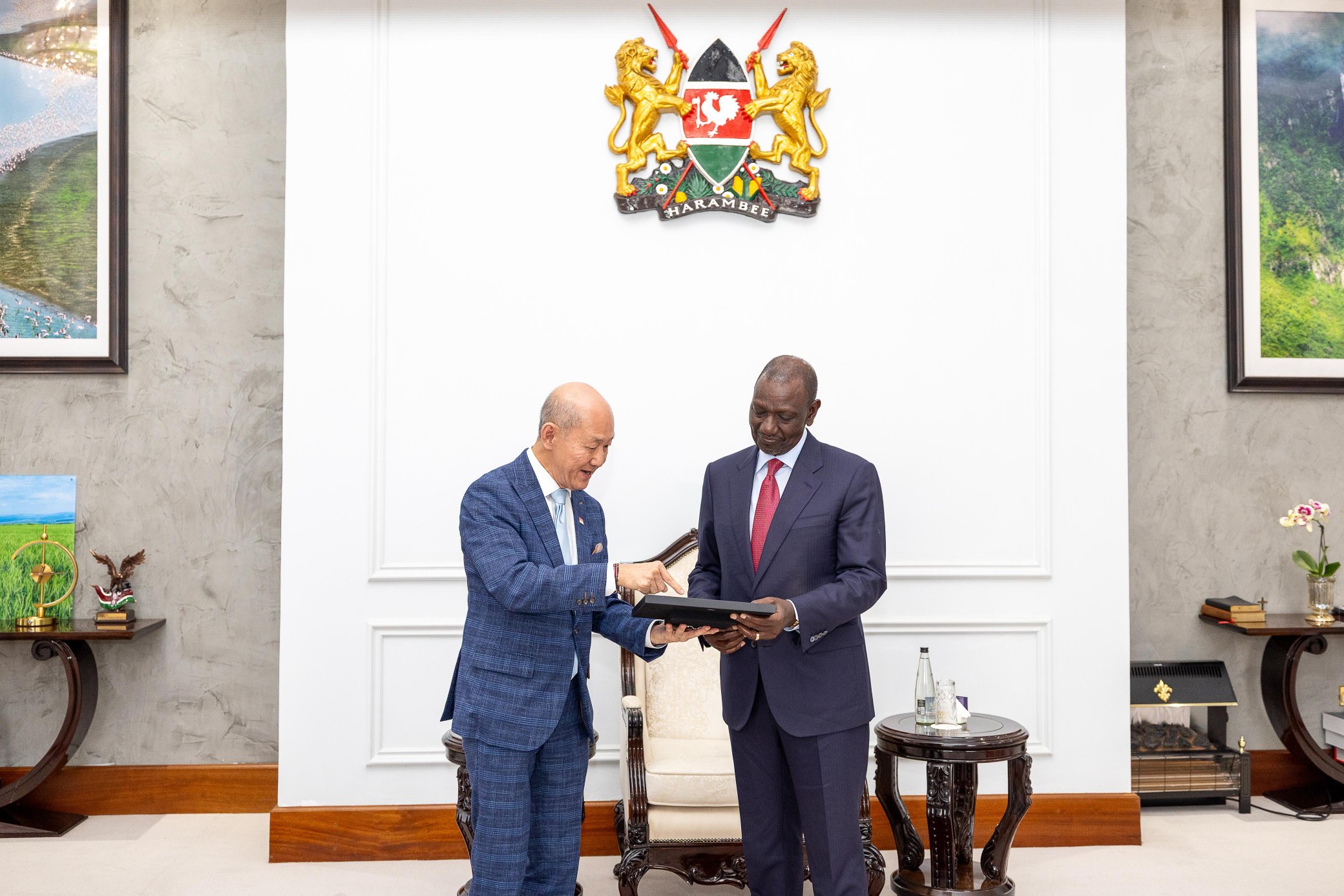
The engagement, though largely ceremonial,
appears to underscore a growing convergence in economic priorities, with Kenya
increasingly looking to Singapore’s development model.
Ruto has framed his development agenda to align with Singapore, widely
regarded as one of the most successful examples of rapid industrialisation and
state-led economic transformation.
Following the meeting, Ruto said Kenya and
Singapore share a “close and mutually beneficial diplomatic relationship,”
anchored on trade, investment, infrastructure development, logistics, digital
transformation and human capital growth, pillars that align closely with his
administration’s economic agenda.
“Singapore holds a special place in our
national development journey. We continue to draw lessons from its remarkable
success,” the President said.
Foreign Affairs CS Musalia Mudavadi, who also met the envoy, said Kenya continues to draw valuable lessons from Singapore’s journey of rapid industrialisation.
Mudavadi said Kenya would continue to strengthen a "forward-looking" partnership anchored on trade, innovation and economic transformation.
Kan also met Kenya Chamber of Commerce president Erick Rutto.
Their discussions focused on deepening bilateral trade, investment and collaboration in ICT, logistics, port management, renewable energy, smart cities and financial technology.
Rutto said the areas are high-impact opportunities for Kenya-Singapore cooperation.
Singapore has stood out as a global hub for
trade and logistics, with world-class port infrastructure, efficient public
service systems and a strong manufacturing base.
Ruto has increasingly pointed
to these attributes as benchmarks, particularly as the country invests heavily
in transport corridors, ports and special economic zones.
The timing of the renewed engagement is
significant. Kenya is currently positioning itself as a regional logistics and
trade hub, leveraging major infrastructure projects such as the SGR and Lamu port
expansion.
The strengthening ties also reflect Kenya’s
broader strategy of diversifying its global partnerships.
While Nairobi
continues to maintain deep economic links with traditional allies and emerging
powers, engagement with Singapore signals a shift toward tapping into Asian
expertise in governance, efficiency and value-added trade.
Ties between the two states have intensified, with Foreign Affairs PS in
August representing PCS Musalia Mudavadi at the fifth Singapore-Africa
Ministerial Exchange Visit.
Korir joined ministers and deputy ministers from 13 African countries
attending the biennial platform.
Singapore has hosted the meeting since 2014 to strengthen links and
encourage the exchange of development experiences between Singapore and Africa.
The other African countries represented at SAMEV were Botswana, Côte
d'Ivoire, Ghana, Liberia, Madagascar, Nigeria, Rwanda, Sierra Leone, Somalia,
South Africa, Tanzania, Uganda, and Zimbabwe.
In May 2023, President Ruto hosted then Singaporean Prime Minister Lee Hsien
Loong for an official visit.
Prime Minister Lee and President Ruto witnessed the signing of three MoUs on
Carbon Credits, ICT, and Skills Development.
The MoU on carbon credits was set to promote collaboration under Article 6
of the Paris Agreement, which enables countries to voluntarily cooperate to
meet their Nationally Determined Contributions.
The two sides not only agreed on the exchange of best practices but also collaboration
on projects to reduce and remove greenhouse gas emissions for mutual benefit.
The MoU on ICT cooperation was set to expand bilateral cooperation to new
areas such as cybersecurity and the digitalisation of government services. On skills
development, the two states agreed on skills development in areas such as
leadership and governance, climate change, and urban development.



![[PHOTOS] The new Ngong –Naivasha Road viaduct](https://cdn.radioafrica.digital/image/2026/06/64d4f771-4432-4aee-ba3c-2f304c4436ec.jpg)








![[PHOTOS] 'Mr Speaker Sir' Gen Z protester in court](https://cdn.radioafrica.digital/image/2026/06/b3e62d8e-25c3-4780-90f9-4eb48b1ce8a7.jpg)