


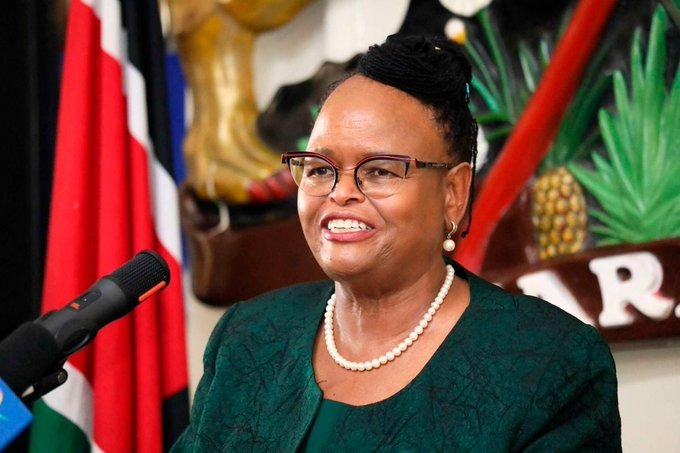
 Chief Justice Martha Koome/X
Chief Justice Martha Koome has called on the Employment and Labour Relations Court (ELRC) to spearhead efforts towards a fully paperless Judiciary, urging the expansion of virtual hearings and greater use of digital platforms to boost efficiency, transparency, and access to justice.
Speaking during the installation of Justice Monica Mbaru as the new Principal Judge of the ELRC at Milimani, Chief Justice Koome acknowledged the strides already made through virtual proceedings but stressed that more work is needed to institutionalise these gains.
“Technology remains a key enabler of judicial transformation,” she said, highlighting the Judiciary’s ongoing reforms under the Social Transformation through Access to Justice (STAJ) Blueprint.
The initiative seeks faster case resolution and aims to ensure no case remains in trial courts for more than three years.
The Chief Justice pointed to the ELRC’s recent achievements, noting a remarkable case clearance rate of 132 per cent in the last financial year.
“Innovation and the growing use of technology have contributed significantly to this success,” she said. Yet, she cautioned that sustaining these gains will require continued commitment to digitisation and process reform.
Justice Koome also urged the court to rethink management structures, embrace localised innovations, and strengthen alternative dispute resolution mechanisms, including mediation and conciliation.
“At the same time, the Court should continue to strengthen its commitment to the multi-door approach to justice. Mediation and conciliation, as provided for under the Employment and Labour Relations Court Act, are vital tools for expeditious and amicable dispute resolution. These mechanisms not only ease the burden on the courts but also promote sustainable and mutually beneficial outcomes,” she said.
She further emphasised the need for the ELRC to develop jurisprudence that is socially responsive and rooted in constitutional values. Such jurisprudence, she said, must serve the interests of employers, employees, and society while contributing to the global evolution of labour law.
On leadership, Chief Justice Koome underscored the collective responsibility of driving judicial excellence. “Leadership in the Judiciary is not vested in one individual alone; it is a collective responsibility. The Principal Judge, together with all judges and staff of the ELRC, must act as drivers of excellence—championing performance, innovation, and accountability,” she said.
Deputy Chief Justice Philomena Mwilu also highlighted the weight of the Principal Judge’s office, noting that it demands both judicial excellence and leadership to guide the court in fulfilling its constitutional mandate while improving service delivery to Kenyans.
Labour Principal Secretary Shadrack Mwadime, representing the Ministry of Labour and Social Protection, said the ELRC holds a strategic role in balancing workers’ rights, employers’ obligations, and broader economic stability.
“The world of work is undergoing profound transformation driven by technological change, increased labour mobility, the rise of the gig and platform economy, and evolving employment relationships. These shifts are redefining how labour is organised, regulated, and protected, placing greater demands on our legal and institutional systems,” he said.
Justice Monica Mbaru, elected unopposed for a five-year term as Principal Judge, vowed to advance the STAJ Vision. “I will champion efficiency in case management, strengthen institutional capacity, promote integrity, and support innovation within our courts. I will also prioritise access to justice for the most vulnerable and ensure that the ELRC continues to stand as a beacon of excellence,” she said.
Justice Mbaru succeeds Justice Byram Ongaya, who was elevated to the Court of Appeal after a four-year tenure marked by significant improvements in jurisprudence and service delivery.

![[PHOTOS] The new Ngong –Naivasha Road viaduct](https://cdn.radioafrica.digital/image/2026/06/64d4f771-4432-4aee-ba3c-2f304c4436ec.jpg)










![[PHOTOS] 'Mr Speaker Sir' Gen Z protester in court](https://cdn.radioafrica.digital/image/2026/06/b3e62d8e-25c3-4780-90f9-4eb48b1ce8a7.jpg)
