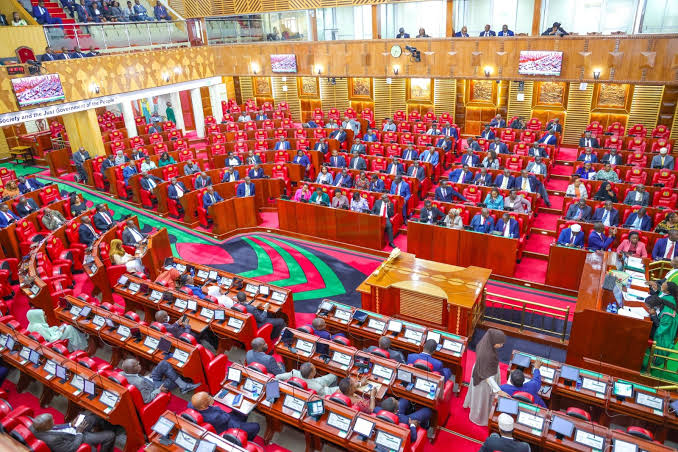
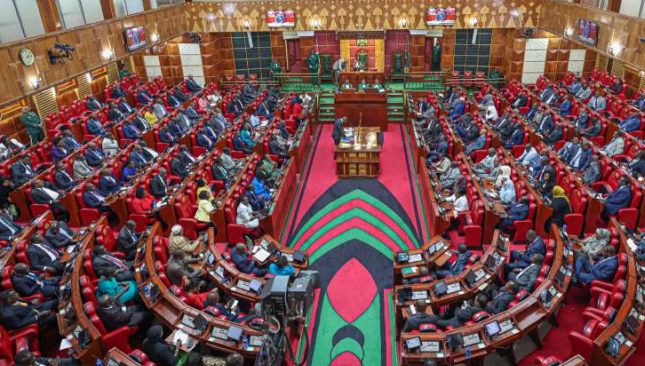
The Star has established that President William Ruto’s UDA and Oburu Odinga’s ODM are plotting a major purge of
errant committee members as Parliament resumes plenary sessions this week.
The move is expected to rein
in dissenting members while consolidating the emerging broad-based political
arrangement between the two parties.
The planned shake-up is
expected to dominate the opening days of the session and is aimed at
disciplining MPs who defied party positions during recent by-elections.
Legislators, returning on
Tuesday after a long break, for the Fifth Session of the 13th Parliament, have a packed legislative and political agenda expected to test party
discipline and reshape power dynamics in both Houses.
Atop the agenda are de-whipping
renegade lawmakers from influential committee positions, consideration of key
budgetary documents and approval of far-reaching infrastructure financing
proposals.
Legislators will also
deliberate on the sale of 15 per cent of government shares in Safaricom and
electoral reforms linked to the National Dialogue Committee (NADCO) report.
The lawmakers will also
vet the nomination of Ida Odinga as Kenya’s ambassador and permanent
representative to the United Nations Environment Programme.
Politics first. Squarely
in the crosshairs are those perceived to be opposed to the evolving UDA-ODM
pre-election pact.
The House leadership will
use the reorganisation to reassert authority over rebellious legislators while
creating room for six newly elected MPs.
In the National
Assembly, the purge is expected to hit Bumula MP Jack Wanami Mwaboka, the chairman
of the powerful Public Investments Committee on Education and Governance. His
deputy, Kitutu Chache MP Anthony Kibagendi, is also expected to lose his
position.
The duo has been vocal
critics of President Ruto and the broad-based government arrangement.
Saboti MP Caleb Amisi is
similarly facing sanctions from ODM. Party insiders say he could be removed as vice-chairman
of the Public Investments Committee on Social Services after openly campaigning
for DAP-K candidate Seth Panyako.
Amisi’s actions during
the by-elections on November 27 ran contrary to ODM’s official endorsements under
the broad-based coalition.
Kitutu Masaba MP Clive
Gesairo is expected to be dropped from the Education Committee.
Borabu MP Patrick
Onserio is also likely to lose his slots in the influential Education and
Research committees.
The is expected to be demoted
and reassigned to the Members’ Facilities and Services Committee, popularly
known as the Catering Committee.
The move is considered an
unmistakable political downgrading and punishment. Kabuchai MP Majimbo
Kalasinga is also under scrutiny.
He is likely to be
removed from Kenya’s delegation to the Pan-African Parliament and stripped of
key committee assignments.
Kalasinga is accused of
financing and backing independent candidate Chris Wekesa in the Chwele-Kabuchai
ward by-election. Wekesa defeated Ford Kenya’s Vincent Maundu, the preferred
candidate of National Assembly Speaker Moses Wetang’ula.
The disciplinary net is
also expected to snare Parliamentary Service Commission members Nyali MP
Mohamed Ali and Nyamira Senator Okong’o Omogeni.
The two are said to have
led campaigns against their parties’ endorsed candidates in Magarini and
Nyamira counties.
The two parties’ leadership
views their actions as direct affronts to party unity.
In the Senate, Nairobi
Senator Edwin Sifuna could also face sanctions. Sifuna, who is also the Senate
Deputy Minority Whip, has been outspoken against his ODM party’s decision to
support President Ruto.
The payback will be
followed by intense legislative work.
Last week, Senate Clerk
Jeremiah Nyegenye led a one-day retreat for Senate staff ahead of the busy
period. He urged staff to remain focused and adaptable as Parliament resumes
its constitutional responsibilities.
“I encourage you to
remain resilient, energised and fully adaptable in your service to the people
of Kenya,” Nyegenye said.
Both Houses will consider
the 2026 Budget Policy Statement (BPS) and the Debt Management Strategy (DMS).
The National Treasury is
required to submit the two documents to Parliament by February 15.
The BPS outlines the
state of the economy, the medium-term fiscal outlook, and proposed expenditure
priorities. It also sets out indicative allocations for county governments.
The DMS details Kenya’s
debt profile, borrowing strategy, government guarantees and an assessment of
debt sustainability.
Once approved, the
documents will form the basis of the Division of Revenue Bill. That legislation determines how revenue is shared
between the national and county governments.
Thereafter, the Senate
will determine allocations for each county through the County Allocation of
Revenue Bill, 2026.
The Senate will also
consider the County Governments' Additional Allocation of Revenue Bill, 2026,
and related disbursement schedules.
The heavy Senate workload
includes 63 bills pending conclusion.
Of these, 18 are at the
Committee of the Whole stage, 42 are at second reading, and three await first reading.
Several motions on
select committee reports that lapsed at the end of the Fourth Session must be
reintroduced. These include the Mediation Committee report on the Coffee Bill.
Motions on petitions,
inquiries, and county oversight visits are also pending. At least 19 petitions
are before Senate committees.
The Senate is also
expected to conclude consideration of the Auditor General’s reports on counties
financial problems by March 31.
A Senate technical report
warns the 2027 election year may disrupt the budget calendar. “With 2027 being
an election year, heightened political activity may necessitate reorganisation
of the budget calendar,” the report read.
In the National
Assembly, Speaker Wetang’ula has cautioned MPs against actions that could delay
resource allocation to counties. He warned that oversight lapses often result
in stalled or reduced disbursements.
“I urge Parliament to
ensure we are not the cause of delayed allocation of resources to counties,”
Wetang’ula said during the MPs’ retreat in Naivasha.
The House will also
consider the government’s proposal to partially divest itself of its stake in
Safaricom PLC in order to raise revenue. The plan seeks approval for the sale
of 15 per cent of government shares to Vodacom Group.
The transaction is
expected to raise about $1.57 billion in non-tax revenue. The funds are
earmarked for major infrastructure projects in roads, water and energy.
If approved, government
ownership in Safaricom would reduce from 35 per cent to 20 per cent.
Another major agenda
item is the proposed establishment of a National Infrastructure Fund and a
Sovereign Wealth Fund.
The proposed framework
aims to attract large-scale private capital while reducing reliance on public
borrowing. The funds are designed to support priority projects in food
security, transport, logistics and energy.
Planned investments
include large-scale irrigation schemes, the dualling of 2,500 kilometres of
highways and extension of the standard gauge railway.
Energy plans include
adding at least 10,000MW from renewable and nuclear sources. Energy and natural
resource matters will also feature prominently.
Parliament will consider
the Field Development Plan and Production Sharing Contracts for oil blocks T6
and T7 in Turkana county. The agreements between the government and Gulf Energy
require parliamentary ratification.
Public participation is
currently underway in both Houses. If approved, the projects are expected to
reduce reliance on imported oil and ease fuel prices over the long term.