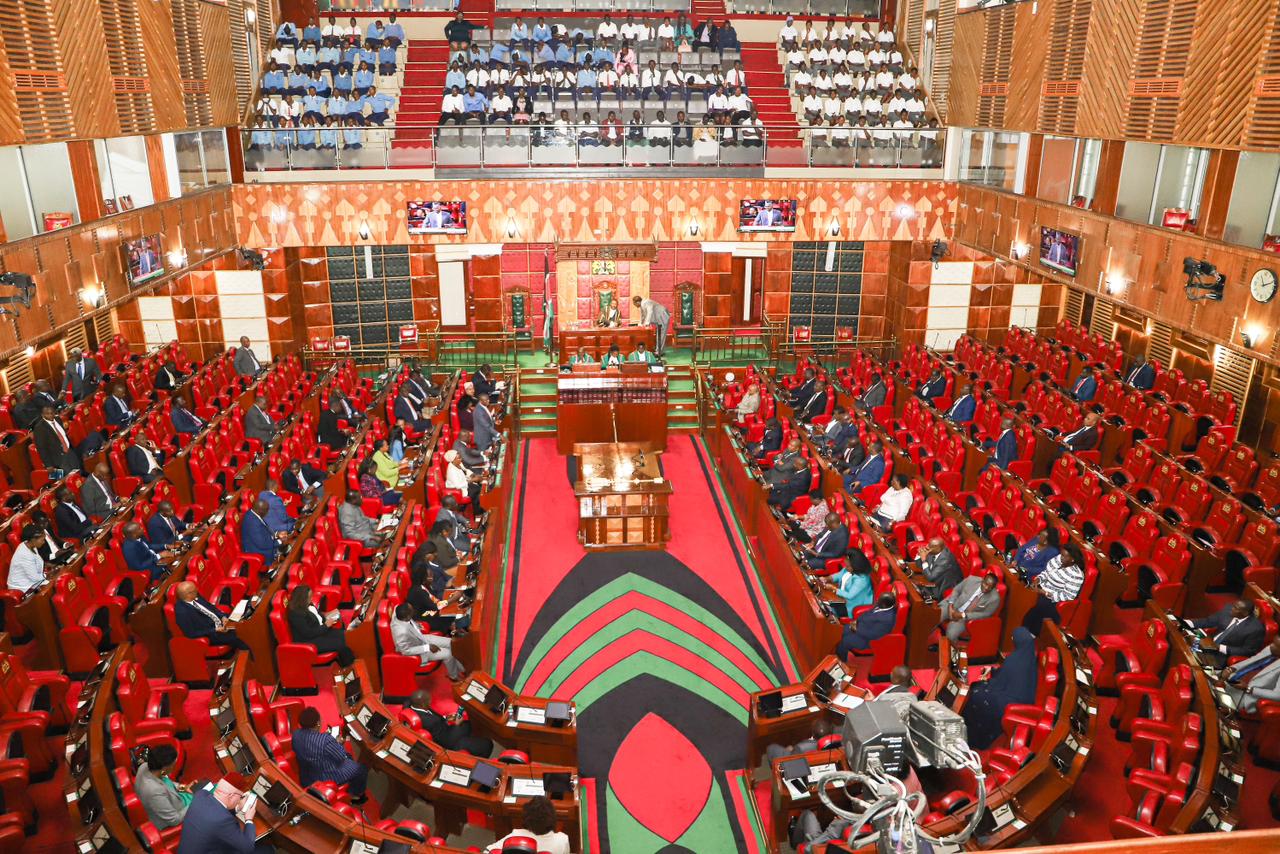
Lawmakers have thrown
a spanner in the works and potentially disrupted 2027 poll preparations as they
called for urgent review and updating of the country’s electoral boundaries.
The National
Assembly’s Constitutional Implementation Oversight Committee has warned of a
major legal and political disaster if the “critical” boundary assessment and
correction are not completed before the next general election.
In a report after
scrutiny of the electoral body’s performance, the committee said failure to
carry out the delineation in time would undermine the integrity of the 2027
General Election.
The
boundaries review determines voting areas and blocs, many of which have shifted
since the last review. New numbers could split votes, eliminate blocs
and affect campaigning and outcomes.
“The boundaries
delimitation period has lapsed [in March
2024] and it needs to be completed before the general elections in
2027,” the committee reported. The panel is chaired by Suba North MP
Caroli Omondi.
The lawmakers demanded
the commission report back to Parliament, detailing concrete steps it has taken
to “initiate the boundary delimitation process”.
The demand pits MPs
against the Independent Electoral and Boundaries Commission (IEBC), as the
electoral agency has said boundary review is not feasible within the 2027
timeline.
“The commission is
considering its options, noting the timelines, competing commission activities
and the necessity of the boundary delimitation exercise,” the commission said
in submissions to MPs. The IEBC is chaired by Erastus Ethekon.
“The situation is a
constitutional crisis that requires Parliament itself to act,” the polls agency
chairman said.
MPs, however, reject
this absolutist stance. Committee chairman Caroli Omondi, the Suba North MP,
said a legal window remains open, allowing the polls to progress and allowing
delayed delimitation.
“Any review must be
completed at least 12 months before a general election, and the new boundaries
shall not take effect if a general election is held within 12 months after the
completion of the review. The 12 months have not, therefore, been exceeded,” he
told the Star in an interview.
He said the committee
has directed the commission to seek an opinion of the Supreme Court on the
matter.
Article 89 of the constitution
requires the IEBC to review boundaries at intervals of not less than eight
years and not more than 12 years.
The last review was
completed in 2012, the eight-year window lapsed in 2020, and a hard deadline of
March 6, 2024, passed without action.
The problem had
worsened because the IEBC lacked the required quorum of commissioners to make
decisions, crippling its capability to decide and act.
The commission
secretariat had turned to the Supreme
Court for an opinion but was turned down.
Critically, the
Supreme Court concluded that delays under Article 89 that requires IEBC to
carry out boundary delimitation can only be addressed through parliamentary
initiatives.
“The lapse created a
constitutional difficulty, but the court clarified that it lacked power to
retrospectively extend or amend those timelines,” a brief on the ruling read.
Despite this ruling,
the judges held that the timelines under Article 89(2) and (3) of the constitution
were binding and could not be disregarded.
The court held that
only Parliament could establish mechanisms for extending timelines in
exceptional circumstances.
A resolution passed by
a majority of National Assembly members and a majority of the county
delegations in the Senate is required. This means the vote
has to be supported by at least 233 members of the National Assembly in plenary
and 45 in the Senate.
A draft bill under the
National Dialogue Committee framework contains a clause requiring Parliament to
vote for an extension of electoral boundaries delimitation. It is yet to be
considered.
Legal and logistical
hurdles have compounded the constitutional crisis.
MPs said the validity
of population data from the 2009 and 2019 censuses remains contested in court.
“This is creating uncertainty
for the boundary delimitation exercise, which relies on accurate population
data,” the committee said.
The data IEBC is to
use for a fair review has been brought into disrepute, amid imminent fear that
delays “risk igniting community, sectarian, class and religious conflicts”.
MPs have acknowledged
the high stakes in redrawing the political maps, even as the future of 27
constituencies, whose protection lapsed in March 2024, hangs in the balance.
They are Voi,
Wundanyi, Mwatate, Galole, Bura, Isiolo South, Samburu East, Laisamis, North
Horr, Saku, Kilome, Mukurweini, Mbeere North, Mathioya, Ndaragwa, Budalang’i,
Vihiga, Othaya, Mathioya, Kangema, Marakwet East, Keiyo North, Tetu, Mogotio,
Lamu East, Lamu West, and Mvita.
In 2012, these constituencies
did not meet the population threshold of 164,000,
making them invalid.
A severe financial
crunch at the polls management body threatens to derail both the delimitation
and the 2027 elections.
The IEBC reports a
budget deficit of Sh7.63 billion for the general election, and is saddled with
Sh5.75 billion pending bills from previous polls.
The commission argues
that preparations for the 2027 polls make undertaking the review impractical.
IEBC chief executive
officer Hussein Marjan said it could take at least a full year to conduct a
satisfactory and credible boundary review.
He cited the high
level of public participation required across the 290 constituencies to arrive
at an acceptable outcome.
Despite the impasse,
IEBC says it has undertaken extensive preparatory work for the review.It already has
prepared a delimitation concept paper, the boundaries review operations plan
and a situational analysis.
The IEBC also has
carried out a pilot study, collected and digitalised administrative units'
geo-data, acquired equipment (funded by UN Development Programme), and trained
staff.
Besides reviewing the
legal framework, IEBC says it has developed delimitation applications and map
and a standardisation manual.
A plan for security
arrangements, civic education and public outreach strategies are also under
consideration.
The IEBC already has
disclosed to MPs that a project and technical boundaries delimitation team to
manage the review is already in place.
IEBC staff have been
trained on the new technology and requisite applications have been developed.
Boundaries Hub a digital
platform that members of the public will use to submit memoranda ¾ is also ready.
A map standardisation
manual also has been used by cartographers when producing the commission's
maps.
A Boundaries Security
Arrangement Plan (BSAP) is also in place to avert anticipated community
flare-ups when voting numbers are adjusted to the benefit or detriment of some
communities and political figures.
Some constitutional
lawyers say that nothing stops the IEBC from conducting a review before 2027.
Lawyer Bobby Mkangi
argued that only war or a natural disaster can create a crisis to delay the
process.
Kamotho Waiganjo said
the danger is that the 2027 elections will not meet the constitutional threshold. He warned against courts taking a technical approach to the
question and said tan extension by Parliament “only sidesteps the issue".
INSTANT ANALYSIS
The MPs’ report sounds
a final warning siren. It is less than two years to the 2027 elections, yet the
IEBC is underfunded, behind schedule on a critical constitutional task, and
struggling and at pains to regulate a new digital battlefield. The countdown to
avert a full-blown crisis has well and truly begun.