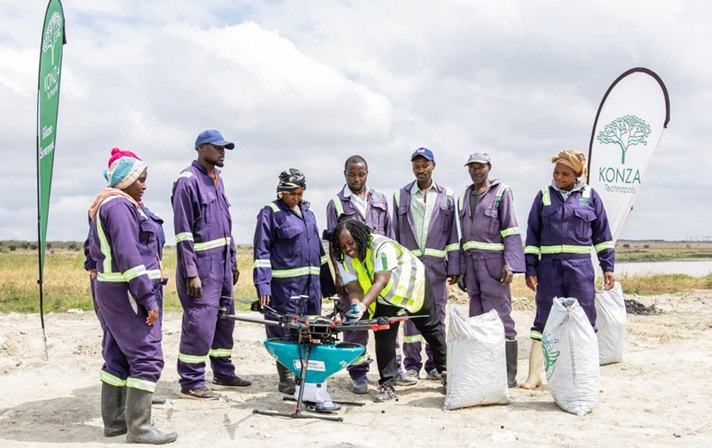
 Technopolis Development Authority Chief Manager Physical Planning Compliance and Environment Annah Musyimi (Centre) loads seed balls into a drone ahead of the seed broadcast at Konza Technopolis that saw over 36,000 seeds broadcast via drone over 400 acres within the Konza Technopolis Wildlife Conservancy/HANDOUT
The Technopolis Development Authority has deployed drones to broadcast 75 kilogrammes of seedballs across the Konza Technopolis Wildlife Conservancy in a move aimed at restoring degraded land and promoting environmental conservation through technology.
The drone-assisted exercise covered about 1,000 acres of degraded savannah within the conservancy, making it among the first large-scale ecological restoration initiatives using drones in an urban-adjacent conservancy in Kenya.
According to the Authority, the seedballs contained three indigenous tree species, such as wild olive, whistling thorn (shittah tree) and fever tree, which are expected to enhance vegetation cover and support long-term ecosystem restoration.
Seedballs are compact spheres made from charcoal dust, clay and compost that encase seeds, protecting them from predators while retaining moisture and providing nutrients that improve germination rates compared to conventional seed broadcasting.
The Authority said the use of drones enables rapid, accurate and large-scale dispersal of seeds, significantly improving the efficiency of landscape restoration efforts while reducing the time and labour required for manual planting.
Chief Manager for Physical Planning, Compliance and Environment Annah Musyimi said the initiative demonstrates how emerging technologies can accelerate environmental conservation and sustainable natural resource management.
"Technology is undoubtedly a game changer and we as the Technopolis Development Authority have taken the lead in showcasing this. Today we have witnessed our drones deploy a total of 75 kilogrammes of seedballs containing three different tree species over a total land area of 1,000 acres in a matter of minutes," Musyimi said.
She said embracing technology would help improve productivity in both the conservation and agricultural sectors.
"It is therefore key for not only us but the majority of the conservation and agricultural sector to embrace technology to aid productivity and development across our nation," she said.
The Authority said the exercise highlights the role of innovation in ecological regeneration while positioning Konza Technopolis as a centre for research and technology-driven environmental solutions.
The conservancy is home to the Konza National Drone Corridor, a dedicated testing and innovation facility for unmanned aircraft systems that supports the development and validation of drone technologies across multiple sectors.
The Authority said the facility provides a controlled environment for testing drone applications in areas such as agriculture, environmental conservation, infrastructure and public service delivery.
It added that the government continues to promote collaboration among ministries, state agencies, research institutions, technology providers and local communities to encourage the adoption of innovative agricultural practices and strengthen environmental conservation and food security initiatives.