Kenya is facing a rapid transition away from its biggest
health donors.
Under current plans, Kenya’s Gavi support will end by 2032,
while the new US health agreement commits Kenya to fully self-fund US-backed
programmes by 2031.
Gavi has been supporting Kenya's national vaccination
programme since 2001, providing vaccines and related supplies worth more than
$950 million (Sh122.5 billion), according to the Ministry of Health.
The new US-Kenya health agreement also requires Kenya to
take over US-funded programmes and absorb thousands of health workers by 2030.
The US will put in about $1.6 billion (Sh206.4 billion) over
five years while Kenya must raise roughly $850 million (Sh109.65 billion) over that
period, after which US funding will phase out.
These timelines put Kenya on track to lose most external
health financing within five years.
“The framework is intended to continue for five years, after
which the participants plan to review implementation of the activities under
this framework and may extend the duration by mutual decision,” the US-Kenya
deal says.
Under Gavi’s rules Kenya entered an “accelerated transition”
in 2022 and was on track to fully fund its vaccines by 2029.
However, in May this year, Health Cabinet Secretary Aden
Duale pleaded with Gavi for more time, proposing to revert to a slower
“Preparatory Transition” phase.
Gavi did extend
Kenya’s exit schedule: its five-year financing phase was stretched to eight
years, giving Kenya until about 2032 to fully assume costs.
“This partnership has been truly transformative,” said
Treasury PS Dr Chris Kiptoo. “Thanks to Gavi’s support, Kenya’s immunisation
programme has been significantly strengthened, ensuring that millions of
children across the country are protected from vaccine-preventable diseases.”
These donor exit dates come just as Kenya continues to lean
heavily on aid. Health experts note that Kenya’s health system is dangerously
dependent on a handful of donors.
A World Bank health economist points out that four donors —
the US, the Global Fund, the UK and Gavi — supply 89 per cent of Kenya’s
external health aid.
“Donor dependency is also high in key health sub-sectors in
Kenya, particularly TB, HIV and immunisation. Kenya’s health sector has a high
donor concentration, with just four donors (the United States, the Global Fund
to Fight Aids, Tuberculosis and Malaria, the United Kingdom and Gavi, the
Vaccine Alliance) making up 89 per cent of health ODA (official development
assistance),” Dr Kenneth Munge, a health economist with World Bank, said in a
study.
He noted that this extreme concentration means Kenya is
vulnerable to any one donor pulling back.
Kenya’s domestic health budget has remained stagnant, and
actually shrank in some years. For example, the 2023-24 allocation to the Health
Ministry was Sh141.2 billion, only 11 per cent of the total budget, down from
Sh146.8 billion (about 12 per cent) in the prior year.
That means even without adding new services, the share of
government spending on health remains well below Africa’s Abuja target (15 per
cent of total budget).
Analysts warn that this flat or falling trend — despite
Kenya’s rising middle-income status — leaves little breathing room for new
obligations. Once donors step away, the government would have to make urgent
budget shifts.
Last year, a survey in 15 counties indicated Kenya was not
ready to foot the bill for childhood vaccines when donor funding ends by 2032.
At least 77 senior county officials from 15 counties were
interviewed and all agreed that neither the national nor county governments
show any readiness to handle the costs of immunisation independently once Gavi
exits.
These vaccines cost about Sh36 billion every year but the
government only provides Sh4 billion, being cost of freight and distribution.
Treasury has previously failed to timely disburse co-financing payments to
Gavi.
Earlier last year, the country experienced stockouts, which
former Health Cabinet Secretary, Susan Nakhumicha attributed it to outstanding
claims of unpaid funds for distribution. The government owed the supplier
between Sh1.5 billion and Sh2 billion. “Vaccines should be accommodated in the
national annual budget. I think they should factor it in the national budget
because it needs a huge sum of money,” said one county official.
The study, “Are we ready to transition from the Global
Alliance for Vaccines and Immunization support? Perceptions from 15 Kenyan
counties”, was published in the Pan African Medical Journal.

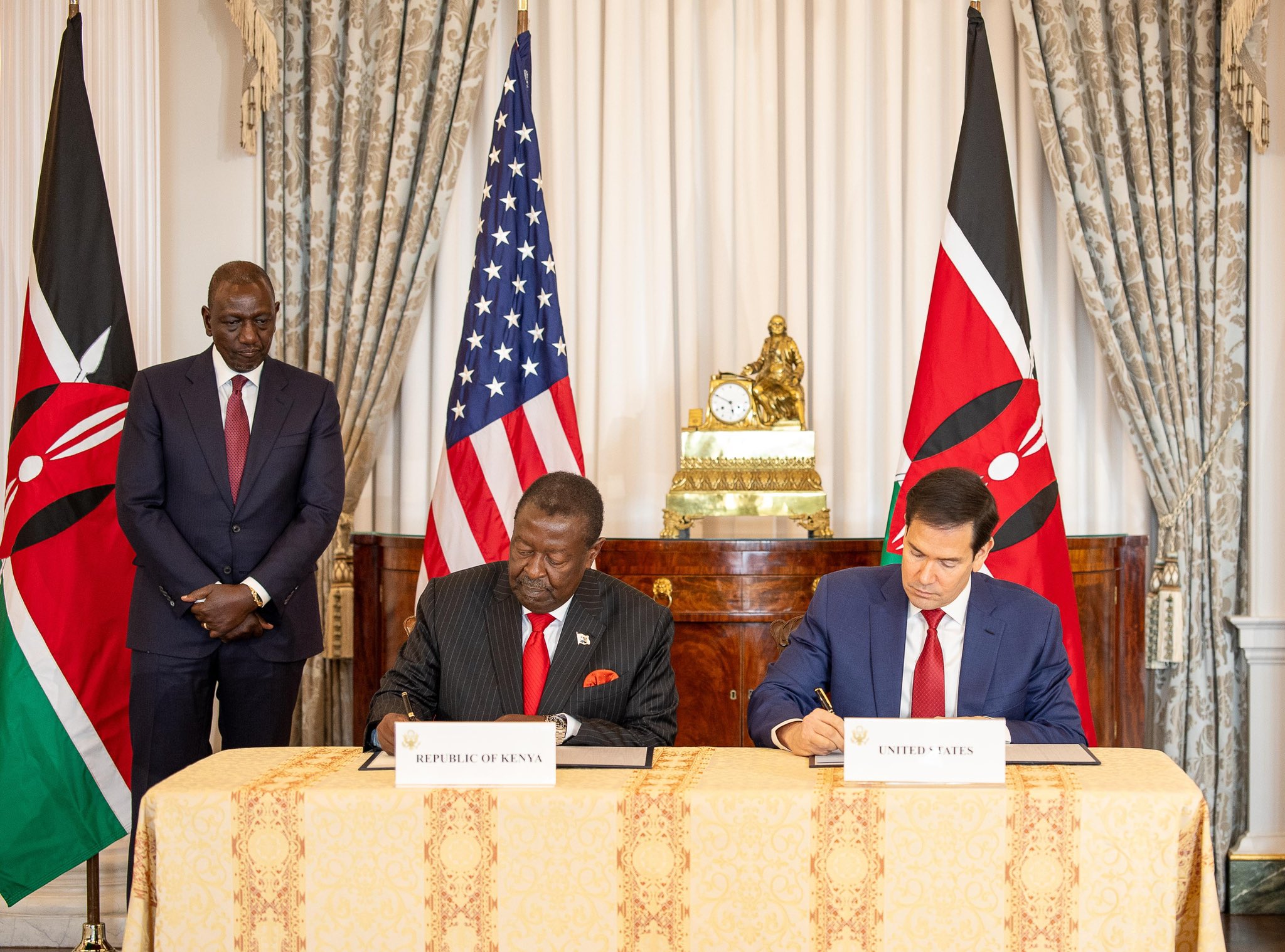 President William Ruto witnesses the signing the Kenya– US Health Cooperation Framework by Foreign Affairs CS Musalia Mudavadi and Secretary of State Marco Rubio in Washington DC, United States, on December 4 /PCS


![[PHOTOS] The new Ngong –Naivasha Road viaduct](https://cdn.radioafrica.digital/image/2026/06/64d4f771-4432-4aee-ba3c-2f304c4436ec.jpg)




![[PHOTOS] 'Mr Speaker Sir' Gen Z protester in court](https://cdn.radioafrica.digital/image/2026/06/b3e62d8e-25c3-4780-90f9-4eb48b1ce8a7.jpg)