This
country has had five presidents since independence. My favourite is Uhuru
Kenyatta. And that is because, in my view, he was the only one who ever
acknowledged and tried to address the “original sin” of the nation, namely the
breakdown of ethnic relations that gave rise to the divisions, marginalisation
and attendant stunted development that both tend to cause. In supporting Raila
Odinga, the long-term hate figure of his Kikuyu people, for President in the
2022 election, the former president made the toughest call of any leader in
this country in 70 years.
It
was a decision fraught with political risks, especially given that the opponent
on the ballot was someone he had warned his community to seriously beware of.
It was evident that Uhuru’s own political and state systems, made up of power
wielders from his community, were uncomfortable with the proposition, but their
boss obviously underestimated the entrenched sociocultural and political hate
that been manufactured, for decades, and indoctrinated among his people,
against the ODM leader and the latter’s Luo community. The project failed.
In
subsequent months and years, some of Raila’s own supporters have generously
made the claim that Uhuru had all along been engaged on a “long con” game,
supposedly working with his estranged deputy, William Ruto, while taking the
ODM boss for a ride. I have never bought this claim. The passion with which the
former President worked to stop the ascendancy of Ruto to the presidency, and
the consistent warnings to his people, are things which wouldn’t possibly be
used to mask a con game. I am persuaded that Uhuru meant it, and loved the
nation enough to risk a move like this.
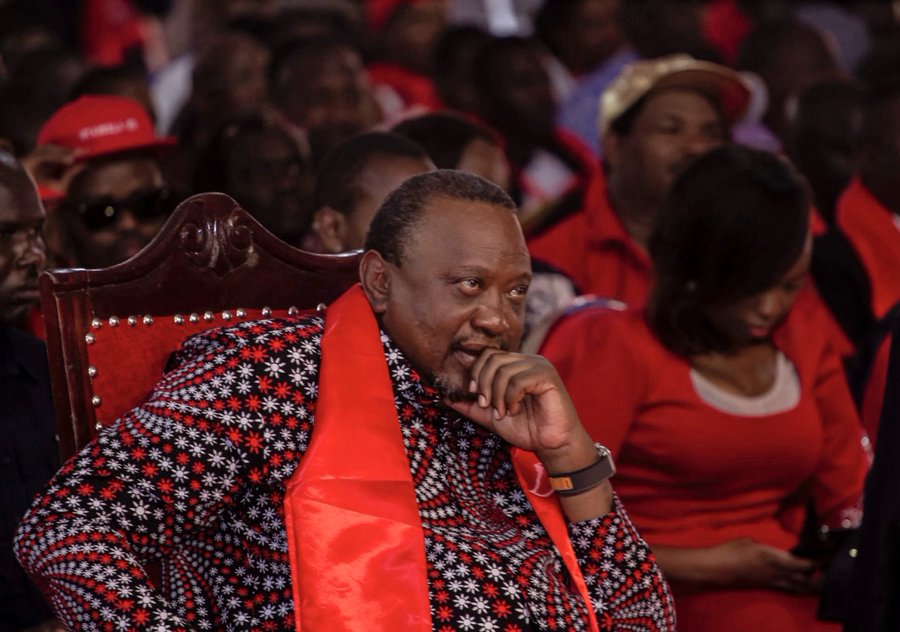
Last
weekend, the former president reappeared, in full political force, at his
Jubilee party’s National Delegates Conference. After he spoke, both the
government and the opposition seemed angry with him. Government functionaries
and the regime’s notorious social media hashtag warriors were enraged by
Uhuru’s comparison of certain gains from his rule that he thinks have been
negated by the Ruto government.
The
opposition, led by impeached DP Rigathi Gachagua, on its part, was apprehensive
that Uhuru’s re-entry into the country’s politics, while appearing to back his
former Interior CS, Fred Matiangi, rather than join forces with Gachagua in a
desired Mount Kenya movement, would help divide the region and play into the
hands of Ruto. However, in his speech at the Jubilee function, the former
President seemed to dismiss Gachagua and his movement wholesale.
I
have stated before that, whatever faults one may find with Uhuru, the one thing
that is certain is that he has always loved the country and put it first,
before any other considerations. This is an alien gospel to the Gachagua choir.
The truth being that outside his adoring Kikuyu base, Gachagua is largely a
despicable, detestable and divisive character. If anything, I suspect that his
unending political and tribal rhetoric only aims to create the conditions and
environment for the election of as many MPs on his party in 2027, from his
region, being numbers with which he can blackmail the next president into
making concessions for him, the way he did with President Ruto in the early days
of this regime.
The
lesson for the impeached DP is simple; even those who seek alliances with his
Kikuyu community need a good Kikuyu, not a divisive one fuelled by tribal rhetoric
like him. And indeed, Uhuru is a good one, someone with whom other regions would
readily make deals. In fact, if it turns out that Uhuru prefers Matiang’i for president
in 2027, one electoral cycle after his unequivocal support for Raila in 2022,
he will have vindicated himself as the “good Kikuyu” whose vision and foresight
transcends ethnic boundaries, something I believe Gachagua will never master in
his entire life.
I
am excited by the return of Uhuru because he will most likely accord the nation
a third force in the 2027 election. In fact, the more difficult it becomes to
tell where ODM stands, as the long-term distinct voice of the oppressed, the
more voters orphaned by ODM’s capitulation in government will look up to Uhuru
for direction. The former president was in power just three years ago, so his
tentacles still run deep within the financial, political and security networks
that run the country. I am certain that those who dismiss him do so at their
own peril.
Jubilee
is yet to state unequivocally that it will present Matiang'i as its presidential
candidate in 2027. But if they do, they need to find a way to make him a bit
more exciting on the political trail than he already is. His speeches are flat,
and in a country where aesthetics matter, he dances like a man undergoing a
seizure of some sort. Besides, his dismissal of accusations of police brutality
during his reign as Interior CS, especially the sticky issue of the River Yala
bodies, is too casual. I think the former CS and his team must address this
latter matter conclusively, and stop assuming that it will just go away.
There
is yet another tricky proposition coming up. Uhuru may have the financial might
or political networks, but his ‘project’ will need either Raila’s bases and
mobilisation skills, or the nascent opposition movement that includes Gachagua,
to make a proper stab at the presidency in 2027. Additionally, since Matiang’i
comes from a smaller community, away from the three that tend to define the
destiny of elections, this team must rope in one or two of the major ethnic
bases, by roping it their influential leaders into the project.
But
there is danger in well-laid plans becoming apparent too soon. If the formation
is done too early, it will become too easy to scuttle. However, too late also
may mean activating a formation when the people have already been lost to more
organised opponents. My experience is that the winning party or coalition, or
any consequential electoral movement, since 2002, is usually cobbled up as a
last-minute venture. This narrative would fit neatly into how the Narc Rainbow
coalition came into being in 2002, the origins of both ODM and PNU in 2007, as
well as the quick-fix coalition arrangements that have been reached in
subsequent elections.
Based
on the foregoing, the party or coalition that will win the 2027 election, or
the ones that will give it a run for its money on the ballot, will become
clearer just a few months to the election. But while we wait for that, there is
comfort to be drawn from the return of Uhuru to the political scene, to become one
of those who seek to steer the political platform ahead of what may possibly be
the most divisive election yet. This comfort, I submit, is based on the overriding
fact that the former president, regardless of his faults, has shown over and
over again that he cares enough for the country to err on the side of
statesmanship, rather than swim with the popular tribal wave. At a time when
such statesmanship and wisdom are critical to the survival of the nation, and
the future stability of our democracy, I am overjoyed to him return as a
frontline player in the pre-election season. It can only get better from here.

 Former President Uhuru Kenyatta during Jubilee's National Delegates Conference / FILE