The uniform donned by a member of the disciplined forces is a gazetted symbol of authority, legitimacy, pride and commitment to serve the republic, carrying the possibility of personal risk.
It is, therefore, an item that doesn’t match the spectacle of a uniformed security personnel going live on TikTok or other social media, to defy his superiors or other commands, seeking to garner the usual celebrity clout among social media users.
There is a thin line between that and anarchy.
The growth of social media as a tool of expression among young people, however, has also exposed the weak discipline and poor doctrine in sections of the security services, chiefly the police service.
It is not uncommon to find police officers, in full uniform, taking to those diverse media apps to express political opinions. Indeed, a celebrity athlete, known to be a police officer, used to be a common face at public rallies a few years ago, going the full hog to endorse an opposition candidate.
In more recent times, another celebrity musician, also a policeman, has been a regular performer at functions where political chants are generously made.
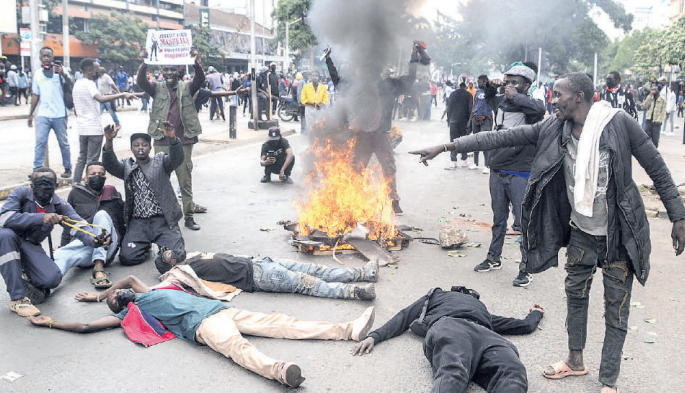
The highlight, however, remains the case of a police constable who, following the Saba Saba protests earlier this month, retreated to his social media account to announce to the public that he was rejecting a transfer to a remote part of the country.
He alleged the said transfer was grounded on malice, supposedly arising out of his refusal to implement a shoot-to-kill order from his superiors.
Security officers take an oath to defend the nation from its enemies after being trained on the taxpayers’ tab.
I’m not sure many of them realise it, but there are many more enemies of the country outside it, therefore, the borders are the best sentry points to encounter the nation’s adversaries.
I say this to demystify the widely held view by many members of the security establishment that postings to remote borders of the country constitute a form of punishment, although they still hold that they serve to protect the country.
Certainly, there can’t be as many national enemies at the preferred postings to weighbridges and banks!
I often make comparisons between the level of professionalism and discipline within the police service and that of the military. As I have stated before, the military is swift and firm in its response to misconduct.
Both servicemen and officers know what is coming as soon as they cross the line. Speaking of which, it is important to make a distinction that is usually muddled up by the media.
Whereas within the police service, everyone from constable to IG is referred to as “police officer”, the only officers in the military are commissioned officers from the rank of 2nd Lieutenant to General. The others are service members.
Kenyan media loves to lump all soldiers together as “military officers”. I remember watching a news item a few months back, when a local TV station reported that a “senior military officer” had been arrested for murder in Nakuru county.
And because senior military officers should generally be a reference to members of the General ranks (Brigadier to four-star General), I sat up straight to catch the news properly, wondering how such a senior officer would end up in such ignominy.
You can imagine my shock when the person turned out to be a sergeant, who in the military, is neither an officer nor senior.
Be that as it may, the fact that the police service is so heavily politicised and has too much contact with the civilian population, makes it prone to gross indiscipline within its ranks.
Indeed, officers facing disciplinary action within the service are not averse to seeking help from politicians and godfathers to quash any cases facing them.
These unseemly actions only perpetuate the culture of impunity that drives the outspoken nature of a few elements within the service. But there is no denying that the training and doctrine gaps among the police are too glaring to ignore.
Policemen and women in the public sphere, especially celebrity ones, have so much to learn from their military counterparts, among them Lieutenant Colonel Paul Tergat and Warrant Officer II Hellen Obiri.
They conduct themselves with dignity outside the barracks and are almost always conscious of the heavy responsibility that comes with service.
When they speak, they confine themselves to the sports they take part in, knowing the disciplined institutions they serve have spokespersons already. Obviously, there must also be the realisation that any misplaced words would seep into the ranks and plant seeds of discord.
Security officers know their roles require them to remain apolitical and to rise above the petty divisions within the civilian population.
They also know that the delicate tribal relations in the country call for the custodians of state instruments of violence to give a wide berth to political and tribal rhetoric driving these divisions.
Because the existential danger we face emanates from the possibility that security agents will resort to their ethnic lenses when dealing with the population. If that ever becomes the norm, we will have thrown the nation to the dogs.
Yet, even when a policeman may rightly claim he is fighting an unfair transfer, in the middle of a tribally charged protest season, such complaints can easily be fitted into existing political patterns and allocated ethnic tones.
I am clear in my mind that activism in the police ranks endangers public safety, because it opens the door to vociferous activists bearing lethal weapons.
It should be clear to all that any police officer who goes on social media and disparages his superiors or the institution itself, has already lost the requisite discipline it requires to stay in service.
I stated here two weeks ago that all the years of police reforms have, not surprisingly, concentrated mostly on the top command of the service, a reality based on the belief that if the top was reformed, then reform would flow down within the ranks.
Besides, the political class, the main actors in constitutional reforms, has always assumed that the identity and vetting process of the top echelons of the force were the main gaps in need of sealing in the old format of police leadership.
There is compelling evidence, however, that neglecting the lower ranks for so long now poses a long-term challenge.
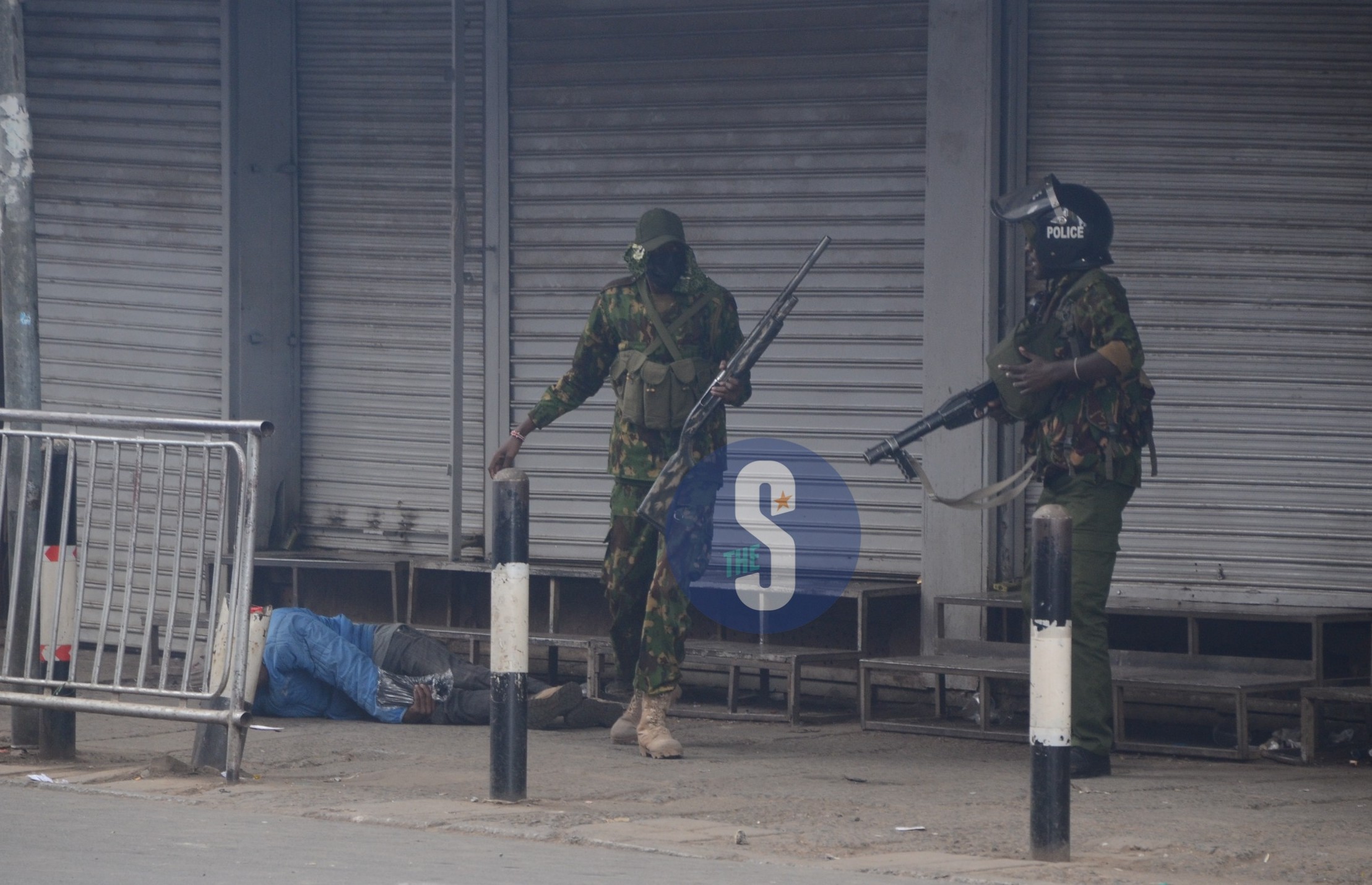
It is already too much that police brutality has become a perennial cancer in the country. The behaviour of riot police amidst recent protests has also raised questions about the level of professionalism and training in the service.
If we add to that mix “political police officers” who find the need to engage in public discourse over trending political issues, we have a time bomb. We joke too much in this country, even with very serious matters.
There was a reason that the founders of the nation didn’t countenance the idea of security officers forming and joining unions, until a recent court ruling. There is more reason it shouldn’t be easy for cops to go on social media and liberally express political opinion. Security is not a nursery school game.

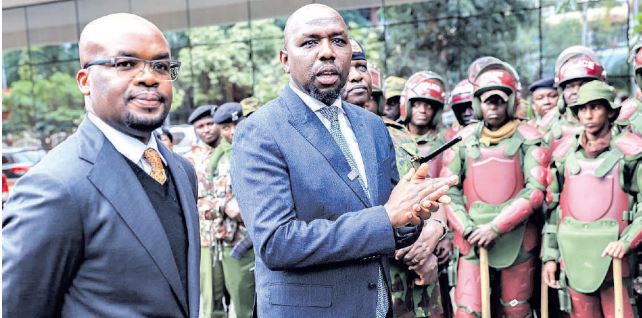 Interior PS Raymond Omollo and CS Kipchumba Murkomen with police officers on Saba Saba day on July 7 /HANDOUT