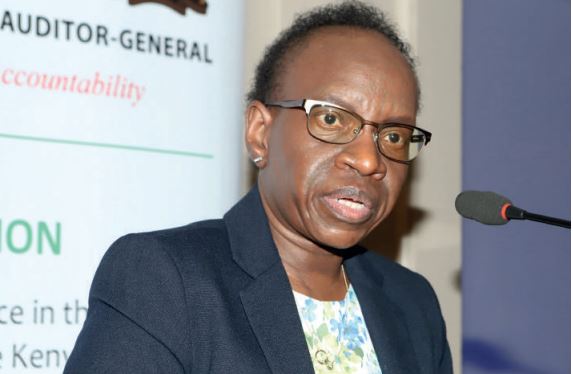
A new report by Auditor General Nancy Gathungu has put accounting
officers on the spot amid revelations of financial mismanagement and blatant
wastage of public funds within hundreds of donor-funded projects.
The revelations paint a grim picture of inefficiency and
potential graft that is costing Kenyan taxpayers billions in the projects
co-funded by development partners.
The comprehensive review, covering the financial year ending
June 30, 2024, audited 213 projects with a combined financial commitment of Sh2.285
trillion.
It reveals that despite gradual improvements in financial
reporting, numerous projects are plagued by infractions that undermine their
very purpose and burden the nation with unnecessary debt.
The most glaring finding is the colossal pile of pending
bills, which now stands at Sh68.88 billion across 115 projects.
This figure has seen a steady and alarming rise over the
last four years, ballooning from Sh35 billion in the 2020-21 fiscal year to
Sh48 billion, Sh65 billion, and now Sh68.9 billion.
Two road projects implemented by the Kenya National Highways
Authority (KeNHA) are the worst offenders: the Mombasa Port Area Road
Development Project (Sh7.73 billion in pending bills) and the Kenya Transport
Sector Support Project (Sh7.15 billion).
“These obligations primarily relate to delayed payments for
civil works, procurement of goods and services, consultancy contracts, and
staff-related dues,” Gathungu stated.
“Notably, in some instances, the bills have remained
unsettled for prolonged periods, undermining project timelines and delivery.”
The audit further revealed that many of these pending bills
lacked key documentation, such as registers and ageing analyses.
Most noticeably, responsible agencies failed to clear these bills
as the "first charge" of the subsequent year's budget as required by
law, an omission that could lead to sanctions against accounting officers.
In a finding that raises serious red flags for possible
misappropriation, 22 projects incurred expenditures totalling Sh2.55 billion
without any adequate supporting documentation.
These payments were made without approved work plans,
payment vouchers, contracts, or invoices.
The report also highlights severe implementation challenges.
At least 50 projects were significantly behind schedule,
while nine were found to have completely stalled.
The East Africa Skills for Transformation project at Meru
National Polytechnic has stalled, with Sh444 million in construction works
frozen due to court cases.
Similarly, the Bus Rapid Transit Line 5 Project had not even
commenced two years after its scheduled start, leaving Sh320.58 million in idle
funds. A separate audit flagged its proposed location.
Perhaps most serious are the 28 projects that remain
incomplete long after their contractual end dates. The dualling of Magongo Road
is 92 per cent complete, but 24 months past its extended deadline.
The East Africa Kidney Institute has been incomplete for four years
after its expected completion, even though the government has already begun
repaying the loan used to fund it.
The State Department for Agriculture was singled out as the
most affected, with projects worth Sh2.75 billion either incomplete,
underutilised, or abandoned, including unproductive boreholes in arid counties
and non-operational irrigation facilities.
Weak contract management led to direct financial losses for
the taxpayer, with the audit revealing that 17 projects incurred Sh4.88
billion in avoidable interest payments on delayed settlements to contractors.
The Covid-19 Health Emergency Response Project alone accounted
for Sh930.6 million of the avoidable payments and exposure to litigation.
In the same vein, 15 projects engaged in outright ineligible
expenditure amounting to Sh1.81 billion, spending funds contrary to financing
agreements and the law governing public finance.
In a telling case, the Africa Climate Summit Project spent
Sh475.52 million on a summit held in September 2023, even though the financing
agreement for the funds was only signed in November 2023, two months after the
event.
The Transforming Health Systems project spent Sh314.92
million despite having a nil approved budget, while the Kenya Water Security
project incurred Sh301.80 million in costs from idle time and premature connections.
The report further points to delays in fund disbursement
from both the government and donors, long-drawn procurement processes, and
inadequate oversight.
“These issues have resulted in inefficient utilisation of
resources, delayed delivery of intended benefits, and the risk of failing to
achieve project objectives,” Gathungu said.
INSTANT ANALYSIS
Some implementing
entities did not remit unutilised project funds back to the donors after the
expiry or completion of the project, contrary to the refund clauses in the grant
or credit agreements. Funds were, in
some cases, maintained in commercial bank accounts that were not specified
or approved under the financing agreements, undermining donor oversight
and financial controls. In some
instances, delays in drawing down committed funds exposed the government
to unnecessary commitment fees charged on undisbursed balances.









![[PHOTOS] Families, leaders attend funeral service of 16 Utumishi Girls fire victims](https://cdn.radioafrica.digital/image/2026/06/a363a6df-b59e-42c2-8d68-5c938d8500f0.jfif)