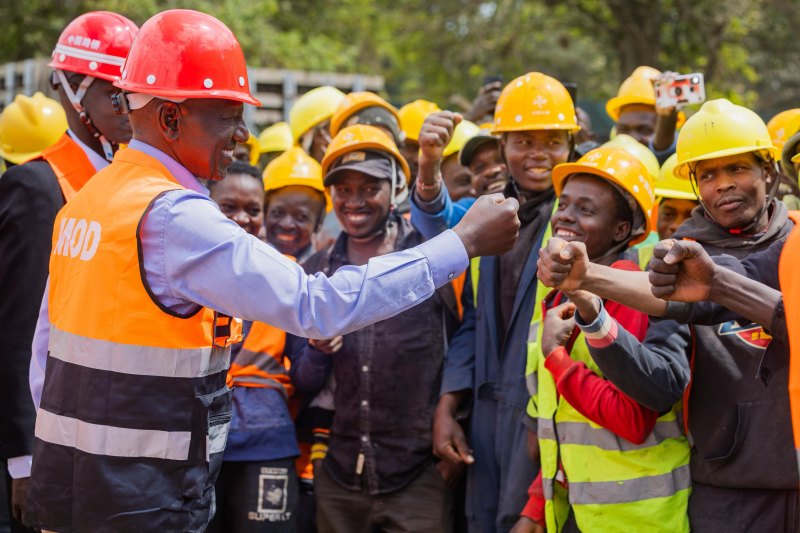
Ruto revealed a six-point "people-centered" plan that will see millions of job opportunities created and economic growth spurred.
The President spoke at Uhuru Gardens in Nairobi where he led the nation in marking the annual Labour Day celebrations, though this year there's not much to celebrate.
The event was attended by Deputy President Rigathi Gachagua, Cotu boss Francis Atwoli, Prime Cabinet Secretary Musalia Mudavadi, Labour CS Florence Bore and other dignitaries.
The head of state said his Kenya Kwanza administration has focused on revamping the agricultural sector, expanding industrial production and growing micro, small and medium enterprises.
The government has also embarked on signing bilateral labour agreements for Kenyans to secure jobs abroad.
“In our plan, we need to expand, to grow and to develop the Kenyan work force because that is the jewel of the resources we have in the Republic of Kenya,” Ruto said.
The State is also investing heavily in the digital space to tap into numerous job opportunities as well as focusing on the ambitious housing programme to bridge the housing gap and create real jobs for young people.
The President announced the plan at the time millions of Kenyans are facing hard times due to massive job losses partly attributed to the Covid-19 pandemic and the wracked economy.
Ruto also revealed his government’s far-reaching reforms in the health sector to reduce the disease burden as well transforming the saving model to ensure Kenyans enjoy decent life in retirement.
Addressing hundred of workers who braved the chilly weather to observe Labour Day, Ruto said his administration has deliberately pumped billions into the sectors to not only increase the country’s food security but also create jobs.
“We are putting a special plan in the agriculture sector because it is this sector that has so many job opportunities,” he said.
He said the government has spent Sh3 billion to build markets in every constituency to ensure farmers get markets for their produce.
The national and county governments are also spending Sh10 billion on building agricultural industrial parks across all the 47 counties.
“We are doing this so we can aggregate our agricultural produce and give real value to our farmers by eliminating middlemen, cartels and brokers so Kenyan workers on the farm can earn a decent wage and a decent living,” he said.
The President reinforced his administration’s decision to subsidise production through providing of cheaper fertiliser, saying that's the surest way to fix the country’s food security.
In addition, the government seeks to create about 200,000 jobs by expanding Special Economic Zones (SPZs) and Export Processing Zones (EPZs).
The government is establishing EPZs in Dongo Kundu and Naivasha as well as five others in various parts of the country.
Ruto unveiled the State’s special programme to grow businesses, specially the micro, small and medium enterprises (MSME)to create jobs and spur economic growth conforming to his bottom-up economic blueprint.
The head of state that the ministry of cooperatives and SMSEs has established a new funding method for small traders through the Hustler Fund.
The lot will no longer require collateral to access the loans as before.
“Even if they don’t have a title deed or log book we have a new collateral mechanism that enables MSME entrepreneurs to access credit. Their borrowing record will be the new collateral to access credit,” the President said.
Ruto revealed that the Hustler Fund, which has been lending individuals small loans since it was introduced six months ago, will go bigger next month.
“We will take the Hustler Fund to the next level where you as the businessperson operating kiosks, kinyozi and boda bodas, you can borrow between Sh10,000 and Sh200,000 from next month.”
“That is in our plan to ensure our small businesses can also help to employ five people, 10 or 20 people,” Ruto said.
In what appears to be the head of state's biggest bet on job creation, Ruto said the government seeks to create at least million jobs through the housing programmes.
The State aims to build at least 200,000 units every year across the country, creating more than a million jobs — masons, plumbers, carpenters, welders, electricians and others — in the process.
Currently, the housing shortage stands at about 6.5 million units. Most Kenyans, especially those in urban areas, are staying in slums and other informal settlements.
“You must be deliberate about where and how many jobs you are going to create in which sector and for what reason,” the President said.
“In housing plan, it’s not only the houses we are looking for, we are also looking for jobs for these youths, he emphasised.
Further, the government in partnership with MPs and Technical and Vocational Education and Training Institutions (TVETs) aims to establish digital hubs in every ward.
Already, the government has acquired 20,000 computers for Tvets for youths to exploit job opportunities available online.
“The reason we’re expanding our digital footprint is because we want to tap and connect our young people with digital jobs. That will be possible under the whole programme that connects young people to jobs anywhere in the world,” he reiterated.
The President also eyes to sign 10 bilateral labour agreements, starting with Germany later this week when Chancellor Olaf Scholz visits on Thursday, to send Kenyans to work aboard.
Among the countries Kenya has lined up to sign agreements with include the US, Canada, United Arab Emirates and Saudi Arabia.
Currently, Kenyans in diaspora remit about Sh400 billion every year, an amount the President is more than what the country earns from coffee, tea or horticulture.
“We have so many counties that are telling us that they want workers from Kenya… We are signing 10 bilateral agreements in the next couple of months,” he disclosed.
The President also reiterated his administration’s shift to increase the workers’ pension contribution from Sh200 every month to three per cent of their income.
The move, he said, will not only ensure the worker enjoys a decent life in retirement but also enhances the country’s saving culture to avoid over-reliance on external lenders for loans.
“Why should a Kenyan worker retire into poverty?” he asked.
“In Kenya, the culture of saving is at eight percent of the GDP. In other countries like China, it is 55 per cent of GDP. We’ll never take loans from China again,” he said as he revealed that savings from pensions have increased from Sh1.2 billion every month to Sh3.5 billion.
The government has also changed the model of universal health coverage to focus on promoting health and preventing intervention.
Consequently, the State will hire 100,000 health promoters — one for every 100 households — who will be in charge of community health.
In a bid to help millions of hustlers who have been forced to sell their property to pay medical bills, the President said the government has reduced contributions to NHIF to Sh300 from Sh500.
For those employed, the NHIF contribution will be deducted at 2.7 per cent of their income.
The government is also developing new wages and a remuneration policy that harmonises wages for public and private employees and eradicates discrimination.
(Edited by V. Graham)


![[PHOTOS] The new Ngong –Naivasha Road viaduct](https://cdn.radioafrica.digital/image/2026/06/64d4f771-4432-4aee-ba3c-2f304c4436ec.jpg)










![[PHOTOS] 'Mr Speaker Sir' Gen Z protester in court](https://cdn.radioafrica.digital/image/2026/06/b3e62d8e-25c3-4780-90f9-4eb48b1ce8a7.jpg)