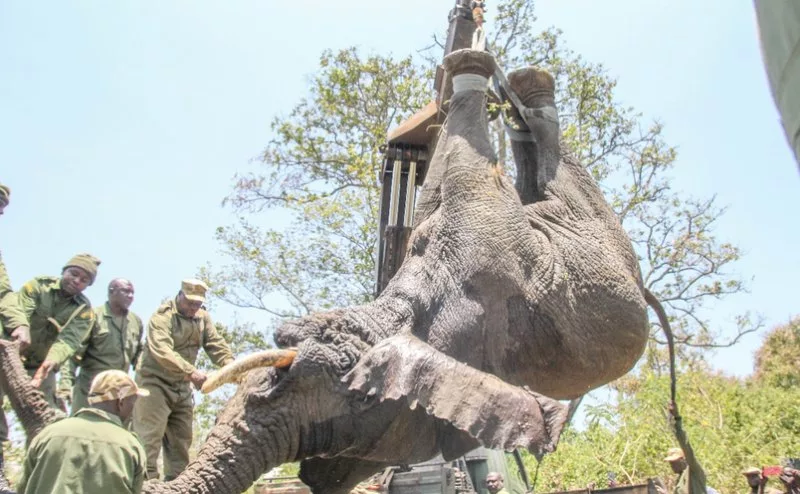
 KWS Veterinary and Capture Unit relocates a troublesome bull
elephant from Kithoka Village near Imenti Forest, Meru County, to Tsavo
East National Park/file
KWS Veterinary and Capture Unit relocates a troublesome bull
elephant from Kithoka Village near Imenti Forest, Meru County, to Tsavo
East National Park/file
The Kenya Forest Service has called for public participation
on the controversial construction of an airstrip and other infrastructure
inside a gazetted forest in Meru county.
In a public notice published in sections of the media, KFS
said the proposed airstrip and ancillary infrastructure will occupy
approximately 27 acres.
“The Kenya Forest Service proposes to construct an airstrip
and ancillary infrastructure at Upper Imenti Forest (Meru Forest Station) to
enhance aviation access for forest management, emergency response and regional
economic development,” KFS said.
It said preliminary site surveys and wind assessments had
found the proposed site suitable for the project.
It said the site is characterised by sparse vegetation cover
and is therefore expected to result in minimal ecological disruption.
KFS has invited members of the public and other stakeholders
to submit their views, comments, concerns and recommendations regarding the
proposed construction of the airstrip, including the runway, apron and
ancillary infrastructure.
It said the exercise is in compliance with the Constitution
of Kenya, relevant statutory laws, regulations and guidelines on public
participation.
Stakeholders have been asked to submit their written views
to the County Forest Conservator's office in Meru town.
They can also download the public participation
questionnaire from the KFS website, www.kenyaforestservice.org, and submit it
to the county office in Meru or email it to [email protected].
“Your comments and submissions will be treated with the
utmost confidentiality and should be received on or before July 21, 2026,” KFS
said.
The controversial project has sparked protests from
conservation organisations, which have termed it destructive to the forest
resource.
An Environment and Land Court in Meru has already issued a
third conservatory order stopping the ongoing project following a petition by
Pan African Climate Justice Alliance and Meru Forest Conservation Forum.
Rhino Ark Charitable Trust is among the organisations that
have rejected the project.
Rhino Ark is a key stakeholder in the conservation of the Mt
Kenya forest ecosystem, which includes the Upper Imenti Forest Reserve and the
Lower Imenti Forest Reserve.
Over the past 14 years, the Trust has invested more than Sh1
billion in constructing 320 kilometres of perimeter electric fencing around the
Mt Kenya forests to mitigate human-wildlife conflict and reduce illegal
extraction of forest resources.
This includes 54 kilometres of electric fencing around the
Upper and part of the Lower Imenti forest reserves.
The electric fence has effectively reduced human-wildlife
conflict in the Imenti forests. Before its construction, wildlife killed an
average of five people from neighbouring communities every year.
Given the critical importance of the Mt Kenya ecosystem, the
entire Mt Kenya Forest Reserve, together with the Upper Imenti Forest Reserve,
Lower Imenti Forest Reserve and Thunguru Hill Forest Reserve, was gazetted as a
National Reserve on July 24, 2000
through Legal Notice No. 93 of 2000 to “ensure maximum protection of the
valuable resources in the area”.
The Trust has given several reasons why the project should
not be allowed.
In a letter to the National Environment Management
Authority, the Trust said the project would affect water resources because Mt
Kenya is one of Kenya's five main water towers.
The others are the Aberdare Range, Mau Complex, Cherangani
Hills and Mt Elgon, which together provide most of the country's water.
The Trust said the Upper Imenti Forest Reserve lies on the
hydrological divide between the Tana and Ewaso Nyiro catchments.
It also warned the project would affect biodiversity. The Mt
Kenya forest ecosystem hosts rich biological diversity in both habitats and
species, particularly plant species.
The Trust said a comprehensive study carried out between
February 1992 and August 1994 found that the ecosystem hosts 882 plant species,
subspecies and varieties belonging to 479 genera and 146 families.
It said Mt Kenya has 81 endemic plant species and a wide
variety of wildlife.
“Six species of large mammal of international conservation
interest occur within the Mt Kenya forests – elephant (Loxodonta africana),
black rhinoceros (Diceros bicornis), leopard (Panthera pardus), giant forest
hog (Hylochoerus meinertzhageni), bongo (Tragelaphus euryceros isaacii),
black-fronted duiker (Cephalephus nigrifrons hooki).”
The Trust said about 12 species of ungulates, including
bushbuck (Tragelaphus scriptus), suni (Neotragus moschatus), red duiker
(Cephalophus harveyi), grey duiker (Sylvicapra grimmia altivallis), defassa
waterbuck (Kobus ellipsi prymnus), mountain reedbuck (Redunca fulvorufula) and
Cape buffalo (Syncerus caffer), are also found in the ecosystem.
Various primates also occur, including the black-and-white
colobus (Colobus guereza), Sykes monkey (Cercopithecus mitis) and olive baboon
(Papio anubis).
Mt Kenya is also an important bird area.
According to the Trust, 53 of Kenya's 67 African highland
biome bird species, at least 35 forest specialist species and six of the eight
species found in the Kenyan Mountains Endemic Bird Area occur in the Mt Kenya
ecosystem.
Rhino Ark said two separate elephant censuses conducted in
2016 and 2020 by the Wildlife Conservation Society, Kenya Wildlife Service,
Rhino Ark, Mount Kenya Trust and the Bongo Surveillance Project established
that Mt Kenya hosts between 1,900 and 2,600 elephants.
“The studies also revealed that during the dry season, the
Upper Imenti Forest has the highest density of elephants. This is exactly where
the airstrip is being constructed.”
The Trust said the airstrip under construction is near a
known elephant maternity area.
It said the Lower and Upper Imenti forest reserves form the
central section of the wildlife corridor linking conservation areas in the
north, such as Shaba National Reserve, with Mt Kenya.
The Trust further said no public consultations had been held
on the airstrip project, as required by the constitution and that no
Environmental and Social Impact Assessment (ESIA) study had been conducted as
required by law.
The Trust also said there is an alternative existing
airstrip, Gaitu Airstrip, 14 kilometres southeast of Meru town, which can be
upgraded.
INSTANT ANALYSIS
Public participation
is intended to shape decisions before implementation, not after works have
begun or legal disputes have emerged. The consultation now gives KFS an
opportunity to demonstrate transparency and address concerns over environmental
impacts, legal compliance and alternative sites. However, critics are likely to
question whether the exercise is a genuine attempt to influence the project's
future or simply a procedural step to satisfy legal requirements.