

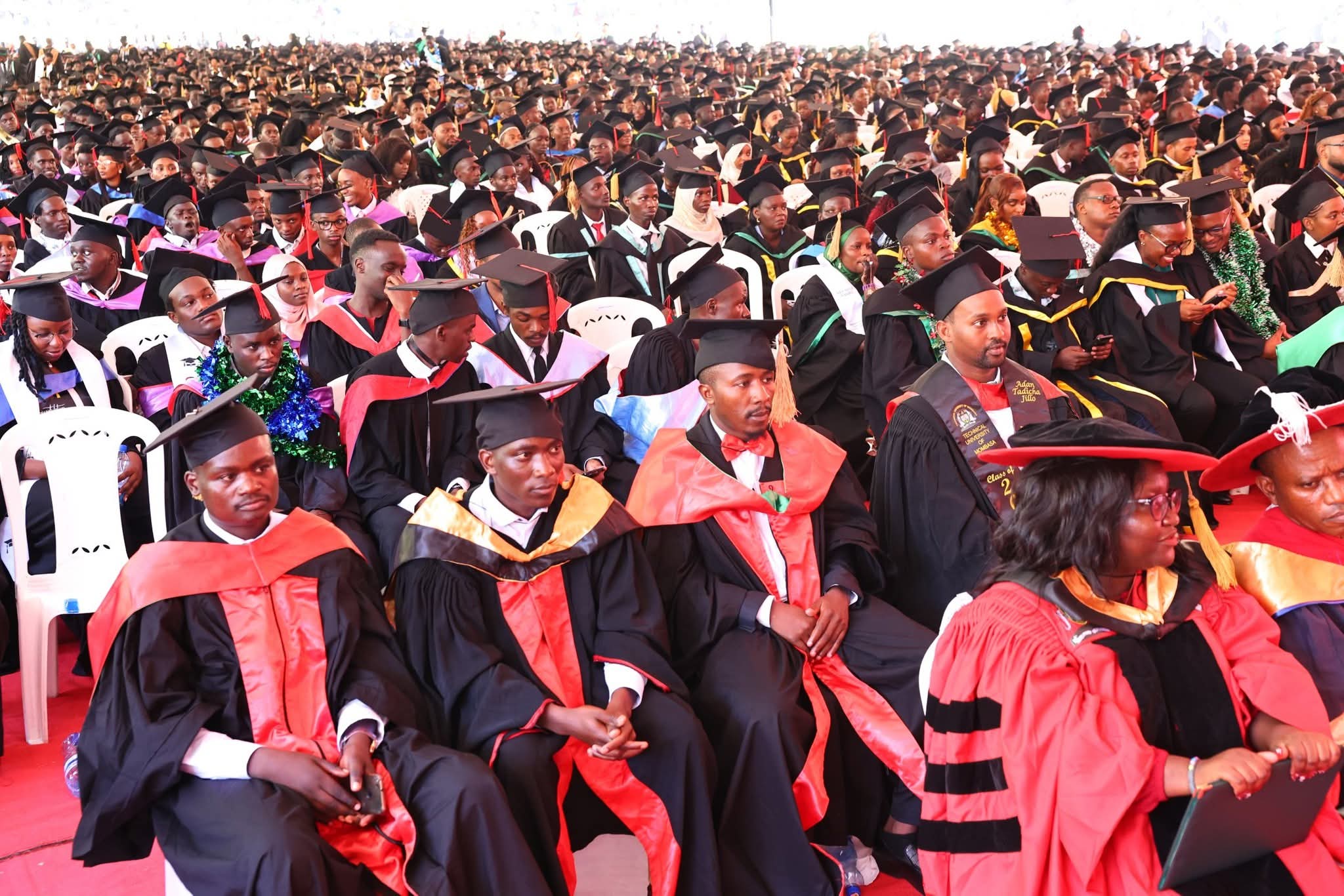
Graduands at TUM’s 12th graduation
ceremony on Thursday / BRIAN OTIENO
The Technical University of Mombasa has been
identified as a key beneficiary in Higher Education, Science and Technology Phase II funding by the African Development Bank, Education CS Julius Ogamba
has announced.
He said on Thursday the bank will facilitate
the establishment of a centre of excellence for research and training in blue
economy and civil engineering (CBECE) at a cost of $16.3 million (about Sh2.1
billion).
This initiative
builds on the Higher Education, Science and Technology (HEST) Phase I project, which improved
Kenya's technical and vocational training capacity.
“The centre aims to
address emerging challenges and opportunities in these sectors, such as coastal
engineering, port management, sustainable fisheries, maritime logistics and
climate-resilient infrastructure,” Ogamba said,
His speech was read by Higher Education secretary Carol Hunja during the 12th
graduation ceremony at TUM where 3,281 students graduated.
The CS said with AfDB's
funding, the centre will serve as a hub for capacity building, policy research and industry collaborations, fostering multidisciplinary partnerships between
academia, government and private sector stakeholders.
“It will also attract
international research collaborations and investments, positioning TUM as a
leader in marine and coastal research, resilient infrastructure development,
and environmental sustainability,” Ogamba said.
He said the centre’s
training and research outputs will contribute to evidence-based policymaking
and enhance Kenya's participation in the global blue economy.
The CS said the government is committed to supporting
higher education by ensuring requisite infrastructure is in place to meet the set standards and guidelines that guarantees global competitiveness.
The government, he said, facilitated the construction
of TUM’s School of Medicine at a cost of Sh266.8 million, with an additional Sh35.1
million for mechanical ventilation and refrigeration.
The TUM School of Medicine and
Health Sciences was officially launched on September 5, making it the first
ever medical school in Mombasa county, and making TUM one of 13 universities in
Kenya accredited to offer medicine.
TUM council chairman Frederick Odede said the world
today is
defined by rapid technological changes as well as global transformation.
“At TUM, we have long recognised that
technology is the vessel that will carry our nation forward. However, we need
to always remember that sustainability is what will lead us to the true destination,” he said.
Odede called for wise use of technology, ensuring innovation not only advances
immediate needs but also protects the planet, uplifts communities and secures the wellbeing of future generations.
The council chairman said
TUM had had remarkable achievements this year, mentioning the establishment of the
Institute of Maritime and
Seafaring Studies, the only one of its kind in Kenya offering degree-level
training in nautical science.
“This achievement places TUM firmly on the
pedestal in advancing the blue economy, a sector that holds
immense promise for Kenya’s sustainable
development and global competitiveness,” he said.
Equally significant,
he said, is the successful launch of the School
of Medicine, a bold and
visionary step towards strengthening the nation’s healthcare capacity.
“Through this new school, the university is
not only contributing to medical education and research but also
responding to Kenya’s need for well-trained healthcare professionals,”
Odede said.
The council,
he noted, will continue to support strategic initiatives that enhance
research, promote technological advancement and foster partnerships
that link academia with industry,
government and the global community.
TUM vice chancellor Leila Abubakar said this
year’s theme 'Sailing with Technology to chart Sustainable Futures', reflects
the university’s unwavering commitment to innovation, research, and
sustainability.
“It speaks to our vision of preparing
graduands not just to succeed academically, but to navigate and shape a rapidly
evolving, technology-driven world,” she said.
She said the university has put in place
robust mechanisms to ensure high-quality education for all students.
“We have continued to expand and renovate our facilities, including measures to accommodate persons with disabilities. In line with this, we are also offering specialised educational support and attachment opportunities for persons with disabilities, to gain the skills, experience, and knowledge needed to thrive,” she noted.
Instant Analysis:
Sectors like fisheries, tourism, maritime transport, energy and minerals present the country with immense potential as part of the blue economy.
It is estimated the blue economy, currently worth about Sh37 billion annually, can reach Sh300 billion if fully harnessed.