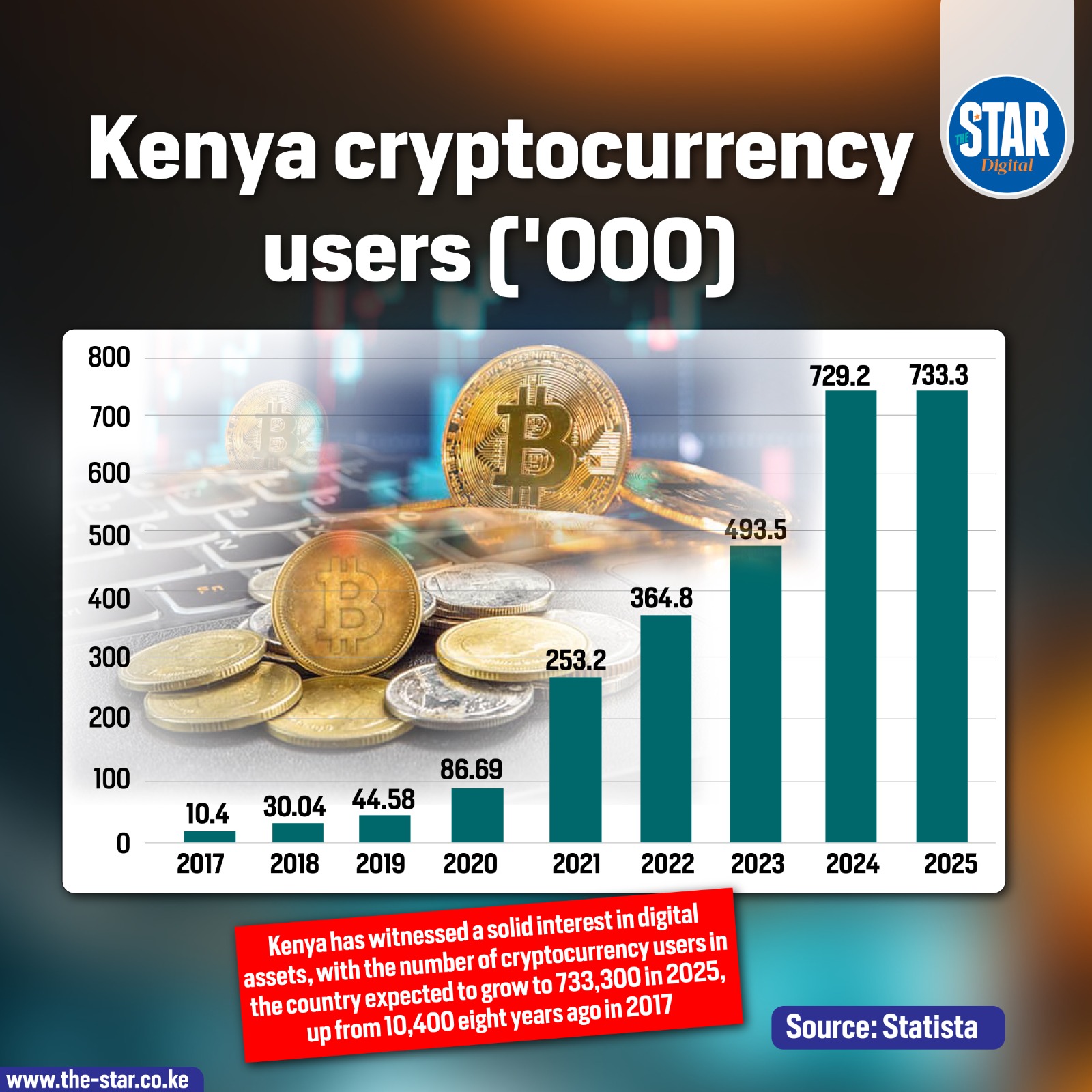
The rapid rise of cryptocurrencies across Africa is opening a new frontier for illicit financial flows (IFFs), worsening a crisis that has already cost the continent more than $1 trillion (Sh130 trillion) over the past five decades.
The scale of the losses is staggering.
Africa is estimated to have lost an amount roughly equal to all official development assistance it received during the same period, depriving governments of resources needed for hospitals, schools, roads and other critical public services.
The outflows have also fuelled corruption, weakened institutions and deepened poverty and inequality across the continent.
Experts now warn that the growing adoption of digital currencies is making it easier for criminal networks and tax evaders to move money across borders undetected.
Africa is currently the world’s second-fastest-growing cryptocurrency market, recording a 120 per cent increase in crypto transactions in 2021, according to Chainalysis’ 2022 Crypto Crime Report.
While cryptocurrencies are increasingly being used as a cheaper and faster alternative for cross-border payments, authorities say they are also creating anonymous and decentralised channels for money laundering, tax evasion and illegal fund transfers.
The lack of clear regulatory frameworks in many African countries has further complicated oversight, making it difficult for authorities to trace transactions or enforce compliance.
“Without clear monitoring and enforcement systems, cryptocurrencies threaten the legitimacy of financial systems and create opportunities for illicit actors to move funds undetected,” the report notes.
The growing concern over crypto-related illicit flows has pushed several African countries to intensify efforts to curb the vice.
South Africa, Rwanda and Zambia are among countries now focusing on cryptocurrency-linked IFF risks under a new anti-IFF programme spearheaded by the Collaborative Africa Budget Reform Initiative (CABRI) and the Swedish Tax Agency (STA).
The initiative is part of a four-year programme under the SECFIN Africa initiative aimed at strengthening African countries’ ability to detect and combat illicit financial flows through coordinated and locally-driven solutions.
This year’s programme has brought together multidisciplinary teams from Kenya, Liberia, Namibia, Rwanda, South Africa and Zambia, including officials from Ministries of Finance, revenue authorities, financial intelligence units and enforcement agencies.
The programme is built around the Problem Driven Iterative Adaptation (PDIA) model, which focuses on identifying country-specific challenges, developing tailored solutions and continuously refining interventions through practical feedback and collaboration.
According to the programme organisers, traditional policy measures have largely failed to effectively address illicit financial flows due to institutional weaknesses, corruption, fragmented enforcement systems and poor international cooperation.
African countries also face additional challenges including fragile institutions, political instability, informal economies and weak financial regulations, creating fertile ground for illicit financial activities.
Tax-related crimes remain the single largest source of illicit financial flows globally and in Africa, accounting for billions of shillings in lost revenues every year.
These crimes include trade mispricing, profit shifting, under-declaration of imports, false documentation and the use of offshore accounts and shell companies to conceal income and assets.
According to the Tax Justice Network, Africa loses between 10 and 30 per cent of its potential tax revenues annually through tax-related illicit activities.
Kenya is among countries grappling with rising trade-based tax crimes despite having existing customs laws and enforcement systems.
Authorities say the country continues to lose substantial revenue through practices such as missing trader fraud, customs mis-invoicing, under-declaration of goods and falsified trade documents.
The illicit schemes distort trade data, undermine fair competition and weaken public trust in the tax system.
Kenya’s team in the CABRI programme is now working on developing more effective detection systems, stronger inter-agency coordination and tailored enforcement responses that align with local realities.
Beyond tax crimes, illicit financial flows are also heavily linked to organised crime and weak governance structures across the continent.
The United Nations Office on Drugs and Crime estimates that between two and five per cent of global GDP is laundered annually, helping finance organised criminal networks and illegal financial operations.
Africa’s natural resources sector remains one of the most vulnerable areas for illicit financial flows.
Oil, gas, mining and timber industries are particularly exposed because of high-value transactions, weak oversight and opaque ownership structures.
Illegal mining, unregulated logging and wildlife trafficking continue to cost African economies billions of shillings annually while accelerating environmental destruction.
The financial and banking sector, particularly informal and unregulated financial systems, has also emerged as a major conduit for money laundering activities.
Real estate and construction are equally vulnerable, with criminals often using property transactions to conceal the origins of illicit wealth.
In Namibia, authorities are now turning attention to the fisheries sector, which contributed nearly four per cent of the country’s GDP in 2024 but generated disproportionately low tax revenues.
Investigations have pointed to possible export undervaluation and profit-shifting practices within the sector.
Liberia, on the other hand, is focusing on anti-money laundering reforms after authorities identified fragmented enforcement systems and weak coordination among agencies as key vulnerabilities being exploited by organised crime networks.
Programme organisers say stronger collaboration and data sharing between institutions will be critical in restoring the rule of law and strengthening governance systems.
They argue that tackling illicit financial flows requires more than just policy reforms. Countries must also invest in institutional capacity building, technological innovation and stronger regional cooperation to dismantle transnational criminal networks.
Stakeholder engagement and political commitment are also seen as essential in sustaining reforms and closing loopholes exploited by illicit actors.
The programme’s organisers believe locally designed solutions offer the best chance for success because illicit financial flows often evolve differently across countries and sectors.
By bringing together tax authorities, financial intelligence agencies, enforcement bodies and policymakers, African countries hope to build stronger systems capable of tracking illicit transactions, recovering lost revenues and protecting public resources.
As digital finance continues to expand across the continent, the battle against illicit financial flows is expected to become even more complex.
But officials involved in the programme say stronger cooperation, smarter regulation and better use of technology could help Africa stem the massive financial leakages that have drained the continent’s wealth for decades.




![[PHOTOS] The new Ngong –Naivasha Road viaduct](https://cdn.radioafrica.digital/image/2026/06/64d4f771-4432-4aee-ba3c-2f304c4436ec.jpg)





![[PHOTOS] 'Mr Speaker Sir' Gen Z protester in court](https://cdn.radioafrica.digital/image/2026/06/b3e62d8e-25c3-4780-90f9-4eb48b1ce8a7.jpg)