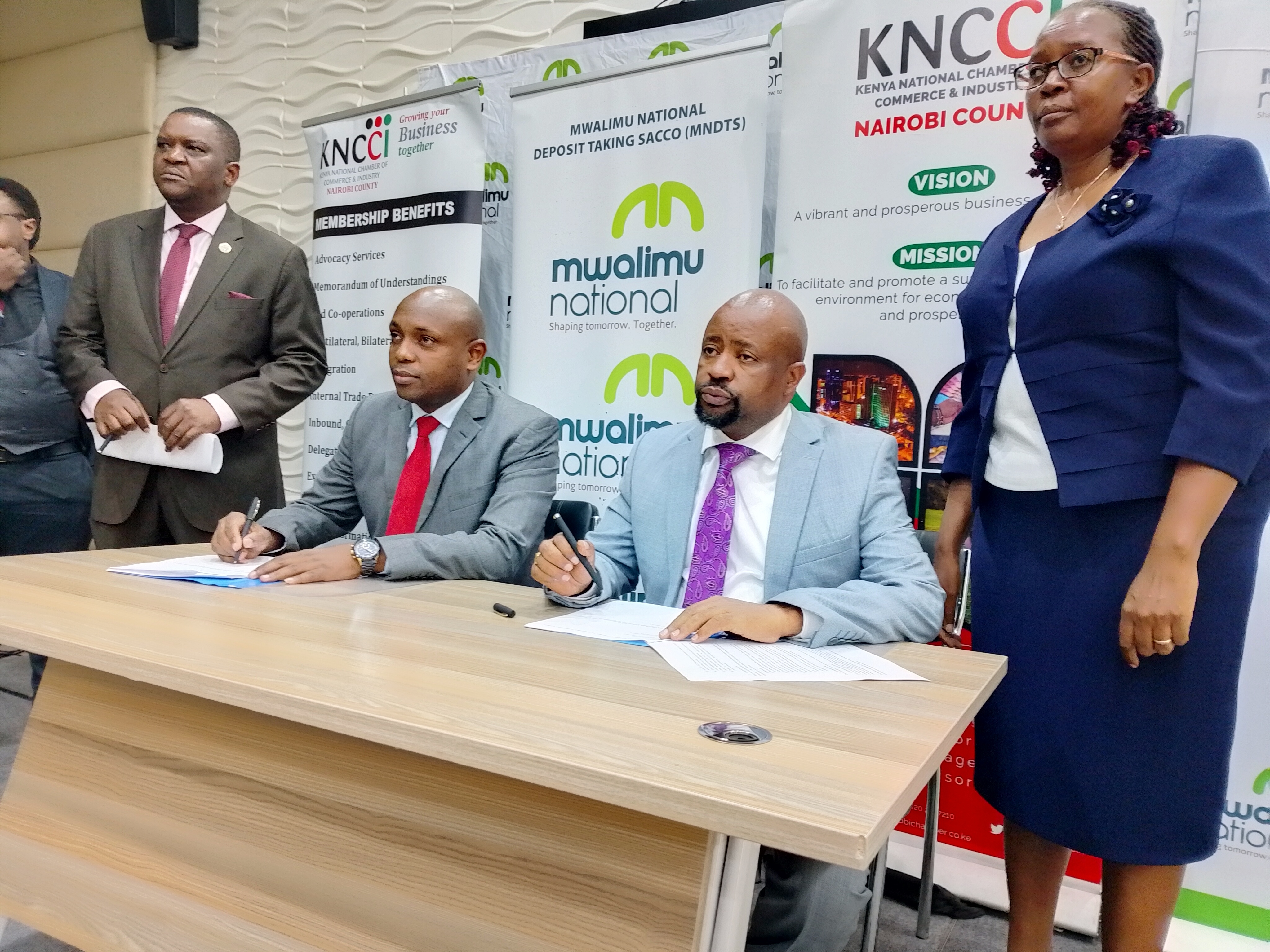
The sacco, which has for long been associated with teachers, has partnered with the Kenya National Chamber of Commerce and Industry (KNCCI), Nairobi Chapter, to reach businesses including in the Jua Kali sector.
Speaking during the signing of the MoU in Nairobi yesterday, Mwalimu Sacco chairman Joel Gachari said the strategic partnership seeks to empower businesses and entrepreneurs.
“We aim to strengthen support for entrepreneurs, SMEs, youth-led enterprises, and the wider business community through financial inclusion, enterprise development, and capacity-building initiatives,” Gachari said.
KNCCI will offer its wide membership network, with the partnership designed to empower businesses through access to financial solutions, business networking opportunities, financial literacy programmes, mentorship, and market linkage initiatives.
“This strategic collaboration will help accelerate enterprise growth and create sustainable economic opportunities for entrepreneurs across Nairobi county. The partnership is expected to bridge critical gaps affecting SMEs, particularly in access to affordable financing, business support services and enterprise sustainability,” KNCCI Nairobi Chapter chairman, James Mwaura, said.
According to Mwaura, access credit remains a challenmge for many SMEs and businesses in the informal sector, leaving a majority to rely on expensive digital loans and shylocks.
“Mwalimu Sacco is going to give us that big solution, whereby we are going to remove people from these expensive loans. To grow the economy, we need access to liquidity and affordable credit is key,” he said.
Mwalimu Sacco CEO Kenneth Odhiambo said plans are in place to expand lending to the manufacturing, real estate, trade and the blue economy.
“In the short run, we are starting with small businesses including the informal sector the later we can be able to go into the bigger industry players,” he said.
The sacco’s loan book stood at Sh56.3 billion as of last year, having grown from Sh47.2 billion in 2024. Member deposits closed the year at Sh56.5 up from Sh52.2 billion.
Its asset base grew to Sh76.3 billion up from Sh68.8 billion with major investments in property.
Under the plan with the chamber, Mwalimu plans to lend at an average rate of 12 per cent in interest rates with tight lending rules to be put in place to avert bad loans.
“We have tried to ensure that our NPL remains within the regulatory threshold, that is at less than five per cent. When it comes to the informal sector, we are going to employ good credit management. Credit appraisal is going to be tight to ensure that any amount of money we give tis collectible,” Gachari said.



![[PHOTOS] The new Ngong –Naivasha Road viaduct](https://cdn.radioafrica.digital/image/2026/06/64d4f771-4432-4aee-ba3c-2f304c4436ec.jpg)








![[PHOTOS] 'Mr Speaker Sir' Gen Z protester in court](https://cdn.radioafrica.digital/image/2026/06/b3e62d8e-25c3-4780-90f9-4eb48b1ce8a7.jpg)