

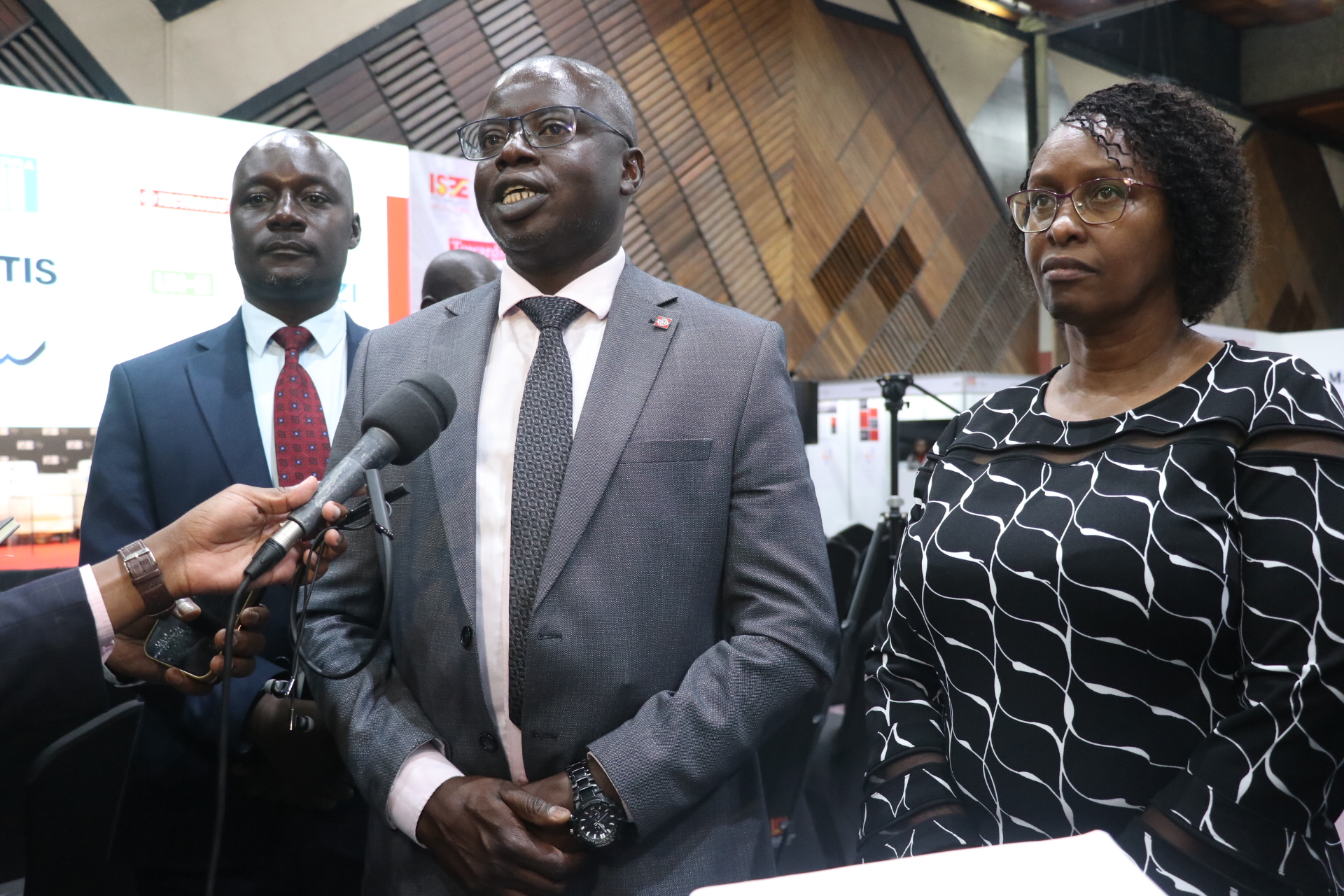
 Institution of Engineers of Kenya secretary Jackton Mwembe, KEBS director of standards development and trade Zacharia Lukorito and Engineer board of Kenya CEO Margaret Ogai address the media during the International Sourcing Exposition for Elevators and Escalators ( ISEE) Africa exhibition at KICC, Nairobi on December 2, 2025/LEAH MUKANGAI
Kenya plans to tighten safety standards for lifts and escalators amid a rapid shift toward high-rise construction.
This, even as industry players warn that regulatory gaps, poor maintenance and skills shortages expose millions of urban residents to accidents in high-rise buildings.
Speaking at the inaugural iSEE Elevators and Escalators Expo in Nairobi, the Kenya Bureau of Standards (KEBS) said it is disseminating new safety and performance standards in a bid to catch up with a building sector that is expanding faster than oversight systems can cope.
“We have seen lifts that suddenly drop or trap people for hours. These incidents are discouraging and very dangerous,” said the KEBS director of standards development and trade, Zacharia Lukurito.
“The equipment installed may be correct, but when maintenance is not properly done, faults creep into the operation. That is why we are here to ensure everyone understands and complies with the applicable standards.”
Lukurito said KEBS has adopted key international standards, covering safety in lifts and escalators, alongside a broader series dealing with planning, installation and maintenance.
The bureau, he added, is also working with regional bodies to harmonise standards across East Africa and the continent.
The shift comes as Kenya undergoes a huge vertical transformation, driven by urban densification and the government’s affordable housing programme.
Towers of 20 floors are now routine in Nairobi and secondary cities, and developers are preparing for 50-storey projects as land scarcity deepens.
“We are building very high, very fast, and this is the right time to have this conversation,” said the general manager of the Kenya Property Developers Association, Rose Kananu.
“Developers must understand that lifts are not just another piece of equipment, but essential safety components.”
Kananu said demand for elevators in Kenya has surged dramatically, fuelled by tighter land constraints, urban growth and rising middle-income demand for modern housing.
But she warned that new lift approvals from KEBS and the Directorate of Occupational Safety and Health Services risk being added to an already clogged regulatory pipeline.
“Approval delays are one of the biggest bottlenecks in real estate. If lift approvals take too long, projects will stall,” she said, adding that KPDA has launched an approval tracking system to provide data-driven advocacy.
Alongside standardisation, safety enforcement has emerged as a critical concern. KEBS has recently deployed surveillance teams to crack down on substandard building materials, including cement, which Lukurito said had posed risks to structural integrity.
“Today, most of the cement you find in the market is compliant because we have removed substandard products,” he said. “We will continue doing so to ensure that buildings being constructed are safe.”
But even with improved oversight, a shortage of specialised engineering and technical skills threatens to slow progress.
Engineers Board of Kenya chief executive Margaret Ogai said the country has 28,000 registered engineers, with competencies across mechanical, electrical, mechatronics, civil and structural engineering core disciplines required in lift design and safety.
“Our engineers are up to scratch, and our qualifications meet global standards. What we need now is local production and manufacturing to create jobs and reduce foreign exchange pressure,” she said.
Ogai urged international elevator manufacturers to invest in Kenya, arguing that the market potential is large enough to support local assembly plants.
“We already have a big affordable housing programme, and these houses need elevators. It is time to set up manufacturing here,” she said.
Beyond engineering capability, developers and regulators also linked lift safety to accessibility and disability rights, noting that reliable vertical mobility is central to compliance with the Persons with Disabilities Act.
“Lifts are critical enablers for persons with disabilities to access buildings,” Lukurito said. “Safety is not just technical compliance—it is a human rights issue.”
Yet Kenyan industry bodies acknowledged that new industries will also exacerbate unemployment unless local skills are developed to match demand.
“The establishment of such industries opens up the market for engineers. But we must bridge the skills gap through training, innovation and structured transition from academia to industry,” said Engineer Jackton Mwembe, secretary of the Institution of Engineers of Kenya.