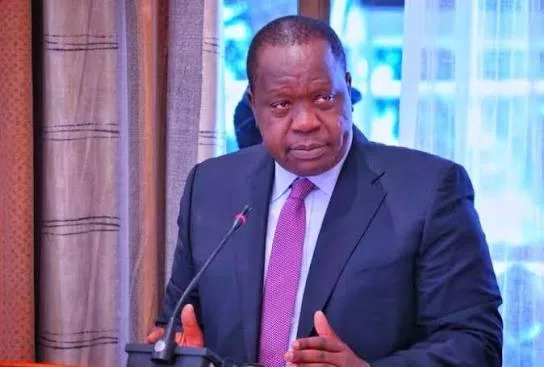
Investments, Trade and Industry Cabinet Secretary Moses Kuria on Tuesday said the new tax will be known as Export and Investment Promotion Levy.
The tax also targets furniture, paper and paperboard product importers, with plans to add pharmaceuticals onto the list.
Kuria said the Cabinet has made a preliminary approval with the levy expected to come into place once public participation is concluded.
Products from the East African Community are however exempted.
Kuria said the move aims at discouraging importation of products that can be manufactured locally.
“We are going to see some items slapped with serious levies so that we are able to protect our industries. We are going to start with steel products in the coming few days,” Kuria said.
He spoke at the ministry’s offices at the Two Rivers Mall during a briefing on supporting local businesses.
“I will move to other sectors like pharmaceuticals and all that once we are convinced we have capacity as a country…once I am convinced we have capacity for toothpicks, I will do the same," Kuria said.
He said products that can be produced in Kenya should not be imported at the expense of local industries.
While commissioning the Devki Steel Mill in Samburu, Kwale last November, Ruto said policies to stimulate the sector were being developed ahead of an expected spike in the use of steel as the government rolls out its infrastructure, manufacturing and affordable housing programmes.
He assured investors of the government’s support, including the elimination of brokers and abolishment of punitive levies and taxes for local players.
The levy, if affected, will be a boon to local players who face competition from cheaper imports, mainly from Asia and Europe.
Major players in the country’s steel industry include Devki, Doshi Group, Tononoka Steel, Apex Steel, Accurate Steel Mills, Tarmal Steel, Abyssinia Group and Kens Metal Industries.
“Every time the country imports products that can be produced locally, it denies local players an opportunity to grow and create jobs,” Kuria said.
Cheaper imports, the CS said, have continued to depress the country’s manufacturing sector, whose contribution to the GDP has shrunk from nine per cent to seven per cent.
Kuria said his ministry has a target of raising the sector’s contribution to the economy to 15 per cent by 2027, and at least 20 per cent by the year 2030.
“ I mean to do exactly that and those people who are used to seeking tax exemptions and short cuts, there is no space for those games anymore,” the CS said.
Importers who had a hint of the planned levies started huge imports in December, bringing in billets worth Sh18 billion in less that three weeks.
Steel billets are the second stage product produced during the process of making steel bars. The raw steel can't be utilised in its pure form; it needs to be cast into shape before it is employed.
The country is also a big importer of wire rods.
“They have been stockpiling…this will not happen. The country has to make a choice. We must fix this economy, create jobs and reduce pressure on the shilling by cutting imports,” the CS said.
Iron and steel are among products that have been pushing up the country’s import bill in recent years, which rose to Sh2.1 trillion in 2021–Economic Survey 2022.
This was a 30.9 per cent increase from Sh1.6 trillion in 2020.
“Expenditure on imports rose largely on account of increased expenditure on petroleum products, iron and steel, animal fats and oils and vehicles,” Kenya National Bureau of Statistics notes in its report.
During the year, the country spent Sh155.5 billion on iron and steel imports, up from Sh105.1 billion.
Manufacture of furniture dropped by 3.6 per cent in 2021 as the country spent up to Sh8.8 billion on importing products, up from Sh7.2 billion.
The value of paper and board imported was Sh38.9 billion, up from Sh29.1 billion as China remained the single leading source of Kenya’s imports, accounting for 20.5 per cent of total imports valued at Sh441.4 billion.