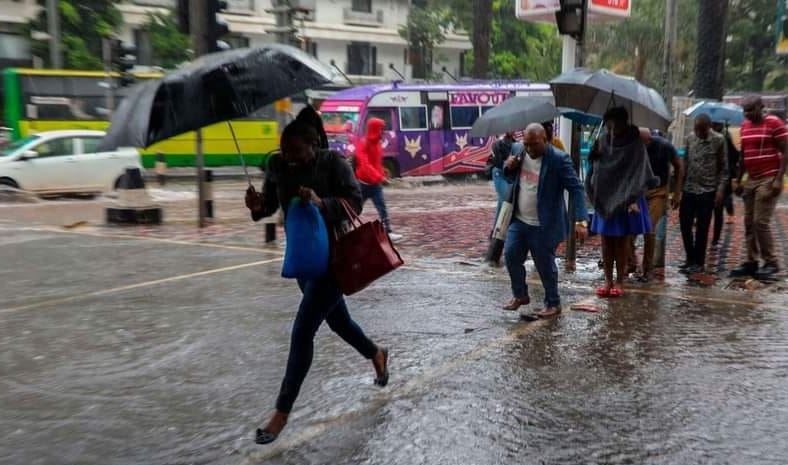


If you are in Nairobi, trying to make your way through the busy streets, you may encounter some difficulties.
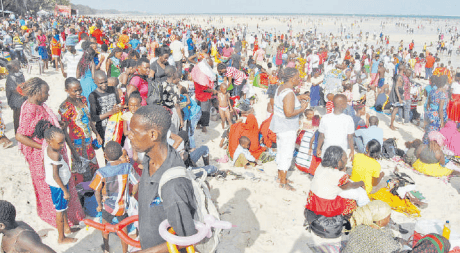
It appears as if the capital city’s roads and avenues have shrunk over the past few months, making the walk more crowded than usual.
Just a simple trip down towards Nairobi's Bus Station terminal, for example, can turn into a complete nightmare.
This is because the town is infested with hawkers streaming from almost everywhere these days, trying to make a sale.
These enterprising Kenyans, though not an unfamiliar sight on Kenyan streets, have been increasing in numbers over the past few months.
If you are not careful enough, you may end up walking into a hawker's make-shift stall spread out over the pavements.
Kiarie Mwangi, a hawker selling socks in Nairobi's Central Business District (CBD), said that on more than one occasion, people have walked over his wares.
"My business is not that big, so I spread out my merchandise over a small carton box on the side of the pavement," he says laughing.
"I think people see it when it is too late and then they end up stepping on them or jumping over them, depending on how flexible they are."
On asking him why he could not simply move out of the way, Kiarie said that it was a good business strategy.
"When pedestrians are passing, they are usually very busy-looking and in a hurry as Kenyans in the city always are. When they almost step on my merchandise, it makes them slow down and acknowledge me," he said.
Kiarie said that he has made a sale that way several times, by people bumping into him on the pavement as they rushed off somewhere across the city.
He said he is well aware of the fact that he was not supposed to be selling there but also that he was at the mercy of pedestrians.
"I'm trying to earn a living and any spot I can get in the CBD to sell my merchandise, I will take it and hope that as Kenyans pass me by, they will notice me and take pity on me," he said.
NO CHOICE
This desperation in Kenyan hawkers is what is sending them into the streets, far beyond where they are allowed to hawk by the Nairobi county government.
On every other street, you can hear hawkers calling to passers-by. The desperation is heavy in their voices as they call out and even grab onto pedestrians, trying to get their attention.
Florence Achieng sells women's blouses, dresses and undergarments along Odeon, near Tom Mboya Street, in Nairobi's CBD.
Every day, she wakes up at 4am and rushes to arrive in town from Kitengela at 7am.
She has been coming all the way from Kajiado county every single day for the past two months.
She tries to beat the morning traffic and other hawkers to get to that spot she sells her clothes from.
"I have to be there early enough to get that spot. It is not very strategically placed in terms of oncoming human traffic, but it was the only place available in the CBD," she said.
Achieng used to sell her clothes at a stall in Kitengela, but lately, she had not been able to pay for her stall's rent.
"A friend of mine who hawks in town told me that there was a small space outside of a bakery where she usually sold undergarments, and I could not let that opportunity pass me by," she said.
Achieng asked her friend what she did when the County Council Officers, popularly known as Kanjos, came along.
She was told that there was a way they dealt with the Kanjos.
Instead of them chasing me away, I just give them something small as a token of appreciation for letting me continue with my business and then life goes on
BRIBING 'KANJO'
The county government's county officers are infamous for waging war against Nairobi hawkers.
However, they seem to have turned a blind eye to them lately.
Hawkers have encroached onto places they should not even be at, making it hell for the general public and even posing a safety hazard.
Antony Kimemia owns an electronics shop on Ronald Ngala Street in Nairobi, where he said hawkers throng the entrance to his business.
Occasionally, Kimemia said, he has had to get into altercations with some of the hawkers selling fruits and vegetables outside his shop because they are blocking his business.
"I know that all they are looking to do is earn a living, but they are also costing me from earning my living," he lamented.
"Sometimes window-shoppers pass by my shop perusing to see the latest gadgets I have but with hawkers all over the pavements, it makes it nearly impossible for them to reach my shop," he said.
Kimemeia often sees pedestrians walking on the roads instead of on the pavements designated to them because they are trying to avoid hawkers.
"One of these days, someone might get hit by a car or a boda boda in this busy street because there is no safe place to walk on," he cautioned.
So, why are hawkers still holding the streets captive?
Kimemeia said the authorities seem to have an understanding with the hawkers because they let them stay.
"Kanjos still patrol the streets looking for hawkers who are selling at illegal places, but as far as I can see, they have not chased away the ones outside my shop, even though you can clearly see that they are not meant to be there," he said.
Achieng said usually, they solve the issue of encroachment with a small 'fee' they call a fine.
"Instead of them chasing me away, I just give them something small as a token of appreciation for letting me continue with my business and then life goes on," she said.

You have to remember that during election time, everyone is a potential voter. You cannot go around harassing people who might vote for you
ELECTION TRUCE
In the past, Kanjos have been less lenient on hawkers, often violently descending on them when they find them in the wrong.
This has seen many aspirants in the race for the county government seats incorporate a change to this trend in their campaign strategies.
The Nairobi Metropolitan Services went as far as trying to revamp the unit and rename it the Nairobi Inspectorate Department, with Nairobi Inspectorate officers even getting new uniforms.
Francis Ngumo, an M-Pesa shop owner on Ronald Ngala Street, said there is nothing new or revamped about these new Kanjos.
He said this was a common trend he had seen in his 13 years of running a business in the Nairobi CBD.
"You have to remember that during election time, everyone is a potential voter. You cannot go around harassing people who might vote for you," he said.
Ngumo said that by not harassing hawkers, even the ones who were selling at undesignated places, some politicians somewhere were hoping to save face and make voters out of them.
"It is not a secret that they are being lenient right now because they have to be, but soon enough, I believe they will come to their senses and turn the CBD back from looking like a marketplace," he said.
Naserian, popularly known in the streets as Mama Shiko, shared the same sentiments as Ngumo.
She has operated a Charity Sweepstakes booth near Tom Mboya Street in Nairobi since 2016, and she recalls that that year, there was also a calm before the storm.
"Kanjos rarely arrested people that year around this area I work at," she said.
"The few who got arrested were back to the streets even hours later after being arrested, and they had their merchandise. In 2017, after the elections, they were back at it."
She said that this reprieve is only for a short moment.
While Kanjos continue to look the other way during this season and hawkers continue to flock to the streets, more and more Kenyans will continue to get agitated and put in harm's way.
Jane Ngomeli, a resident of Langata, said the hawkers have become a menace and law enforcement needs to do something.
"With so many hawkers on the streets, crowding everywhere, it is hard to know whether you are safe from pickpockets and other criminals in the CBD," she said.
Ngomeli said the city is already unsafe and the more people there are on the streets, the more vulnerable the public becomes in the event of an attack or wanting to flee to safety.