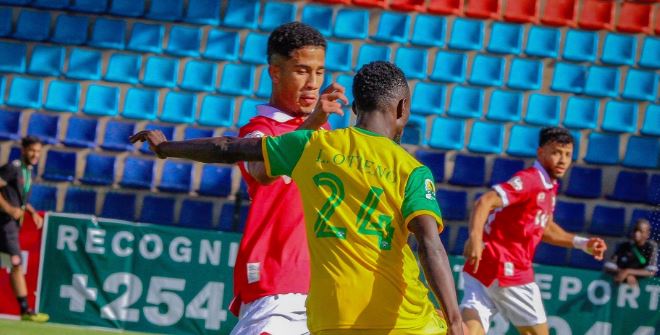

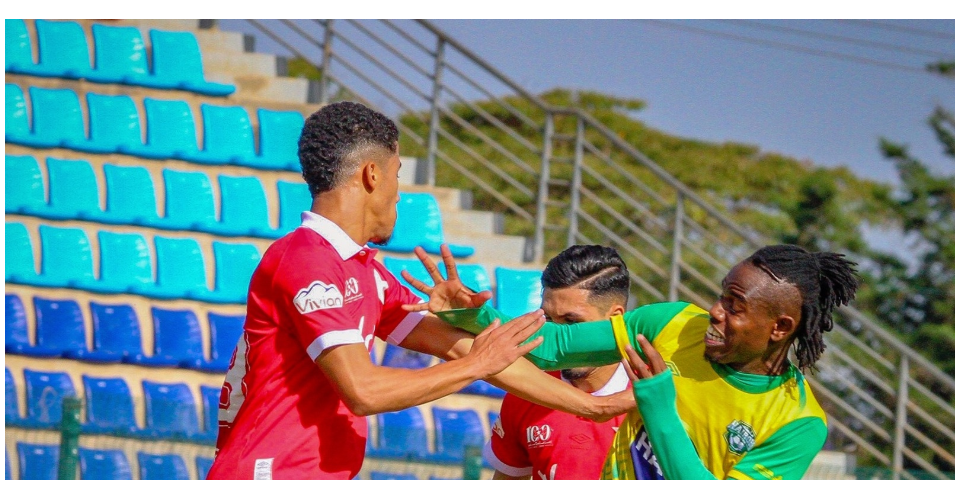
 Nairobi United's Kefa Aswani vies for the ball with a player from AS Maniema Union/HANDOUT
When head coach Nicholas Muyoti speaks about Nairobi United, he does so with the steady composure of a man who has learned to respect the slow architecture of progress.
His words do not lurch toward grand promises; they settle instead on the patient territory of possibility.
In the early days of the club’s debut season in the Kenyan Premier League, he is careful to resist the seduction of prediction. A top-five finish, he says, is ambition enough.
There is a restless rhythm to Nairobi, a city where football clubs draw their character from old loyalties, contested histories, and the tense choreography of ambition.
For Nairobi United—winners of last season’s National Super League and the FKF Cup—this is a new landscape. Their arrival in the top flight was swift and emphatic, yet their entry into the league feels less like a victory lap and more like an examination of identity.
“We will talk about titles when the time asks for it,” Muyoti says. His tone is unhurried, as if reminding himself that progress cannot be coerced.
Nairobi United occupy 10th place on the league table, a number that tells only a fraction of the story. Their 12 points place them 7 points behind leaders Gor Mahia, but they have played 3 fewer matches.
Those missing fixtures mark the shadow cast by the CAF Confederation Cup—Africa’s sprawling, unpredictable battleground of football culture, altitude, travel, and demand.
They are Kenya’s only representatives left on the continental front after the Kenya Police exited the Champions League preliminaries.
However, after storming to the group stage of Africa's second biggest showpiece, Naibois have suffered two heartwrenching defeats, crashing 3-0 to Wydad Casablanca in Morocco before another disappointing 1-0 loss to AS Maniema Union of DRC in Nairobi days later,
With that distinction comes the invisible pressure of expectation: the early-morning travel, the distant stadiums, the strain of navigating two competitions when most of their domestic rivals contend with only one.
“We are holding the weight of both,” Muyoti acknowledges. “The travel, the mental shift, the rest—these things matter more than most people realise.”
The calendar is unforgiving. Weeks feel like corridors, narrowing and widening at unpredictable intervals. Matches approach quickly; recovery arrives slowly.
For a team encountering such intensity in its first season at this level, Nairobi United have shown a surprising steadiness. They are discovering that experience is not only a matter of years played, but of trials endured.
The tempo of continental football has begun to leave its imprint on their style—quicker transitions, quieter moments of resilience, a sharper sense of consequence.
The coaching staff have redesigned training sessions to accommodate the rhythm of travel and the ebb of fatigue. Players rotate more frequently now. The squad’s depth, once theoretical, has become essential.
“This is a group learning who they are,” Muyoti says, “and who they might become.”
There is no restlessness in his voice, only a cultivated understanding that development is its own kind of success.
Around the club, there is an emerging calm among supporters—an acknowledgement that building a competitive identity in a league as textured as the KPL requires patience.
Crowds at home fixtures have been steady and encouraging, with a tone that feels less demanding and more companionable.
Nairobi United’s rise through the divisions has drawn new admirers, many of whom recognise that the club is attempting something both ambitious and responsible: growth without haste.
The three pending KPL fixtures hover like an unopened chapter—capable of altering the entire narrative but still waiting to be written. Analysts suggest those matches could position the club as a more persuasive company in the league’s upper half. But Muyoti avoids such arithmetic.
“We will examine ourselves when the moment calls for it,” he repeats.
He speaks in the cadence of someone intent on preventing impatience from becoming the team’s first true opponent.
As Nairobi United navigate their first Premier League season, several truths have emerged:
The demands of travel will test their resolve. Their cohesion will depend on how well they preserve fitness in crowded weeks.
Their growth will hinge on their ability to convert opportunity—especially the games they still owe—to points.
And their identity will take shape somewhere between their domestic obligations and the lessons brought home from distant stadiums across the continent.
For now, Nairobi United remain a club refusing to rush its own story. Muyoti’s top-five target reflects an understanding that sustainable success is rarely forged in the urgent pursuit of silverware. It is built instead in the quieter seasons—the ones where discipline outpaces desire, and foundations matter more than spectacle.
Should they achieve that target, their debut campaign will stand not only as an athletic achievement but as a testament to a methodical, almost literary patience—a belief that good teams, like good stories, are seldom crafted in a hurry.