As Kenya inches closer to the 2027 general election, one political theme is becoming
increasingly dominant: youth empowerment. From policy speeches to public
appointments, the political class is keen to demonstrate that it is listening
to the country’s youthful majority.
The message is clear - young people are being brought
into government, given visibility and positioned as partners in shaping the
nation’s future. On the surface, this appears to be a welcome shift.
Under the current administration of President William Ruto, youth
empowerment has been framed as both an economic and political priority.
Initiatives such as the Hustler Fund, youth-focused enterprise programmes and
digital innovation platforms have been rolled out with the promise of unlocking
opportunity. At the same time, young professionals have found their way into
key government positions, reinforcing the narrative that the system is opening
up.
But beneath this visible inclusion lies a more uncomfortable reality:
the structure of power in Kenya remains largely unchanged. And that is where
the problem begins.
Youth appointments, while symbolically powerful, operate within a
political and economic system that was never designed to be inclusive. They
offer presence without power, visibility without voice. In many cases, they
serve to legitimise the very structures that continue to marginalise the
majority of young people.
Take the economic dimension. Despite targeted funds and programmes,
youth unemployment and underemployment remain stubbornly high. Access to
capital is still mediated by bureaucracy, political connections and uneven
information flows.
Many of the flagship initiatives, while well intentioned,
function more as short-term relief mechanisms than as structural solutions to
inequality and exclusion. They do not fundamentally alter the conditions that
make economic participation difficult for millions of young Kenyans.
The political terrain is even more restrictive.
Running for office in Kenya remains an expensive affair. Campaigns are
driven by money, networks and patronage. For most young people, especially
those outside elite circles, the barriers to entry are simply too high.
What we
are witnessing, therefore, is not a broad-based opening of political space, but
a selective incorporation of a few young individuals into an otherwise closed
system.
Political parties, which should serve as vehicles for democratic
participation, have done little to change this reality. Internal democracy
remains weak, nomination processes are often opaque and decision-making is
heavily centralised.
Youth wings exist, but they are rarely sites of real
influence. Instead, they function as mobilisation tools during elections - energised when votes are
needed, sidelined when decisions are made.
Even within government, the limits of youth inclusion are evident. Young
appointees operate within rigid hierarchies where strategic direction is
determined elsewhere.
Their ability to influence policy is often constrained by
institutional culture, political loyalty and the ever-present risk of
alienating those who facilitated their rise.
This is why the growing assertiveness of Kenya’s youth should not be
misunderstood.
Across the country - and especially in digital space - young people are organising, questioning
and demanding accountability. They are no longer satisfied with symbolic
gestures.
The rallying call of “nothing for us without us” is not about token
representation; it is about meaningful participation in decision-making
processes that affect their lives.
As 2027 approaches, there is a real risk that youth empowerment will be
reduced to a campaign strategy - a language deployed to mobilise and manage
votes without addressing the deeper structural issues at play. We have seen
this before: promises made in the heat of political competition, only to
dissipate once power is secured.
Kenya cannot afford a repeat of this cycle.
If youth inclusion is to be more than cosmetic, then the country must
confront the harder question: how do we change the rules of the game?
First, there must be serious reform of campaign financing to lower the
cost of political participation and create a more level playing field. Without
this, leadership will remain the preserve of the wealthy and well-connected.
Second, political parties must be democratised. Transparent nomination
processes, accountable leadership structures and genuine grassroots
participation are essential if young people are to have a meaningful pathway
into leadership.
Third, youth participation must be institutionalised in ways that go
beyond consultation. This means embedding young people in decision-making
processes with real authority - particularly in budgeting, policy formulation
and oversight.
Finally, economic empowerment must move beyond funds and programmes to
address structural inequality. This includes creating sustainable jobs, supporting innovation
ecosystems and ensuring fair access to opportunities across regions and social groups.
Kenya’s youth are not just a voting bloc; they are the country’s present
and its future. Ignoring their demands - or responding with half measures - risks deepening frustration and
eroding trust in democratic institutions.
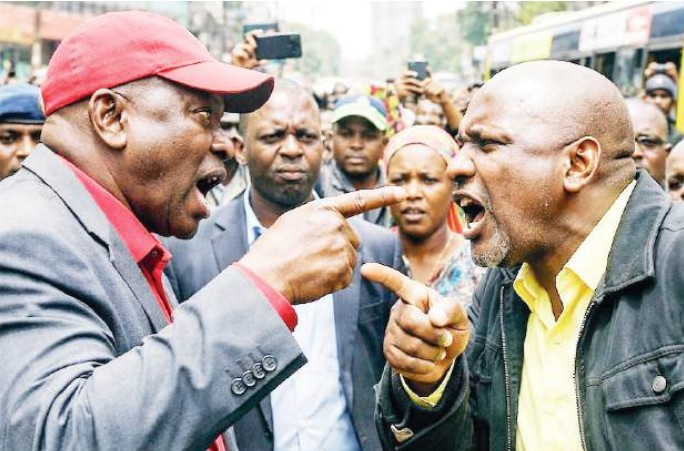
To ensure structural change, Kenya’s youth must move beyond the politics
of expectation and embrace the politics of organisation. Structural change will
not be handed down — it will be demanded, organised and secured.
If Kenya’s youth truly believe in “nothing for us without
us”, then the task ahead is clear: not just to be included in the system, but
to fundamentally remake it.

 To ensure structural change, Kenya’s youth must move beyond the politics of expectation and embrace the politics of organisation /FILE






![[PHOTOS] The new Ngong –Naivasha Road viaduct](https://cdn.radioafrica.digital/image/2026/06/64d4f771-4432-4aee-ba3c-2f304c4436ec.jpg)