The
ninth Tokyo International Conference on African Development took place in
Yokohama, Japan, from August 20 to 22.
Representatives
of 49 African countries, including 33 heads of government equivalents,
participated, together with many international organisations, NGOs and business
entities from Japan, Africa and the world. Prime Minister Shigeru Ishiba of
Japan and President Joao Lourenzo of Angola (chairman of the African Union)
co-hosted it.
The
TICAD 9 summit set the tone for the Japan-Africa relationship in the coming
years. What is the key tone? This is the reaffirmed partnership to walk
together through the present-day volatility in the world. Its main theme
‘Co-create innovative solutions with Africa’ captures the spirit of this
resolve.
Since
the beginning of the year, Japan and Africa, together with the rest of the
world, have been exposed to hitherto-unknown volatility in geopolitics and
geoeconomics. TICAD 9 was the first major international conference in which the
whole African continent got together for discussion with an external partner in
this context.
Both
Japan and Africa are more exposed than ever before. We face shared challenges.
We should join forces. Common challenges include peace, stability, economy,
food, energy, finance, trade, minerals, health, climate, waste, governance,
youth, disaster preparedness, and many other issues, as discussed by the
attending leaders who signed the TICAD 9 Yokohama Declaration.
Prime
Minister Ishiba led the discussion by pledging to accelerate Japan’s
undertakings in seven areas, namely: 1) facilitating investment in Africa, 2)
facilitating mobilisation of private funding sources, 3) promoting industrial
cooperation including better use of artificial intelligence and Digital
Transformation and creating more resilient mineral supply chains
Also:
4) strengthening the connectivity of Africa both internally and externally, 5)
strengthening health policies, 6) developing human resources with a focus on
youth and women, and 7) building peace and stability in Africa.
Other
three cross-sectors were emphasised in discussions: 1) sustainable growth led
by private sectors, 2) youth and women and 3) regional integration and
connectivity. Under this setting, the leaders of the 49 African countries and
Japan discussed these issues head-to-head in a single space for three days,
forging renewed comradeship.
What
are the net outcomes of TICAD-9? In my view, they are three-fold.
First,
the new Japan-Africa partnership aspires for a more resilient Africa, Africa
with more strategic autonomy.
Japan
announced initiatives to further these goals, such as the Indian Ocean-Africa
Economic Zone; the Nakara Corridor Greater Region Cooperation;
Industry-Government-Academic Study Committee for Strengthening the Japan-Africa
Economic Partnership and the Package for Facilitating Health Investment in
Africa.
Neither
flip-flops nor hegemonic competition are part of Japan’s business in Africa. It
will stay committed to stable and steady development of Africa, hoping to be a
trusted partner to be relied upon by Africa, even at a time when Africa needs
to deal with flip-flops or hegemonic competition by others.
Second,
the new Japan-Africa partnership will engage in the core issues around
sustainable growth. Africa needs employment, including for the youth and women,
and increased productivity. It must have enough employment and increasing
productivity to realise the rise of income levels en masse that will result in
the creation of a significant middle class in each African nation’s economy.
We
should use investment and trade to crack open the choke points to this goal.
That will be the key to sustained growth in demand, and thus, sustained growth
of the economy.
At
TICAD 9, the Public-Private Business Dialogue and the TICAD Business Expo and
Conference were organised precisely to address these core issues. The
seriousness of the engagement is seen in none other than the signing of more
than 300 business agreements between Japan and Africa that took place over the
three days.
Third,
and finally, the new Japan-Africa partnership opens a period of more
comprehensive relations between Japan and Africa beyond diplomacy and the
economy.
It
is now 32 years since the first TICAD summit meeting was held in 1993, and the
relations between our countries have attained maturity.
On
the sidelines of the plenary meeting, international organisations, private
businesses and civil society groups arranged more than 200 thematic events. The
events promoted human contacts, exchanges and mutual understanding that went
far beyond their original themes.
Concurrently,
Expo 2025 Osaka-Kansai is ongoing. Each day, more than 130,000 people visit the
Expo displaying the exhibitions of 158 countries, including African nations.
Through
the visits, the Japanese people collectively revisit the importance of feeling
the touch of the international community learning from it. For example, the
number of the visitors to the Kenyan exhibition is reported to be, on average,
13,000 per day. No less than 10 per cent of all the expo visitors deepen their
affinity with Kenyan culture through the exhibition.
The
expo, in effect, significantly extends the wing of Japanese interest in Africa
toward culture. The power of African culture, through the expo exhibition,
works on the minds of the Japanese to be more open to the totality of the
African reality, including culture. The expo and the TICAD side events
reinforced each other.
Africa
and Japan, now stand at a new starting point. The challenges ahead of us are
not easy to overcome. But together, we can surmount them. And, indeed, we will.

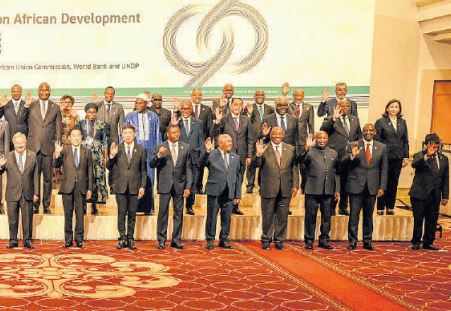 President William Ruto joins other presidents and heads of goverment during the opening session of the TICAD 9 in Yokohama in Japan /REBECCA NDUKU/PCS