The first thing that strikes you upon landing in Beijing is not the towering skyscrapers or the sheer size of the city. It is the order.
Wide multi-lane highways stretch into the horizon, lined with lush green trees and colourful flowers. The streets are remarkably clean, traffic flows with surprising discipline, and modern high-rise buildings rise elegantly against the skyline. Everywhere you look, there is a sense of planning, purpose and efficiency.
For many first-time visitors, China challenges long-held perceptions from the moment they leave the airport. Here is a nation of more than 1.4 billion people, yet one where modern infrastructure, environmental conservation and technological advancement appear to coexist seamlessly.
For two weeks, five journalists from Radio Africa Group — Allan Jaoko, Brenda Obath, William Njuguna, Sheila Wafula and myself — joined 25 other colleagues from across Kenya on a media exchange and training programme organised by the Research and Training Institute of China’s National Radio and Television Administration.
The programme offered participants a rare opportunity to experience China’s development journey firsthand, while deepening their understanding of the country’s media landscape, culture and technological advancement.
“What struck me most about China wasn’t just its scale, though it is vast, immaculately clean and staggeringly beautiful. It was how deeply a unified culture, history and collective mindset runs through absolutely everything,” Classic 105 presenter Brenda Obath said.
“From infrastructure to hospitality to how people move through public spaces, there is an unmistakable intentionality that makes the country function like a well-directed broadcast, with every element serving the larger editorial vision.
“Despite a significant language barrier, it was genuinely one of the smoothest international trips I have been on, and that says everything. Africa, Kenya especially, has several leaves to take from what China has quietly built over centuries and continues to refine. We talk a lot about development. China simply executes it.”
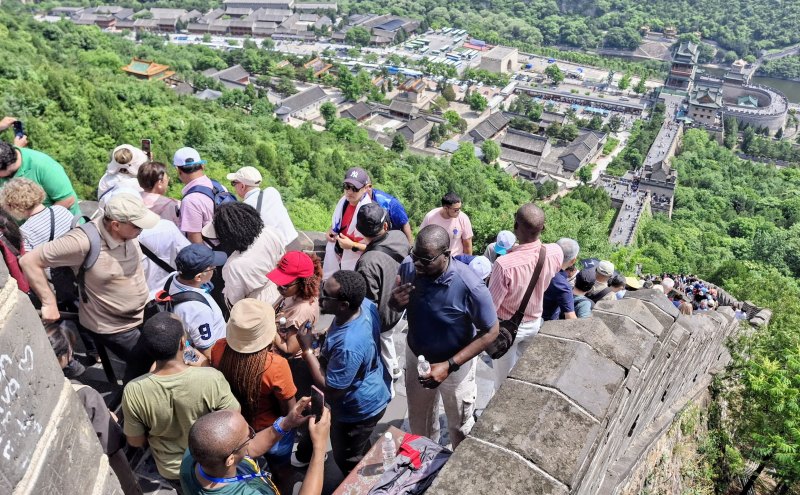
Among the highlights of the programme were lectures on constructive journalism, artificial intelligence and traditional Chinese culture, alongside visits to some of China’s most iconic landmarks, including the Great Wall, the Summer Palace and the Temple of Heaven.
GREAT WALL
For millions of tourists who visit the Great Wall of China each year, the experience is more than sightseeing; it is a journey through history. Originally built to protect Chinese states and later the Chinese empire from invasions and raids by nomadic groups from the north, particularly from the Mongolian steppes, the Wall stands today as one of humanity’s greatest engineering achievements.
Much of the structure seen by visitors today was built during the Ming Dynasty between the 14th and 17th centuries. Faced with persistent threats from northern invaders, Ming rulers strengthened and rebuilt large sections using stone and brick.
According to Chinese surveys, the entire Great Wall system stretches for more than 21,000km, making it one of the largest construction projects in human history.
The Summer Palace offered another fascinating glimpse into China’s imperial past. Built during the Qing Dynasty as a summer retreat for emperors, the palace combines elegant gardens, temples, pavilions and corridors around the scenic Kunming Lake and Longevity Hill. Today, it remains one of China’s most visited Unesco World Heritage Sites and a symbol of the country’s rich cultural heritage.
Equally captivating was the Temple of Heaven. Built in the early 15th century during the Ming Dynasty, the complex served as a sacred place where emperors prayed for good harvests and blessings for the nation. Renowned for its striking architecture, particularly the Hall of Prayer for Good Harvests, it offers visitors a window into China’s spiritual traditions and imperial history.
DEVELOPMENT JOURNALISM
The training sessions were equally insightful. One of the key lessons centred on constructive journalism and the role of media in national development.
“Journalism in China is not merely about criticising or monitoring the government. It is about serving the people and contributing to national development,” Prof Zhang Yanqiu of the Communication University of China said.
“Constructive journalism is a powerful tool for identifying challenges, highlighting solutions and driving social progress.”
While China’s historical landmarks tell the story of a civilisation stretching back thousands of years, its investments in artificial intelligence and emerging technologies offer a glimpse into the future.
A visit to the Zhongguancun Artificial Intelligence Innovation Park in western Beijing provided an eye-opening look at China’s remarkable progress in AI. Spanning more than 800,000 square metres, the science park serves as a comprehensive ecosystem where research, innovation and commercialisation converge to shape the future.
From advanced AI models to sophisticated robots capable of performing delicate medical procedures and handling complex industrial tasks, the demonstrations showcased the breadth of China’s technological ambitions.
“We are making very rapid strides in the medical world. In this facility, we are now working to create an artificial heart. Every day presents an opportunity to improve AI technology,” the park’s director He Fen said.
Amid the cutting-edge innovations, one exhibit captured the imagination of many visitors: an AI-powered coffee robot that transforms a simple cup of coffee into a personalised work of art.
With the press of a button, visitors could take a photograph and have their image instantly printed onto the foam of a cup of coffee.
The machine combined artificial intelligence, precision engineering and creativity to deliver a uniquely personalised experience within seconds.
“The sheer ingenuity of a 5,000-year-old civilisation’s traditions being leveraged in pioneering technology and AI was a privilege to behold,” omnichannel head Allan Jaoko said.
“The harmony and balance in the culture showed that tradition and innovation can co-exist harmoniously. This was a clear depiction of the ancient Taoist principle of yin and yang.”
NATIONAL SPIRIT
Prof Hong Li of the Communication University of China said the Chinese national spirit is anchored in resilience, unity, hard work, self-reliance, pragmatism and harmony.
“These values have been passed down through generations and continue to shape the country’s approach to development, innovation and nation-building,” she said during one of the lectures.
After about a week in Beijing, the Kenya media delegation travelled to the coastal province of Shandong in eastern China. There, the cool breeze from the Yellow Sea welcomed us to the meticulously planned and picturesque city of Qingdao.
The journey offered another perspective on China’s transformation. Once associated with pollution challenges, China today boasts extensive green spaces, thriving urban forests and a visible commitment to environmental conservation.
The four-day stay in Qingdao was both adventurous and educational. Participants visited Qingdao Media Group, where they explored development strategies and achievements driven by technological and content innovation. The group also toured the Shinan District Media Convergence Centre to gain insights into the integration and development of county-level media platforms.
One of the standout attractions in Qingdao was China Movie Metropolis, a world-class film production hub that hosts the world’s largest single soundstage, an advanced infrared motion-capture system and a state-of-the-art underwater production centre.
Beyond its role as a production hub, China Movie Metropolis has become a major tourist attraction, allowing visitors to experience the magic of filmmaking firsthand. From impressive movie sets and themed attractions to immersive exhibitions showcasing the evolution of Chinese cinema, the facility highlights China’s commitment to creativity, storytelling and cultural expression.
TOP-TIER TRANSPORT
Another striking feature of life in China is its highly efficient public transport system. Beneath the bustling streets of Beijing lies a vast underground world of interconnected metro lines that move millions of passengers daily with remarkable speed, precision and comfort. The stations are modern, well-signposted and impeccably organised, allowing commuters to navigate one of the world’s busiest cities with ease.
Our travelling companion William Mboke shared his impression of the country in general.
“Advancement of technology through AI and robotics, its integration into media infrastructure, seamless travel systems and the marketing of historical landmarks as major tourist attractions is simply on another level,” he said.
Equally impressive is the seamless integration of shared bicycles and electric bikes into everyday life. At almost every metro station, hundreds of neatly arranged bikes await commuters. With a simple scan of a QR code, a bicycle is unlocked and ready for use, providing an affordable and environmentally friendly solution for the last stretch of a journey.
The streets themselves offer a feast for the senses. Food stalls line busy corners and markets, filling the air with enticing aromas of sizzling meats, freshly prepared dumplings and an array of local delicacies.
Among the most memorable culinary experiences is the famous Peking duck, its crispy golden skin and tender meat making it a favourite among locals and visitors alike. Rice remains a staple of nearly every meal, accompanying an endless variety of vegetables, meats and sauces.
My colleague Sheila Wafula invoked an ancient Chinese proverb in describing what she witnessed during the trip: “If you think in terms of one year, plant a seed. If you think in terms of 10 years, plant trees. If you think in terms of a hundred years, educate the people.”
As the journey came to an end, one lesson stood out. Development is not always about building the world’s biggest infrastructure projects. While Kenya may not be ready to replicate China’s vast metro networks or futuristic cities, there is much to learn from its commitment to planning, environmental conservation and innovation.
Something as simple as planting more trees, creating greener public spaces and maintaining cleaner streets can transform our cities and improve the quality of life for millions. China’s success is a reminder that lasting progress begins with vision, consistency and the collective determination to build a better future, one step at a time.
![[PHOTOS] The Star, Chinese Embassy host Kenya-China media dialogue](https://cdn.radioafrica.digital/image/2026/06/215e29cd-5ca2-4faf-bb4e-d1686b2c3dad.jfif)