When Jeyron Okal’s grandmother suffered a stroke, his family
did what many Kenyans would do in an emergency, they reached for the phone.
But instead of getting immediate help, they found themselves searching for emergency contacts that either didn’t exist, were out of service or simply went unanswered.
“We tried calling emergency services, but some of the numbers were out of service, while others didn’t exist at all,” Okal said.
With no ambulance on the way, the family drove her to hospital themselves.
She survived, but the delay came at a cost. The stroke left her partially paralysed.
Looking back, Okal believes the outcome could have been different.
“It could have been prevented if the systems were functional,” he said.
What happened to Okal’s family reflects a wider challenge. The Office of the Auditor-General’s 2025 Performance Audit on the Provision of Emergency Medical Care Services in Kenya found persistent gaps in emergency response, from limited public awareness to weaknesses in ambulance dispatch systems.
The findings suggest Okal’s family was far from the only one to face such a challenge.
Only 26 per cent of those surveyed knew which emergency numbers to call, while just 21 per cent had basic first-aid skills, highlighting how unprepared many Kenyans are when emergencies strike.
For many, that experience would have remained a painful memory. For Okal, it became the beginning of a mission.
Determined to understand why getting emergency help was so difficult, the 19-year-old set out to find a solution. He and a friend began developing what would become My Lyfeline, an emergency response app. When his co-founder later left for university, Okal continued building the platform on his own.
Building the app took about six months, but writing the code wasn’t the biggest hurdle.
“The hardest part wasn’t building the app, it was finding the right emergency numbers,” he recalled.
Many of the emergency contacts published online were outdated or inactive, forcing him to visit hospitals, police stations and fire stations to verify them one by one.
“We had to visit hospitals and ask, ‘Is this really your emergency number?’” Okal explained.
As he dug deeper, he realised the problem extended beyond outdated phone numbers. The report also found that Kenya lacks a national ambulance dispatch centre, while communication challenges, including the absence of toll-free emergency numbers, continue to hamper emergency response.
“It opened my eyes to just how neglected these systems are. It’s just so disappointing,” Okal said.
For the 19-year-old, one thing became increasingly clear: most Kenyans assume the country’s emergency response system works until they actually need it.
“I think most people just think it works. They don’t really think about it until it happens to them.” he said.
That realisation became the foundation for My Lyfeline.
Okal said he built the app in the hope of making those first moments of an emergency less chaotic for families like his own.
The Auditor-General’s report highlights many of the same challenges, including low public awareness of emergency numbers, communication gaps and the lack of a national ambulance dispatch centre.
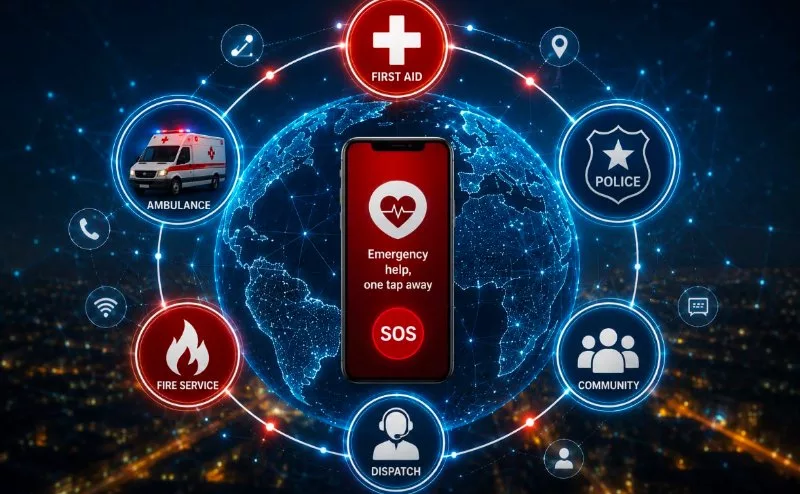
According to Okal, the app allows users to save their medical information and emergency contacts before an emergency happens.
The app's SOS feature is intended to share a user’s location and other essential information with emergency responders, while SMS alerts can still be sent when internet connectivity is unavailable.
He explained that those features are meant to reduce the time spent searching for emergency contacts or communicating critical information during a crisis, some of the same challenges highlighted in the report.
Turning that vision into reality, however, will require far more than writing code.
For My Lyfeline to become part of Kenya’s broader emergency response ecosystem, Okal knows it will require the cooperation of hospitals, ambulance providers and public agencies. It is a challenge he acknowledges will take time.
“I’m not just doing it for the money. I just really love fixing this issue,” he said.
“And until I solve it, I won’t be able to scratch that itch.”