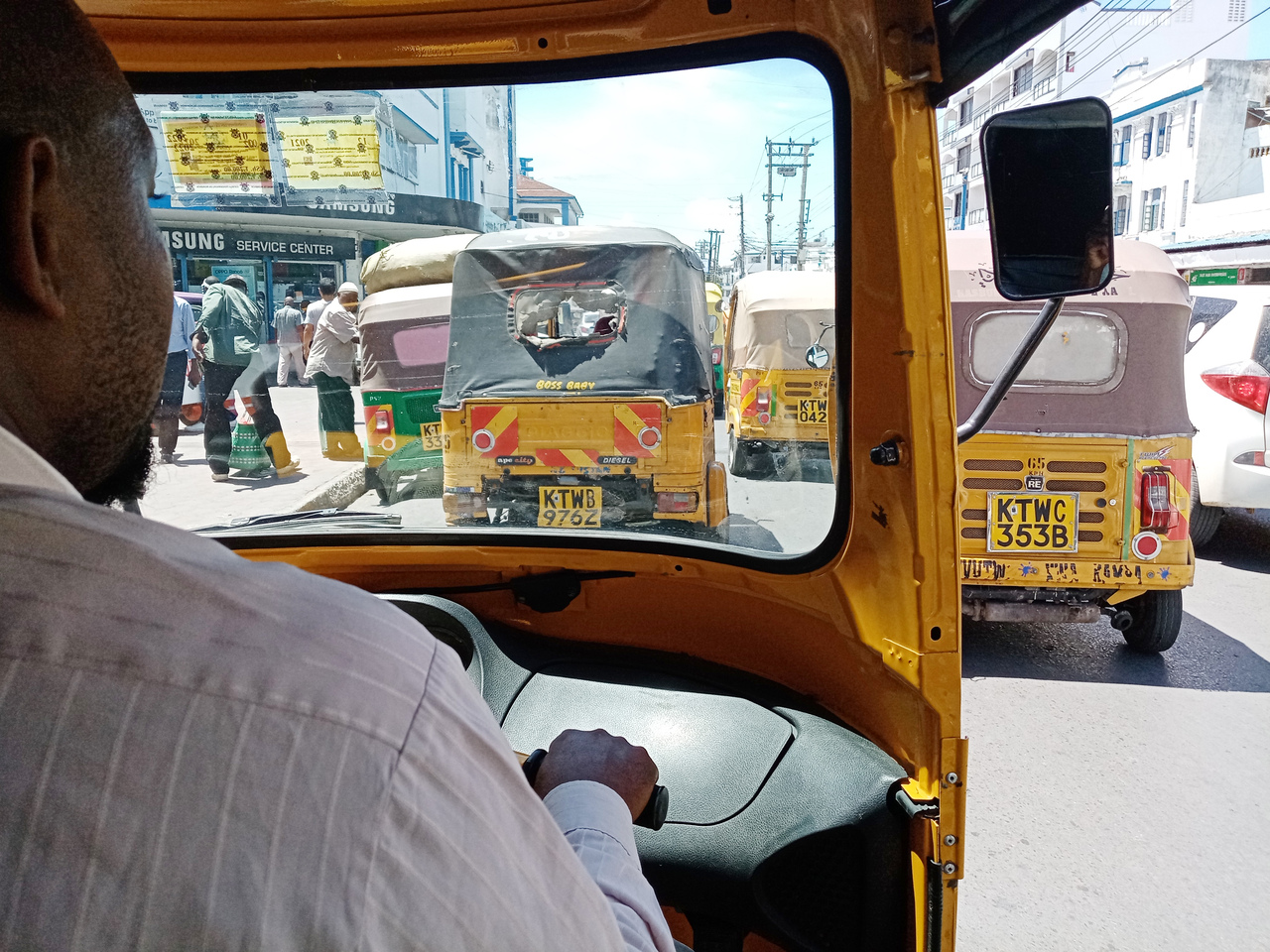
There are some things I can count on when I arrive in Mombasa after being away for a long time: the heat, the way the condensation of the humidity makes your clothes stick to your back, the incompetency and the reckless driving of tuk-tuks and matatus.
As soon as I step off an international flight straight onto the airport of Mombasa, I take a whiff of the thick, hot air and know I've landed. The drive from the airport to my hometown of Bamburi normally offers an insight into the “what’s new” that I need to catch up on.
It is often that very little changes in this congested city, except perhaps the skyline. The chaotic driving between tuk-tuks, boda bodas and matatus is still the same. The narrow streets are still the same, except they somehow look smaller as they get congested much quicker by the swarm of vehicles. And underneath the tall apartment buildings, the dry and dusty earth is still recognisable to me.
As we drove out of the airport into the island, we drove through the completed Kibarani-Makupa causeway, which I had left partially opened in 2023. The road is okay. Is it the best we could have gotten for our money? Absolutely not. And according to folks at home, it hasn't helped significantly in reducing traffic.
It is important to note that I am not comparing our infrastructure to the developed world, I am comparing it to our very own infrastructure in other parts of the country. As a person who lived through the old Thika Road demolition and New Thika Road construction, commuting to and from university every single day, I am well acquainted with what the Chinese are capable of during construction.
The dirt and dilapidation was the thing that stuck out the most as we drove into Mvita in search of a good Swahili breakfast to appease my hunger and craving of home. The once shiny and maintained community football pitches that were donated to communities to give the youth areas for sport and recreation are now dilapidated ruins of their former self.
Broken slides from the children's playground have been abandoned by the side of the road. All I could think about was the sinking realisation that there was no way of recycling that much plastic. Abandoned tuk-tuks are a norm in most residential areas on the mainland.
The drive through Kisauni was a time-travelling roller coaster. Absolutely nothing has changed, it just got more chaotic. Matatus still stop in the middle of the road to pick up or drop off passengers. Tuk-tuks are the nightmare of any vehicle owner. The street is as narrow and congested as ever, with food vendors opting to sell their wares right on the edge of the tarmac.
Bamburi, and by extension Mombasa, is my home ground. Nobody can keep me from speaking my mind when it comes to the state of my hometown. For six years, through part of primary school and all of high school, I commuted to and from Bamburi and Likoni twice a day by matatu. Would I let my child or niece do that now? Absolutely not!
In the past, it was relatively safer and people were still grounded in community. I remember many times I would still be in the matatu at breaking fast time during Ramadan, and the driver or an older person would buy food for the rest of us to break our fast. Little kids would approach anyone and ask them to help them cross the road.
Even though it was a big town in those days, it was possible to go 500 meters and see someone you knew. In fact, one of the many things that stood out to me this time around was that everyone looked foreign. I could not tell holidaymakers and residents apart.
I have mentioned many times that most of my high school cohort does not reside in Mombasa. Out of 160 students at the time, perhaps only 20 still live in Mombasa. I walked about town knowing absolutely no one.
…to be continued.