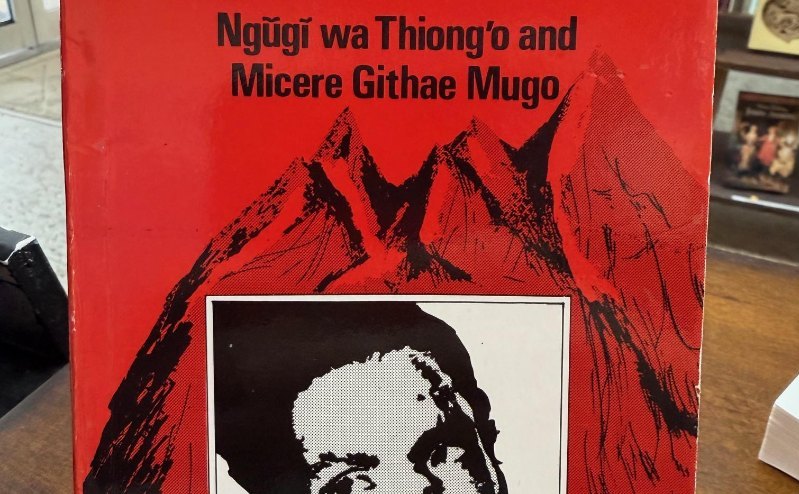
Ngũgĩ wa Thiong’o and Micere Mugo’s The Trial of Dedan Kimathi is not a courtroom drama in the polite, procedural sense. It is a theatrical ambush. From the first moments, the reader is dragged into a charged space, where history refuses to sit quietly in the dock, and where the accused turns the trial back on his accusers. This is not a story about whether Dedan Kimathi is guilty or innocent under colonial law; it is about whether that law itself deserves to exist.
The play reimagines the final days of Dedan Kimathi, the Kenyan freedom fighter captured and tried by the British colonial government in the 1950s. Rather than portraying him as a defeated rebel awaiting execution, Ngũgĩ and Mugo resurrect Kimathi as a defiant, lucid and unbroken symbol of resistance.
The courtroom becomes a battleground where colonial authority, violence and hypocrisy are exposed and interrogated. Kimathi is physically imprisoned but morally and intellectually untouchable. As the authors declare with chilling clarity, “I speak for the living dead and the dead living.” In that single line, Ngũgĩ and Mugo announce the scale of the play: Kimathi is not just a man on trial, but a voice carrying generations of stolen land, broken bodies and unfinished struggles.
What makes the play especially gripping is how it refuses linear storytelling. Past and present collide as peasants, workers, women, collaborators and freedom fighters move in and out of the courtroom space. Songs erupt. Choruses interrupt the judge. Ghosts of resistance haunt the proceedings. The effect is deliberately unsettling. You are never allowed the comfort of distance; the audience is implicated, forced to confront how power disguises itself as justice. When Kimathi states, “The imperialist is afraid of the truth,” the line lands not as rhetoric but as an accusation aimed beyond the stage, beyond the page.
Just imagine a trial where the prisoner never begs, where witnesses do not merely testify but revolt, and where the courtroom itself begins to crack under the weight of historical truth. British officials attempt to reduce Kimathi to a criminal, but each effort only sharpens his stature as a revolutionary. Around him, ordinary Kenyans — market women, workers, peasants — emerge as the moral spine of the narrative, reminding the reader that Kimathi’s struggle was never his alone. This collective presence gives the play its pulse. You are not reading about history; you are standing inside it as it argues back.
Ngũgĩ’s and Mugo’s writing style is central to this intensity. The language is urgent, lyrical and unapologetically political. They blend realism with symbolism, allowing dialogue to function both as character speech and as ideological confrontation. There is little subtlety in the conventional sense, and that is entirely intentional. The authors write with the confidence of writers who know exactly where they stand. Their use of repetition, chant-like dialogue and sharp contrasts between colonial coldness and revolutionary passion creates a rhythm that feels closer to oral performance than printed drama. This style keeps the reader alert, almost on edge, as if the text itself might suddenly rise up and demand participation.
However, the same qualities that give The Trial of Dedan Kimathi its power also produce its most significant weakness. The play’s ideological certainty leaves little room for complexity or ambiguity. Characters aligned with colonial power are often drawn as flat, almost caricatured villains, while revolutionary figures are rendered as morally pure. This lack of psychological depth can limit the emotional range of the drama. Readers looking for nuanced internal conflict or morally conflicted characters may find the play rigid, even preachy at times. The message is clear, but it is delivered with such force that it can feel like instruction rather than exploration.
The Trial of Dedan Kimathi is not interested in balance, it is interested in justice as Ngũgĩ and Mugo understand it. The result is a work that reads less like a neutral historical reflection and more like a revolutionary manifesto in dramatic form. Punchy, confrontational and unforgettable, the play dares the reader to decide where they stand when history itself takes the witness stand, and refuses to be cross-examined.