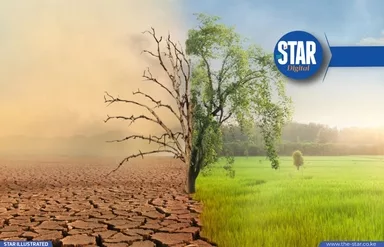
As Kenya approaches the 2027 general election, the most immediate danger may not come from campaign rallies, political slogans or party realignments. It may come from the farm, the kitchen and the market. Climate change and food poverty are quietly becoming a national emergency.
Across many parts of Kenya, food crops have failed or performed poorly. In maize-growing zones that traditionally feed the country, rains have become unreliable, delayed or poorly distributed. The situation in the North Rift, Trans Nzoia and parts of Kakamega is dire.
A friend of mine recently invited me to buy his moisture-stressed maize stalks for livestock silage, only for us to discover that we were facing the same situation. That small conversation told a bigger national story: even the country’s food baskets are under stress.
For ordinary Kenyans, maize, beans and wheat are not just statistics. They are ugali on the table, githeri in schools, chapati in homes, porridge for children and food for workers. They are also cash. When farmers sell maize, beans or wheat, they pay school fees, hospital bills, debts, labour and household expenses. When crops fail, the pain does not end at the farm gate. It enters classrooms, hospitals, markets and homes.
Kenya has relied too heavily on a narrow food basket, especially maize. This dependence makes the country vulnerable whenever rains fail, pests attack, storage collapses or prices rise.
A serious food security policy must therefore ask uncomfortable questions. How much maize, beans and wheat do we consume annually? How much do we produce? What is really in our strategic reserves? Are the records transparent? Are cereals stored safely, or are we still losing grain to weevils, poor storage and corruption?
Openness in strategic food reserves is now a national security matter. Kenyans deserve to know what food stocks exist, where they are stored, their quality, and how long they can sustain the country. Food reserves should not be surrounded by secrecy, political games or cartels. Hunger cannot be managed through rumours.
The country must also take transport seriously. Active railway lines are not a luxury. They are part of food security infrastructure. Grain imports or locally produced cereals must move quickly and cheaply from ports, borders and farms to deficit areas. Roads alone cannot carry the burden during crisis.
The Galana-Kulalu irrigation project and other irrigation schemes must be revisited with honesty, not politics. Kenya cannot continue praying for rain while underinvesting in water harvesting, irrigation and climate-smart agriculture. Long-term irrigation projects are no longer development dreams; they are survival tools.
The international environment is also fragile. Kenya may need urgent grain imports from traditional sources such as Russia, Ukraine, the United States and Tanzania. But global supply chains are no longer stable.
War, sanctions, inter-state conflicts, export bans and high shipping costs can interrupt food supplies. A country that cannot feed itself becomes vulnerable to global shocks it cannot control.
Food insecurity can quickly become social, economic and political instability. Hungry citizens lose patience. Prices rise. Families reduce meals. Children become malnourished. Women carry heavier burdens because they are often expected to find food even when markets are empty.
If infectious diseases break out in the middle of hunger, the danger can escalate sharply. Hunger weakens bodies, health systems and public trust.
The Constitution of Kenya 2010 is clear that every person has the right to be free from hunger and to have adequate food of acceptable quality. This is not charity. It is a constitutional obligation.
Parliament has also passed laws and policies touching on food security, agriculture, disaster management, public finance and social protection. The challenge is implementation.
Government cannot do this alone, but it must lead. The World Food Programme, FAO, USAID, WHO, religious institutions, NGOs, security agencies and county governments must be coordinated before the crisis deepens.
Emergency relief funds, drought response operations, consolidated funds and supply chains must be managed transparently and professionally. Food aid must not become a campaign tool.
In the short term, Kenya should consider zero-rating essential food imports where necessary to cushion households. In the medium term, it must strengthen grain reserves, storage systems, transport networks and farmer support.
In the long term, the country must change eating habits, diversify crops, invest in irrigation and reduce dependence on rain-fed maize.
The 2027 election will test many things. But above all, it may test whether Kenya can protect its people from hunger. A hungry nation is an unstable nation. Food security must now move from speeches to action.
The author is a scholar-diplomat and expert in foreign and security policy based at Moi University